The “Jupyter Notebooks for Education” project

The “Jupyter Notebooks for Education” project is an effort to support the introduction of computational thinking across curricula and disciplines at EPFL using Jupyter Notebooks as a medium.
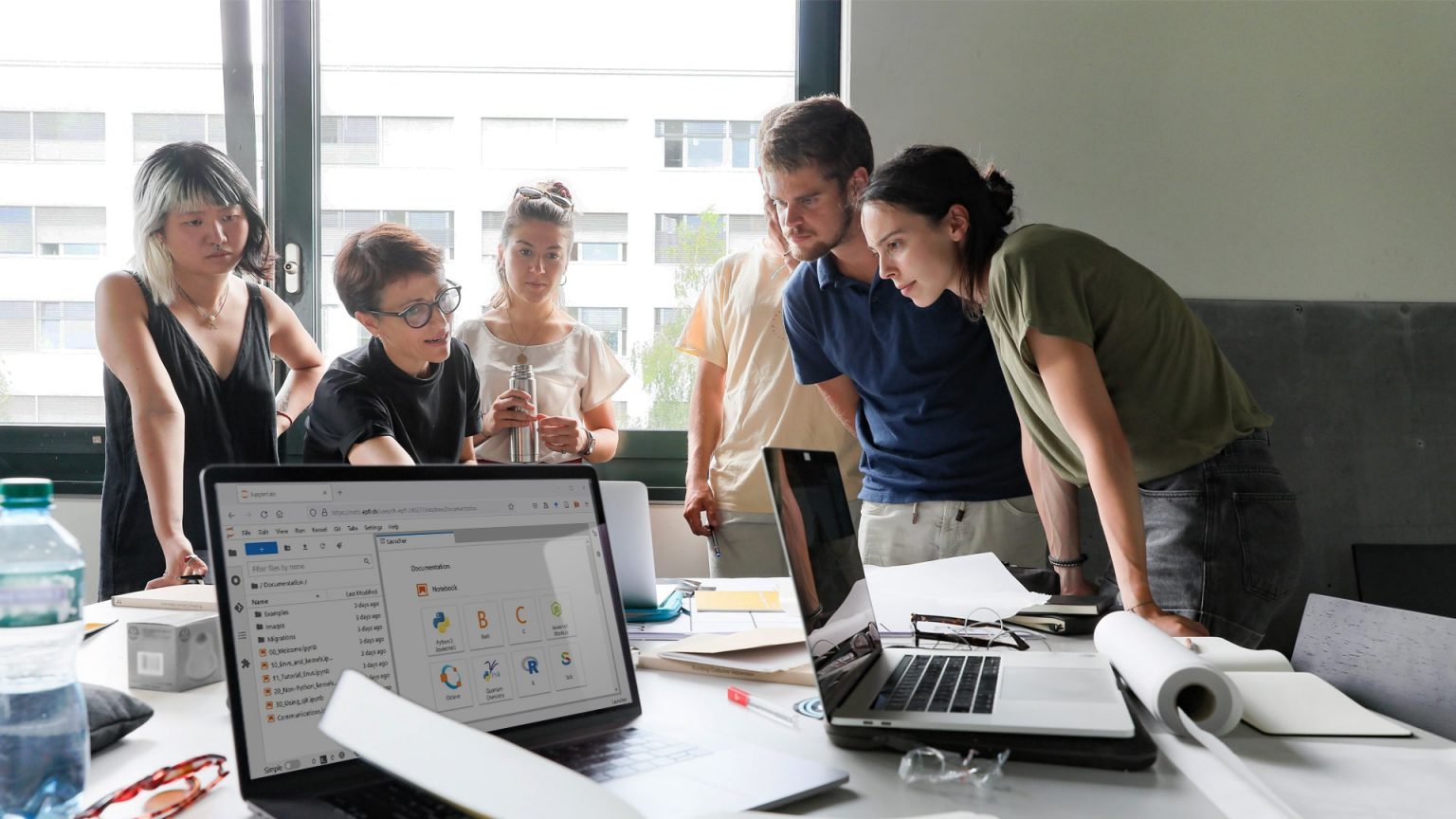
The "Jupyter Notebooks for Education" project – Credit Alain Herzog – The computer screen has been modified

Introducing computational thinking into the curriculum is part of EPFL’s strategic orientations for education. With an exponential diffusion across disciplines, Jupyter Notebooks have become the tool of choice for computational problem solving and investigation from sciences to engineering right through to humanities. By weaving computation with disciplinary content, Jupyter Notebooks implement computational thinking in practice. 

The goal of the “Jupyter Notebooks for Education” project is twofold: provide easy access to Jupyter Notebooks for students and support instructors with the best designs and use in class. Sponsored by the Associate Vice Presidency for Education, the project is carried out by the LEARN, CAPE and CEDE centres with a financial contribution from SwissUniversities as part of the P-8 programme “Digital Skills”

Easy access to Jupyter Notebooks online with a centralized JupyterLab platform

Created and launched early 2019, our centralized JupyterLab platform for education noto, is the first result of the project. Designed with a scalable architecture, noto has grown fast and has doubled its cumulated number of users every year since launch. In September 2023, noto serves more than 500 different users per day on average, and we have reached 12 000 cumulated lifetime users!

We constantly search for the libraries and extensions that are most adapted to education and monitor their updates to offer a state-of-the-art environment to teachers and students.

Noto: one click access to Jupyter notebooks online

Discover noto, our JupyterLab platform for education.

Start using Jupyter notebooks right away

Without configuring your computer or installing libraries, you’ll get a private workspace and free computing.

Evidence-informed and data-driven pedagogical support

Along the infrastructure component of the project, we have put in place a pedagogical support service for teachers developing educational notebooks. Our work methodology involves a) providing teachers with up-to-date information based on the latest results from education research and b) assisting teachers in the collection of data on the use of notebooks by students. 

Using this evidence-informed and data-driven approach, we have accompanied more than 30 teaching teams between 2019 and 2021.

Research on the impact of Jupyter Notebooks on student learning

We contribute to the body of knowledge on the use of Jupyter Notebooks in education by carrying out research on the impact of notebooks on student learning. In a joint effort with the EPFL Center for Learning Sciences (LEARN), we perform different types of studies to investigate how notebooks are used by teachers and how they can help students develop computational thinking skills and learn concepts in other disciplines through computation activities.

Who we are

Publications

Below are publications from EPFL researchers related to the use of Jupyter Notebooks at EPFL.

Testing standards for AI-based scores in automated essay scoring

R. Debelak; M. Ziegler 

PLOS One. 2026. Vol. 21, num. 7. DOI : 10.1371/journal.pone.0354680.

Differential targeting of the nucleosome surface and superhelical crevice sites with Ru and Os organometallic agents

A. Levy; Z. Adhireksan; T. von Erlach; G. Palermo; A. A. Nazarov et al. 

Nucleic Acids Research. 2026. Vol. 54, num. 14. DOI : 10.1101/2025.11.13.688318.

Differential targeting of the nucleosome surface and superhelical crevice sites with Ru and Os organometallic agents

A. Levy; Z. Adhireksan; T. von Erlach; G. Palermo; A. A. Nazarov et al. 

Nucleic Acids Research. 2026. Vol. 54, num. 14. DOI : 10.1093/nar/gkag721.

Supporting Classroom Orchestration and Collaborative Programming with Jupyter Analytics

Z. Cai; R. L. Davis; R. Tormey; P. Dillenbourg 

2026. 6th Annual Meeting of the International Society of the Learning Sciences (ISLS), Irvine, California, USA, 2026-06-15 – 2026-06-19.

How Active User Count Relates to Group Outcomes in Collaborative Programming: An Implicit Scripts Perspective

Z. Cai; R. L. Davis; R. Tormey; P. Dillenbourg 

2026. 19th International Conference on Computer-Supported Collaborative Learning (CSCL) 2026, Irvine, California, USA, 2026-06-15 – 2026-06-19.

Chemiscope 1.0: interactive exploration of atomistic data from analysis to dissemination

S. Chorna; J. Lála; Q. Xu; R. K. Cersonsky; G. Fraux et al. 

Journal of Open Source Software. 2026. Vol. 11, num. 122. DOI : 10.21105/joss.10380.

Developing an interactive neuroimaging education resource with Neurodesk

M. Dörig; M. Masson‐Trottier; T. T. Dao; K. Mapue; A. Jahn et al. 

Aperture Neuro. 2026. Vol. 6, num. SI 2. DOI : 10.52294/001c.160858.

Making atomistic materials calculations accessible with the AiiDAlab Quantum ESPRESSO app

X. WANG; E. Bainglass; M. Bonacci; A. Ortega-Guerrero; L. Bastonero et al. 

npj Computational Materials. 2026. Vol. 12, num. 1. DOI : 10.1038/s41524-025-01936-4.

Accelerating discovery across scientific disciplines through reproducible workflows with AiiDAlab

A. V. Yakutovich; D. Hollas; E. Bainglass; J. Yu; C. Battaglia et al. 

Digital Discovery. 2026. DOI : 10.1039/d5dd00567a.

Training “Data Management Planning & Funding”

EPFL Library 

2026.

Training “ABC of Research Data Management (RDM)”

EPFL Library 

2026.

Proceedings of the OHBM Hackathon 2023

Y. Yang; A. S. Heinsfeld; A. Gondová; B. H. Vieira; Q. Wang et al. 

Aperture Neuro. 2025. Vol. 5. DOI : 10.52294/001c.145051.

Towards Open Bibliometric Indicators (TOBI) et présentation du DOI Screener

S. Willemin 

Dépôts institutionnels et données académiques ouvertes : mesurer, valoriser et diffuser la recherche suisse à l’heure de l’Open Science, Lausanne, Suisse, 2025-06-12.

“Jupyter-Notebook-as-Script”: Investigating the Nature and Impact of Implicit Collaboration Scripts in Computational Notebooks

Z. Cai; R. L. Davis; R. Tormey; P. Dillenbourg 

2025. 18th International Conference on Computer-Supported Collaborative Learning (CSCL 2025), Helsinki, Finland, 2025-06-10 – 2025-06-13.

Embedded solution to detect and classify head level objects using stereo vision for visually impaired people with audio feedback

K. Muñoz; M. Chavarria; L. Ortiz; S. Suter; K. Schönenberger et al. 

Scientific Reports. 2025. Vol. 15, p. 17277. DOI : 10.1038/s41598-025-01529-7.