
Introduction
The main objective of Astrobots group’s electronic engineering activities is to provide innovative solutions for motor control.
Each fiber positioner has its own small scale electronics board in order to reach its individual target. The board contains the power electronics to run the motors, a communication interface to receive targets from the master system, a trajectory interpolation in order to avoid collisions and a position regulator in order to follow these trajectories. There are two main restrictions on the design of the electronics board:
- Space occupancy
The available volume for the electronics next to the two Ø 4mm motors is 1x6mm for the PCB and 1x4mm for the components.
- Power consumption
The power consumption is critical as the dissipated heat can cause turbulence around the focal plane and degrade the quality of the observations.
From initial design to industrial production, through testing and after-sales service, we offer a complete range of services to transform concepts into industrial realities. To cover this wide range of activities, we rely on key areas such as simulation, design, firmware development, and test benches. The following chapters detail each of these areas.
Simulation
We use several cutting-edge software tools to simulate our systems, such as LTSPICE and Altium Designer. These tools allow us to understand transient behaviors and test our electronic controls with motor models that faithfully imitate real behavior. Each simulation is then validated on real test benches.


Design
The design phase is essential for turning ideas into achievable projects. We take pride in creating optimized and innovative designs, taking into account both mechanical and electronic constraints.


Testing is a crucial step to validate the expected power consumption and functional behavior of our designs. We work closely with the mechanical design team to align PCBs with supports and other components. Our test benches are also used for long-duration testing, ensuring that our designs are reliable and require minimal intervention, even in difficult environmental conditions, over periods exceeding 10 years.

Software / Firmware
We focus on developing firmware for our electronic boards and Python code to interface our test benches and actual positioning modules. We primarily use STM32 micro-controllers from STMicroelectronics, as well as their development tools such as STM32CubeMX, STM32CubeIDE, and STM32CubeProgrammer.
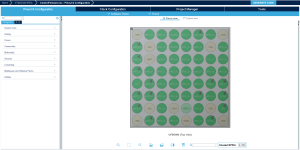
To minimize human interventions after installation, we integrate specific boot-loaders allowing remote system updates without direct physical access.
Some of our projects are publicly accessible on our GitHub repository: EPFL-Astrobots.