
How the nervous system incorporates sensory information and generates motion patterns is generally hard to analyze within a living organism because it is difficult to separate the highly interconnected central and peripheral components in the spinal cord. In addition, the physical interaction between the body and the environment, especially in fluids, is difficult to model and simulate accurately. To address these difficulties, we substitute the dynamics of the nervous system with a set of mathematical equations, while the animal body is replaced by a robotic counterpart. The advantage of this approach is that we can specifically monitor the different central and peripheral inputs and outputs in the nervous system, and selectively activate and deactivate them. Subsequently, we derive a clearer understanding of how locomotion is generated, controlled, and regulated and the results can be verified in real-world environments.
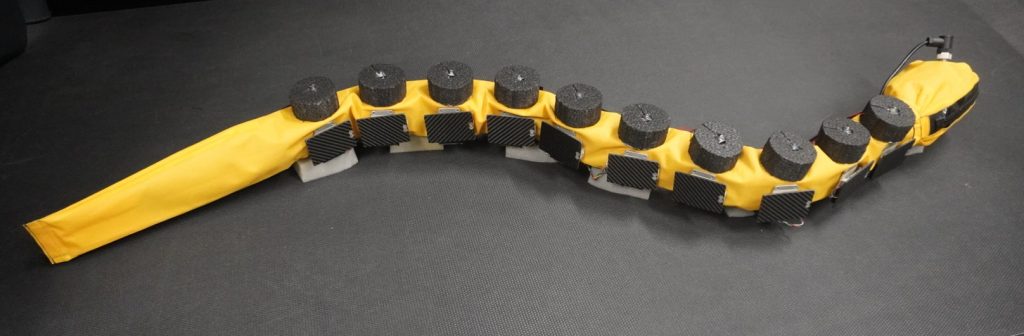
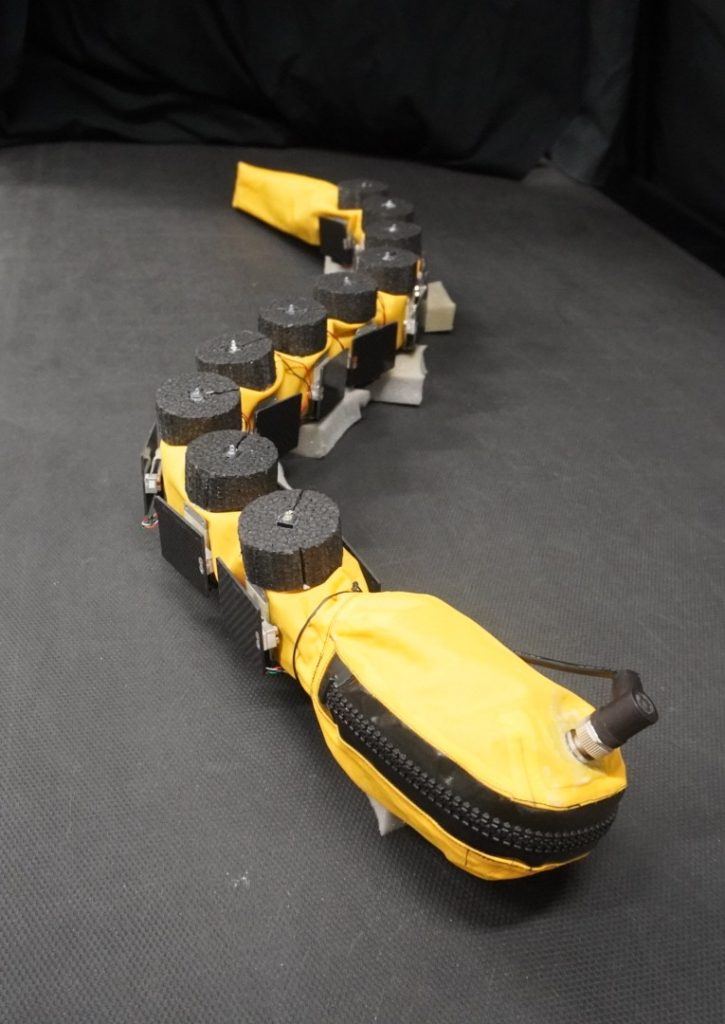
To understand how elongate swimmers such as lampreys and eels traverse amphibious environments robustly, we designed AgnathaX, an elongate undulatory robot. The robot incorporates the main characteristics of this animal that are relevant for locomotion control, including an elongate actuated spine as well as stretch and pressure sensors.
Multisensory feedback makes swimming circuits robust against spinal transection and enables terrestrial crawling in elongate fish (Proceedings of the National Academy of Sciences 2025)
Together with colleagues from Japan (Tohoku University and Future University Hakodate) and Canada (University of Ottawa), we are glad to present our latest study that was published in Proceedings of the National Academy of Sciences (PNAS):
 Multisensory feedback makes swimming circuits robust against spinal transection and enables terrestrial crawling in elongate fish. Kotaro Yasui*, Astha Gupta*, Qiyuan Fu, Shura Suzuki, Jeffrey Hainer, Laura Paez, Keegan Lutek, Jonothan Arreguit, Takeshi Kano, Emily M. Standen, Auke J. Ijspeert, & Akio Ishiguro. *These authors contributed equally to this work. Proceedings of the National Academy of Sciences 122, 18 Au. 2025: Vol. 122, Issue 34, e2422248122. DOI: 10.1073/pnas.2422248122
In this study, we focus on undulatory locomotion as produced by elongated fish such as eels and lampreys. We developed abstract models of the locomotion circuits based on coupled phase oscillators, local stretch and pressure feedback loops, and simulated muscle models that were tested both in simulation and with a real undulatory robot. We also performed swimming experiments with eels before and after spinal cord transaction. 
Our main findings are: (i) stretch and pressure feedback work well together in swimming and can, in principle, both replace direct couplings between oscillators; (2) the swimming controllers could generate good ground locomotion when placed in an arena with pegs; and (iii) our models could replicate the remarkable ability of eels to keep swimming shortly after a full spinal cord transection.
Multiple mechanisms allow for redundant coordination during swimming
We developed abstract models of the locomotor circuits based on coupled phase oscillators, local stretch and pressure feedback loops, and simulated muscles. Various configurations of the neural circuit were tested, with and without coupling (C), pressure feedback (P), and stretch feedback (S).

Our findings show that multiple mechanisms, such as intrinsic coordination in the nervous system (coupling), exteroceptive feedback (pressure), and proprioceptive feedback (stretch), allow for redundant coordination during swimming. Furthermore, proprioceptive feedback can impart properties like fast convergence to a steady state.
Stretch feedback mechanism enables terrestrial crawling
Previous studies have reported kinematic differences in aquatic and terrestrial gaits of elongated fishes, suggesting that elongated fishes possibly exploit the heterogeneity of terrains such as pegs to obtain propulsive forces.
Our findings show that stretch feedback allows exploiting such heterogeneity to obtain propulsive forces in environments with isotropic friction. We show that a control circuit that is primarily aimed at swimming can also contribute to terrestrial locomotion.
Spontaneous swimming with a transected spinal cord model
Eels with a transected spinal cord exhibited swimming with undulatory body waves propagating from head to tail that closely match intact locomotion. This is remarkable as this would lead to paralysis or severe disruptions in most vertebrate animals.
Our analysis suggests that despite the missing connections at the transection, the coordination may happen due to sensory feedback and the ability of spontaneous oscillations below the transection.
Our experiments in simulations and with the real robot could replicate the eel’s impressive robustness. The experiments revealed that frequency-locked swimming can be achieved under spinal transection. Synchronization is easier to achieve when the posterior segments have higher intrinsic oscillator frequencies compared to the anterior ones.
Media Kit:
A media kit for the 2025 PNAS paper was prepared and can be found here.
Emergence of robust self-organized undulatory swimming based on local hydrodynamic force sensing (Science Robotics 2021)
Together with colleagues from Japan (Tohoku University), France (Institut Mines-Télécom Atlantique in Nantes) and Canada (Université de Sherbrooke), we are glad to present our study that was published in Science Robotics:
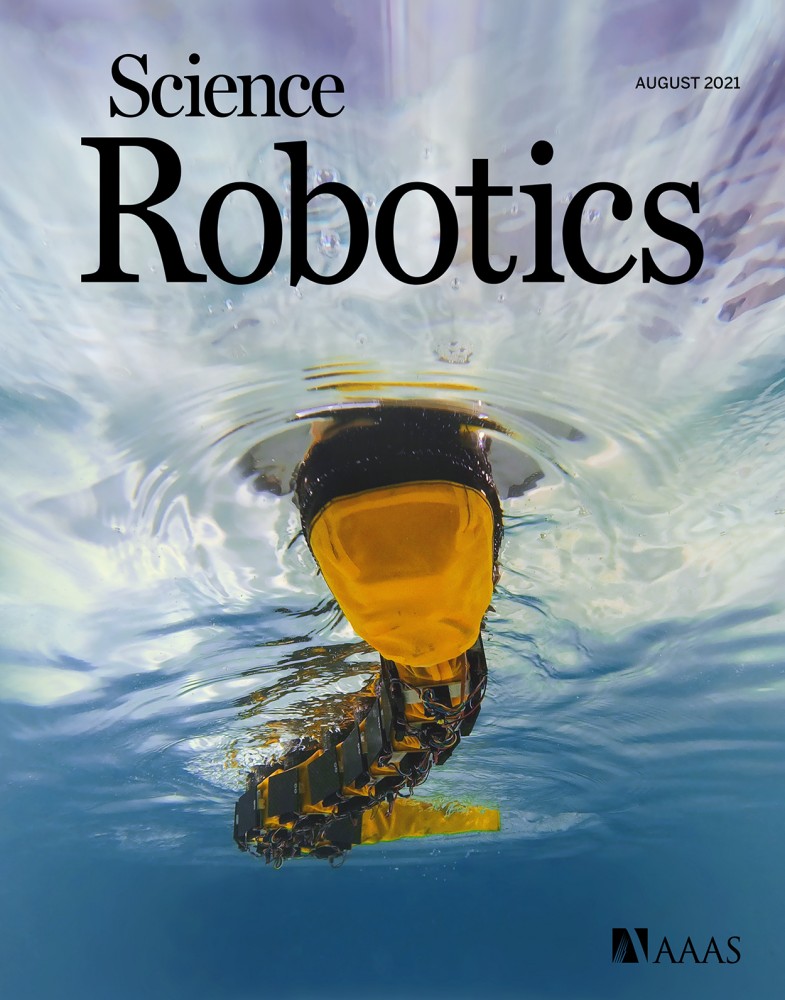 Emergence of Robust Self-Organized Undulatory Swimming Based on Local Hydrodynamic Force Sensing. Robin Thandiackal*, Kamilo Melo*, Laura Paez, Johann Herault, Takeshi Kano, Kyoichi Akiyama, Frédéric Boyer, Dimitri Ryczko, Akio Ishiguro, Auke J. Ijspeert. *These authors contributed equally to this work. Science Robotics 11 Aug. 2021: Vol. 6, Issue 57, eabf6354. DOI: 10.1126/scirobotics.abf6354
You can find direct links to the summary, the abstract, the reprint and the full-text of the article. As part of this publication, we also created an interactive website for readers to interact with our data https://go.epfl.ch/AgnathaX and explore our results.
For more info and metrics click here.
We developed an undulatory swimming robot equipped with distributed force sensors to study the neural mechanisms controlling locomotion in the spinal cord. Our two main findings are: (i) both the central nervous system and the peripheral nervous system contribute to the generation of robust locomotion, and together they offer remarkable robustness against lesions/defaults, and (ii) force sensors in the skin of animals and robots (that sense how much the water pushes against the body) and the physical interactions of the body and the water can provide very useful signals that help generate and synchronize the rhythmic muscle activity necessary for locomotion.
The spinal cord and its role in locomotion
Over the past decades undulatory swimming organisms like lampreys, eels and salamanders have helped scientists to expand our knowledge of neural control. From these animals we have learned in large parts how the nervous system in vertebrates controls cyclic body motions to locomote from one place to another. Swimming is generated by coordinating and sending waves of muscle activations from head to tail.
We know that locomotion in vertebrate animals is due to the interactions of the central nervous system (neural circuits in the brain and in the spinal cord), the peripheral nervous system (the nerves that project to the muscles and all the sensory neurons that provide information to the central nervous system), the body, and the environment. We also know that many of the basic control structures underlying undulatory swimming are located in the spinal cord. There are mainly two mechanisms at work:
- Central mechanisms: They involve so-called central pattern generators (CPGs), which represent distributed populations of neurons that generate rhythmic patterns which are then sent to the muscles to induce rhythmic movements.
- Peripheral mechanisms: They relate to the peripheral nervous system (the periphery of the body and the interface between body and environment) and rely on sensory information (e.g. touch, pressure, etc.) of the environment.
Although previous studies have identified these mechanisms, it remains partially unknown how they play together and how they ultimately generate and modulate locomotion patterns. In this study, we investigated the interplay of these central and peripheral mechanisms with the help of a purposefully designed swimming robot.
A robust interplay based on redundancy
Although it is possible to swim without any sensing, exclusively based on control from CPGs, we found that a system including the peripheral components and an entrainment mechanism was significantly more robust to neural disruptions and was able to sustain forward swimming much better. Tested disruptions were failures in the communication between spinal cord segments, muted CPGs and muted sensors. In these cases when central and peripheral components were working together, they helped to conserve stable swimming patterns and higher swimming speeds. Locomotion can be seen as an emergent and self-organized phenomenon due to these interactions, and hence the title of our article (Emergence of Robust Self-Organized Undulatory Swimming).
Implications both for neuroscience and robotics
Our results show that both the central and the peripheral nervous systems have mechanisms to generate swimming, and that together they produce more robust swimming than any of these alone. In particular, our study confirms that there are important functions provided by peripheral mechanisms that might be “hidden” by well-known central mechanisms. These peripheral mechanisms could play an important role in the recovery of motor function after spinal cord injury as no-a-priori connections within the spinal cord are necessary to maintain a traveling wave along the body.
Although AgnathaX was designed with the goal to study neural control of swimming locomotion, this study also provides novel insights for robotics:
- Using the entrainment mechanism no explicit communication between modules is necessary because swimming emerges in a self-organized manner. As a result such a system exhibits scalable characteristics that supports easy construction and deployment of many modular swimming units with a high degree of reconfiguration and robustness, e.g. for search and rescue missions or environmental monitoring
- The custom designed sensing units provide a new way of accurate force sensing in water along the entirety of the body and could therefore potentially be used to navigate through flow perturbations and enable advanced maneuvers in unsteady flows
- Our work provides design principles for making robots that are remarkably fault-tolerant and robust against damage in their sensors, communication buses, and control circuits.
Interactive Website:
Results of this work can be explored in the interactive website:
https://go.epfl.ch/AgnathaX
Media Kit:
A media kit for the 2021 Science Robotics paper was prepared and can be found here. It contains figures and videos of AgnathaX (with credits information) as well as a press release and a document with F.A.Q.