
Sustainability in education
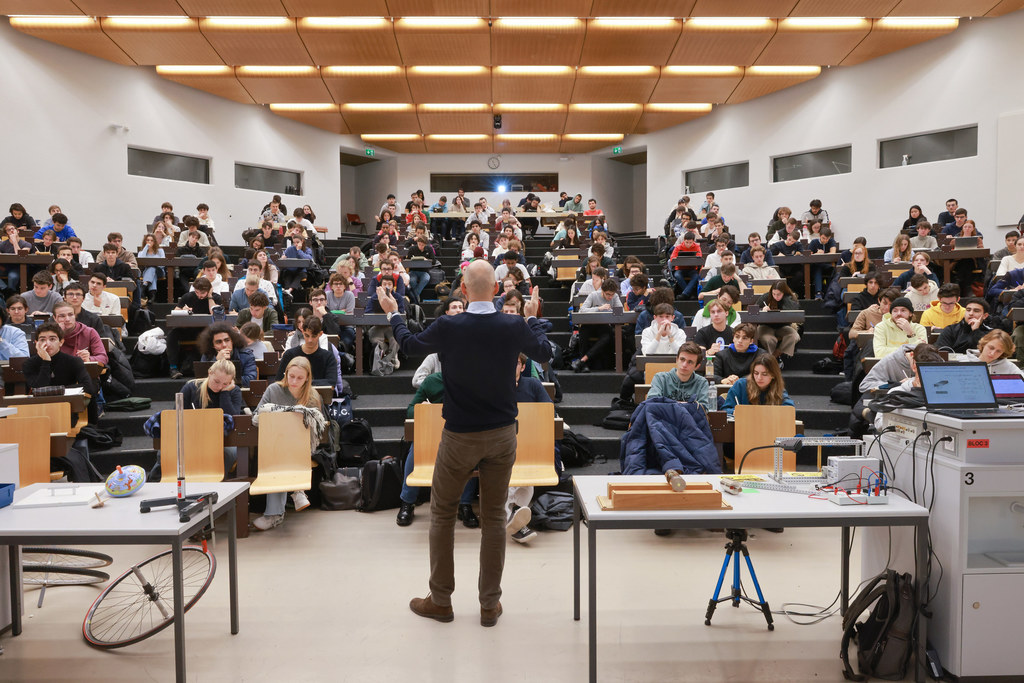
EPFL Auditorium © EPFL Alain Herzog
The climate and sustainability challenges we face are urgent, and require universities like EPFL to make sustainability education a priority. To equip tomorrow’s scientists, engineers and architects with the skills they need to help build and serve a sustainable society, we offer a wide range of curricular and extra-curricular activities, as well as coaching and training programs – all oriented towards sustainability.
EPFL’s sustainability education and community engagement strategy aims to provide a sustainability-oriented education to our entire community. This cultural transformation rests on three mutually reinforcing axes: 1) curriculum transformation across all study programs and levels; 2) student empowerment and engagement 3) capacity building of EPFL staff.
Curriculum transformation
Curriculum transformation builds on three pillars ensuring both breadth and depths of sustainability knowledge and competences: (i) a compulsory 2 ECTS core course for all first-year students (Read the news of September 4, 2024); (ii) field-specific 3-5 ECTS sustainability courses in every Bachelor and Master programs (iii) the integration of sustainability into existing courses where relevant.

The curriculum transformation model was designed by a working “Teach4Sustainability” launched in 2022. This working group brought together faculty, students, administrative staff, and governance representatives to develop strategic guidelines now driving implementation. → Read the news of March 27, 2023
Student engagement and empowerment
Next to courses on sustainability, we offer students support in their academic, extracurricular and professional sustainability journey, through various services: a free coaching service, sustainability-focused internships, the Durabilis Award for academic projects, a student co-created summer camp, a dedicated call for associative projects, student need assessment and an upcoming (Fall 2025) sustainability alumni club.

Capacity building
Finally, we also offer target training and support to teachers, researchers and technical and adminsitrative staff. Teachers can benefit of the Sustainability in My Course workshop, individualized coaching, and an innovative teacher-student tandem system, which pairs faculty with student assistants to help redesign courses through a sustainability lens.
PhD candidates benefit from capacity-building opportunities via the new project-based courses Sustainability in My Research and the upcoming (2026) course Sustainability in My Lab, where participants explore sustainability-relevant research questions and sustainable research practices.
Staff engagement is set to expand in Fall 2025 with the launch of the e-learning course Towards a Sustainable Campus, which uses peer testimonials and videos on orders of magnitude to promote sustainable campus operations. Academic staff will also be supported in reducing the environmental footprint of their research activities through the upcoming (2026) Greenlabs e-learning course.


Study sustainability
We offer a growing number of sustainability-oriented programs and courses that award European Credit Transfer System (ECTS) credits. We also run extra-curricular activities and other types of initiatives, projects and awards (see below).
To learn more about our student sustainability initiatives, visit our Community and Outreach web page.
Teaching sustainability
If our students are to become competent, responsible scientists and engineers, our faculty members must be trained on how to teach basic sustainability topics as well as more specialized classes. Since 2022, we’ve been providing training, personalized coaching and other resources to help faculty members incorporate sustainability into their classes.
Lifelong Learning

Our outreach and continuing education initiatives are intended to promote science and engineering, and to share recent developments in these fields that can be useful to our society and economy. We want to expand this range of programs in order to increase general understanding of sustainability issues, help policymakers make decisions that are evidence-based, update the skills of specialists in engineering and other fields, and raise youth awareness about sustainability through programs at schools and universities.
Specialist training for experts in the field
For more information on outreach programs
Contact
Melanie Studer
[email protected]
+41 21 693 40 96