High-precision micro-manufacturing of ceramics
PI: Prof. Dr. Jürgen Brugger
Project start: 1st July 2017
Project duration: 48 months
SFA website: http://www.sfa-am.ch/ceramic-x0.html
Project team (leaders):
- Prof. Dr. Christophe Moser, Laboratory of Applied Photonic Devices, EPF Lausanne
- Prof. Dr. Demetri Psaltis, Optics Laboratory, EPF Lausanne
- Dr. Gurdial Blugan, Laboratory for High Performance Ceramics, Empa
- Prof. Dr. Katharina Maniura, Laboratory for Biointerfaces, Empa
- Prof. Dr. Helena Van Swygenhoven, Photons for Engineering and Manufacturing Group, PSI
Project team (LMIS1):
- Dr. Pierrick Clément
- Lorenz Hagelüken
Summary:
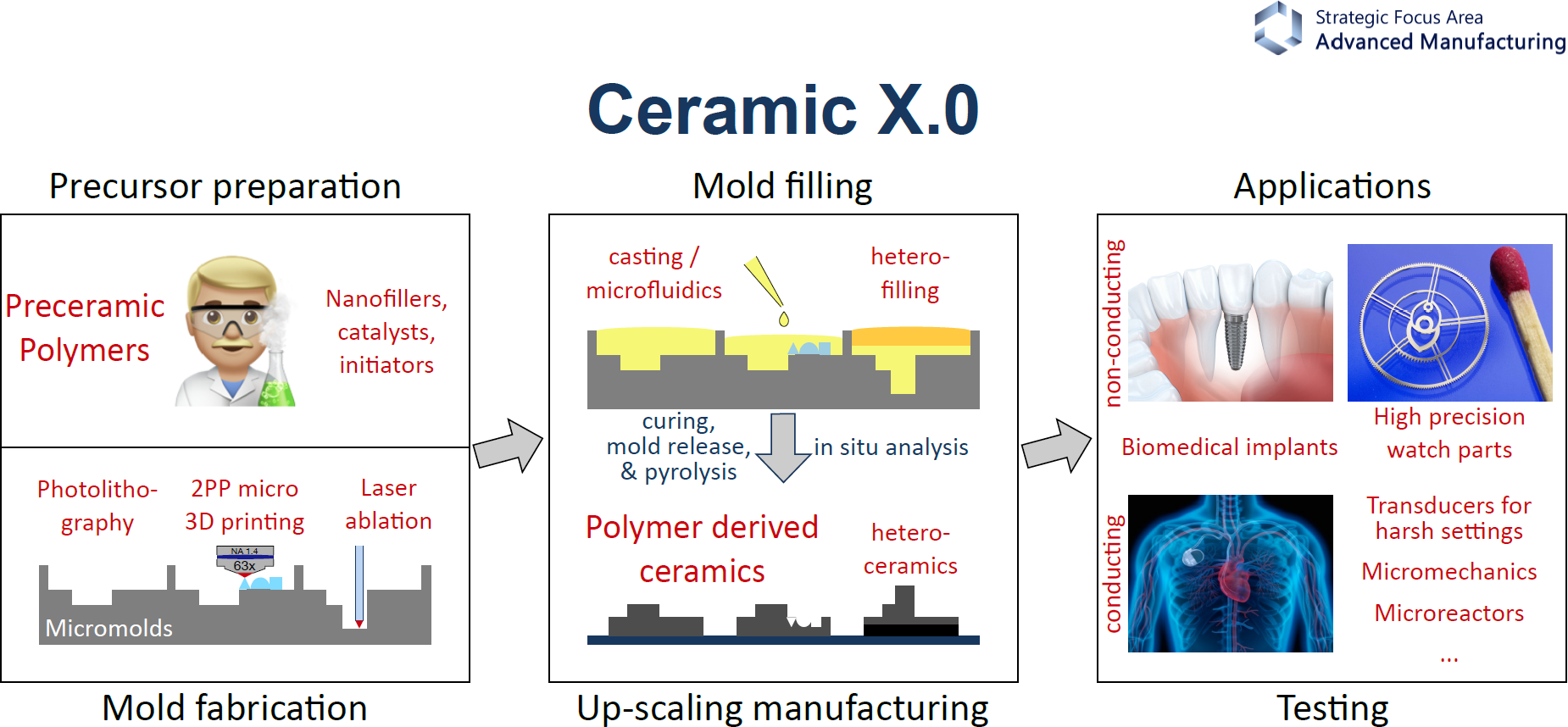
Engineered ceramic materials have found widespread use in various industrial applications due to their unique properties. However, it is difficult if not impossible to produce micron-scale high-precision ceramic components with current manufacturing techniques.
The main aim of this project is thus to develop novel micro-manufacturing techniques for high-precision, ceramic components based on polymer-derived ceramics (PDC). Furthermore, novel PDC materials will be evaluated for their in vitro biocompatibility as dental implants as well as pacemaker electrodes.
Scope of Research Activities
- Development of polymer-derived ceramics (PDC) materials suitable for micro-casting
- Development of processes and devices to …
- Manufacture micro-molds,
- Fill preceramic polymers (PCPs) into these micro-molds (micro-casting) and
- Transform the material into PDC micro-parts by pyrolysis
- Characterization of the ceramic micro-parts regarding in vitro biocompatibility as…
- Dental implants
- Pacemaker electrodes
Key Technical Problems to Solve
- Increase the achievable precision of the ceramic micro-parts.
- Find ways to overcome current issues in the manufacturing of high precision ceramics due to shrinkage.
- Define PDC compositions leading to bright colored implant materials.
- Develop a suitable 3D in vitro model and setup with electrical pacing capabilities to study the fibrotic encapsulation of PDC implant materials.
Demonstrators
- High precision watch parts
- Dental implants
- Implantable (e.g. pacemaker) electrodes
2022
2020
Electrochemical performance of polymer-derived SiOC and SiTiOC ceramic electrodes for artificial cardiac pacemaker applications
J. Jang; P. V. Warriam Sasikumar; F. Navaee; L. Hagelüken; G. Blugan et al.
Ceramics International. 2020. Vol. 47, num. 6, p. 7593 – 7601. DOI : 10.1016/j.ceramint.2020.11.098. 2018
Growth of Large-Area 2D MoS2 Arrays at Pre-Defined Locations Using Stencil Mask Lithography
I. Sharma; Y. Batra; V. Flauraud; J. Brugger; B. R. Mehta
Journal of Nanoscience and Nanotechnology. 2018. Vol. 18, num. 3, p. 1824 – 1832. DOI : 10.1166/jnn.2018.14265. 2016
2015
Cytotoxicity evaluation of polymer-derived ceramics for pacemaker electrode applications
J. Grossenbacher; M. Gullo; F. Dalcanale; G. Blugan; J. Kuebler et al.
Journal of Biomedical Materials Research Part A. 2015. Vol. 103, num. 11, p. 3625 – 3632. DOI : 10.1002/jbm.a.35477. On the micrometre precise mould filling of liquid polymer derived ceramic precursor for 300-µm-thick high aspect ratio ceramic MEMS
J. Grossenbacher; R. M. Gullo; V. Bakumov; G. Blugan; J. Kuebler et al.
Ceramics International. 2015. Vol. 41, num. 1, p. 623 – 629. DOI : 10.1016/j.ceramint.2014.08.112. 2014
Influence of carbon enrichment on electrical conductivity and processing of polycarbosilane derived ceramic for MEMS applications
F. Dalcanale; J. Grossenbacher; G. Blugan; R. M. Gullo; A. Lauria et al.
Journal of the European Ceramic Society. 2014. Vol. 34, num. 15, p. 3559 – 3570. DOI : 10.1016/j.jeurceramsoc.2014.06.002. 2013
Integrated long-range thermal bimorph actuators for parallelizable bio-AFM applications
J. Henriksson; R. M. Gullo; J. Brugger
IEEE Sensors Journal. 2013. Vol. 13, num. 8, p. 2849 – 2856. DOI : 10.1109/JSEN.2013.2261293. 2012
Mechanical and tribological properties of polymer-derived Si/C/N sub-millimetre thick miniaturized components fabricated by direct casting
V. Bakumov; G. Blugan; S. Roos; T. Graule; V. Fakhfouri et al.
Journal of the European Ceramic Society. 2012. Vol. 32, num. 8, p. 1759 – 1767. DOI : 10.1016/j.jeurceramsoc.2012.01.007. 2010
Large arrays of chemo-mechanical nanoswitches for ultralow-power hydrogen sensing
T. Kiefer; A. Salette; G. Villanueva; J. Brugger
Journal of Micromechanics and Microengineering. 2010. Vol. 20, p. 105019. DOI : 10.1088/0960-1317/20/10/105019.