
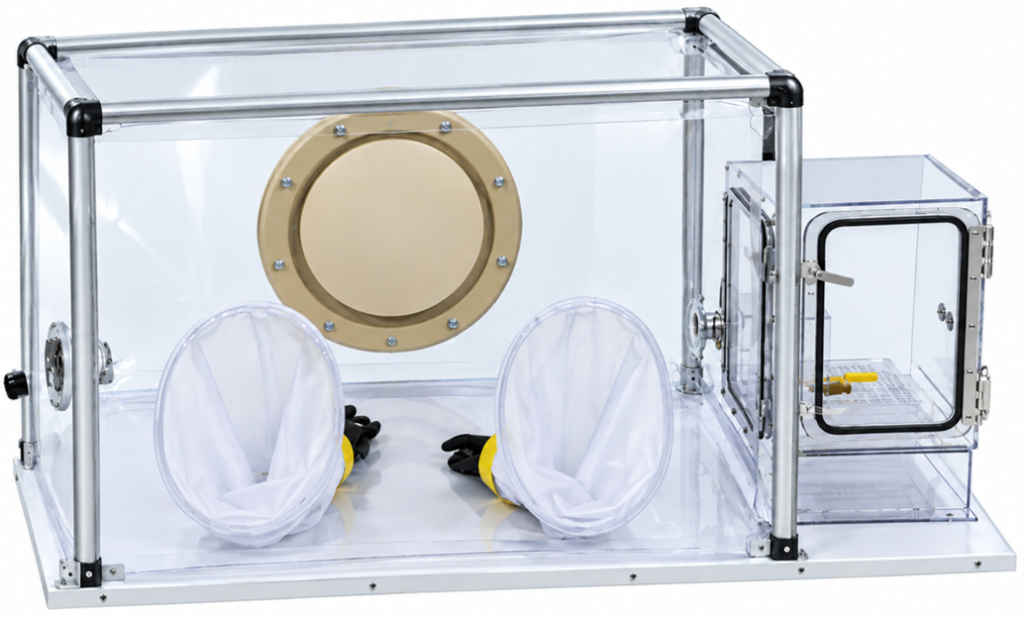
Anaerobic chambers are a technical solution for research requiring oxygen-free conditions. Anaerobic chambers are available in different designs, materials, and operating modes. Less expensive systems are often constructed from flexible vinyl, whereas more robust systems are made of rigid materials such as polycarbonate or stainless steel. Many anaerobic chambers operate under a slight positive pressure to prevent the ingress of ambient air and therefore oxygen into the chamber.
When operating these systems, two major safety aspects must be considered:
- Biological safety, particularly when handling pathogenic microorganisms
- Gas safety, due to the use of flammable and asphyxiating gases in the chamber atmosphere
All users must be informed of the anaerobic chamber operating procedure and trained to apply it systematically. Compliance with the procedure is essential to prevent the temporary formation of flammable hydrogen-air mixtures and to prevent the release of pathogens during normal chamber operation.
When anaerobic chambers are intended for work with pathogenic microorganisms, including Biosafety Level 2 (BSL 2) bacteria, the equipment must meet specific requirements to ensure protection of both laboratory personnel and the environment from potential exposure.
Although positive-pressure operation is advantageous for maintaining anaerobic conditions, it is generally not ideal for applications involving pathogenic microorganisms. Under positive pressure, any leakage may result in the release of contaminated aerosols from the chamber into the laboratory environment.
Potential leakage points include:
- Holes, tears, or degradation of the vinyl enclosure
- Imperfect seals around glove ports
- Leaks at feed-through adapters used for electrical cables, tubing, sensors, or computer connections
- Defective airlock seals
In addition, contaminated chamber atmosphere may be released during airlock operation unless the airlock exhaust is appropriately filtered before discharge.
When a negative pressure configuration is not available or not desirable, and particularly when flexible-walled chambers are used, the following protective measures should be implemented:
1. Continuous HEPA filtration of the chamber atmosphere
The chamber should be equipped with a recirculating HEPA filtration system that continuously removes microbial contamination from the internal atmosphere. The filtration system should remain in operation throughout all manipulations and continue operating for at least 30 minutes after completion of the work and prior to opening the airlock. This helps reduce the concentration of potentially infectious aerosols generated during handling procedures.
2. Additional HEPA filtration of exhausted air
The chamber should be equipped with an additional HEPA filter between the chamber exhaust and the pump to prevent contamination of the pump and associated tubing. If this is not feasible, a HEPA filter should be installed at the pump exhaust to ensure that any discharged air or gas is filtered before release into the laboratory environment.
3. Leaks detection methods
Because many anaerobic chambers operate under positive pressure, a leak may permit contaminated aerosols to escape without necessarily causing an increase in the oxygen concentration within the chamber. Therefore, leak testing should be performed according to the instructions provided in the manufacturer’s user manual for the specific chamber model. For example, in flexible vinyl chambers:
- A soap-and-water solution may be applied to connections and seals; the formation of bubbles indicates a leak.
- A portable gas leak detector supplied by the anaerobic chamber provider, may be used to identify leaks at critical containment points, and for detectors that sense hydrogen and alcohol vapors, placing an alcohol-soaked wipe inside the chamber can improve the detection of small leaks.
4. Maintenance of the Anaerobic Chamber
The anaerobic chamber, including the HEPA filtration system, pumps, portable gas leak detectors, should be maintained according to the manufacturer’s user manual. HEPA filters should be replaced regularly, as recommended by the manufacturer, to ensure effective filtration.
To prevent the formation of a flammable or explosive atmosphere when using anaerobic chambers supplied with a gas mixture containing more than 4% hydrogen (H₂), the following preventive measures must be implemented:
1. Additional step to the airlock operating procedure
The usual procedure for filling the airlock and establishing anaerobic conditions (either automatically or manually) is as follows:
1. Vacuum the airlock and fill it with background gas (N₂).
2. Vacuum the airlock and fill it with background gas (N₂) a second time.
3. Vacuum the airlock and fill it with forming gas.
To prevent the formation of a flammable or explosive atmosphere in the airlock when opening the outer door, the following additional step must be systematically implemented:
4. Before opening the outer door of the airlock, vacuum the airlock and refill it with background gas (N₂). This measure is easy to implement and reduces drastically the risk of fire or explosion by diluting the hydrogen in the airlock.
2. Control of Ignition Sources Around the Vacuum Pump
The area surrounding the vacuum pump must be kept clear and free from:
- Potential ignition sources, including:
- Electrical equipment or plugs that may generate sparks
- Hot surfaces
- Open flames
- Sources of electrostatic discharge
- Flammable products or materials
- Oxidizing agents
3. Ventilation of Pump Exhaust
When the hydrogen concentration in the gas supply exceeds 5%, the vacuum pump exhaust must be connected to the laboratory ventilation or extraction system to prevent the accumulation of hydrogen in the work area.
4. Equipment Maintenance and Monitoring
Routine maintenance must be carried out in accordance with the manufacturer’s instructions. In particular:
- The anaerobic monitor should be functional and properly calibrated
- The vacuum pump and airlock system should be maintained in good working condition