

Lithium batteries pose risks due to their thermal instability. Overcharging, short-circuiting, or physical damage can induce thermal runaway, resulting in fire and/or explosion of the battery. These incidents can cause serious injuries and fires, highlighting the importance of handling, storing, and recycling these batteries with caution.
General Rules
– Follow the supplier’s instructions.
– Avoid: heat sources, flammable materials, vibrations, and direct exposure to sunlight
– Charge on non-combustible surfaces whenever possible.
– Strict prohibition of charging and storage in ATEX-classified areas.
– Do not charge damaged batteries at EPFL.
– Charging and storage in basements are strongly discouraged.
Specific Cases
Batteries for bicycles, scooters, and gyropods
– Charging must be supervised (>30 min absence = temporary stop).
– Charging station available for EPFL: ? Link.
Lithium batteries without BMS (Battery Management System)
– Charge only with an appropriate and balanced charger.
– If available, use a charger with temperature control.
– Charging outside working hours is strongly discouraged.
Other lithium batteries
– Use only the provided charger or a charger specifically designed for the battery model.
– Strictly prohibited to charge non-rechargeable batteries (e.g., button cells).
– On construction sites: unattended battery charging is prohibited outside working hours.
General Rules
– Storage for more than 2 weeks → Follow the supplier’s instructions.
– If no specific guidelines are provided → Store the battery at ~50% charge.
– Follow the precautions in Table 1 (storage based on battery type & energy capacity).
Exemptions from Table 1
The following batteries are not subject to storage restrictions:
– Laptop, phone, tablet, and watch batteries (including smartwatches and pedometers).
– UPS, power banks, batteries for commercial electric/hybrid vehicles (if installed), pallet trucks.
– Power tools & small batteries with an integrated BMS inside electronic devices.
Table 1
| Type of battery | Total energy in the room [Wh] | Maximum battery energy [Wh] | Number of batteries in the room | Storage only |
| Commercial lithium batteries | < 100 | ≤ 15 | ≤ 10 | Lithium battery bag |
| > 10 | Fireballs + Lithium battery box | |||
| ≥ 15 | – | |||
| ≥ 100 | ≤ 500 | ≤ 20 | ||
| > 20 | Contact OHS | |||
| > 500 | – | |||
| Non commercial or altered lithium batteries | – | – | – |
The following products can be purchased on Galaxus through Catalyse. Other products offering the same level of protection or a higher level can also be purchased.
|
Lithium battery bag |
|
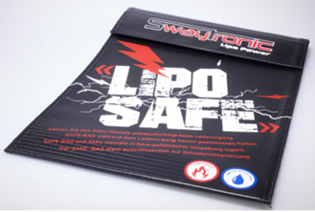 |
Swaytronic LiPo Safe Bag Max storage energy: 15 Wh |
|
Lithium battery box |
|
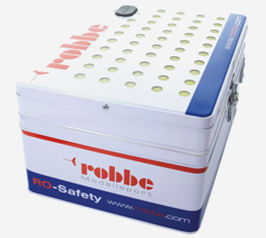 |
RO-Safety Max storage energy: 220 Wh |
|
RO-Safety XL |
|
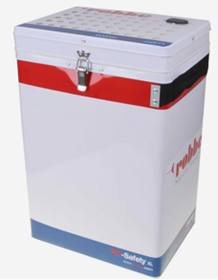 |
Max storage energy: 666 Wh |
|
Fireballs |
|
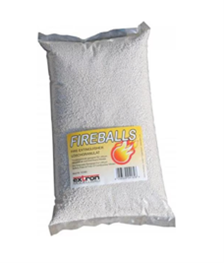 |
Swaytronic Fireballs Fire protection – fire extinguishing granulate |
Immediate actions:
1. Exit the room immediately.
2. Quickly call 021 693 3000 (or 115 from a landline phone).
3. If a fire extinguisher specifically designed for lithium battery fires is available, and if your are trained in its use, attempt to extinguish the fire without putting yourself in danger.
DO NOT USE WATER OR OTHER EXTINGUISHING METHODS NOT INTENDED FOR THIS PURPOSE !
Call 021 693 3000 (or 115 from a landline) so that the intervention team can secure your battery until it is disposed of by a specialist company.
When to dispose of a battery?
– Battery at the end of its life.
– Damaged external casing.
Disposal Procedure:
1. Cover exposed electrodes with insulating tape.
2. Button cells → Wrap them completely with insulating tape.
3. If possible, pack batteries separately in plastic bags.
4. Drop the battery off at a main waste disposal center (PL 0 04) in the designated metallic container. For associated campuses, please contact the building safety delegate.