

Direct links:
- Early assessment questionnaire on collaborations and partnerships (online)
- GEP guidelines for project leads of collaborations and partnerships
- GEP committee “Terms of reference”

EPFL is committed to responsible collaborations and partnerships and to maintaining high ethical and risk management standards in this context. It strives to engage in collaborations and partnerships as openly as possible, while restricting them only when necessary.
Any member of the EPFL community creating a collaboration or partnership is encouraged to consider not only whether their project complies with regulations, but also whether it is appropriate and consistent with the principles of accountability and ethics. The process outlined here supports project leaders and clarifies responsibilities.
What is fair and responsible collaboration?
A fair and responsible collaboration serves one of EPFL’s social missions whilst minimising the risk of harm.
There are therefore numerous factors to consider, relating not only to the specific research, training or innovation project but also to the proposed partners and their respective contexts. The factors to be taken into account are set out in detail in the GEP Guidelines
Who is involved in evaluating collaborations and partnerships?
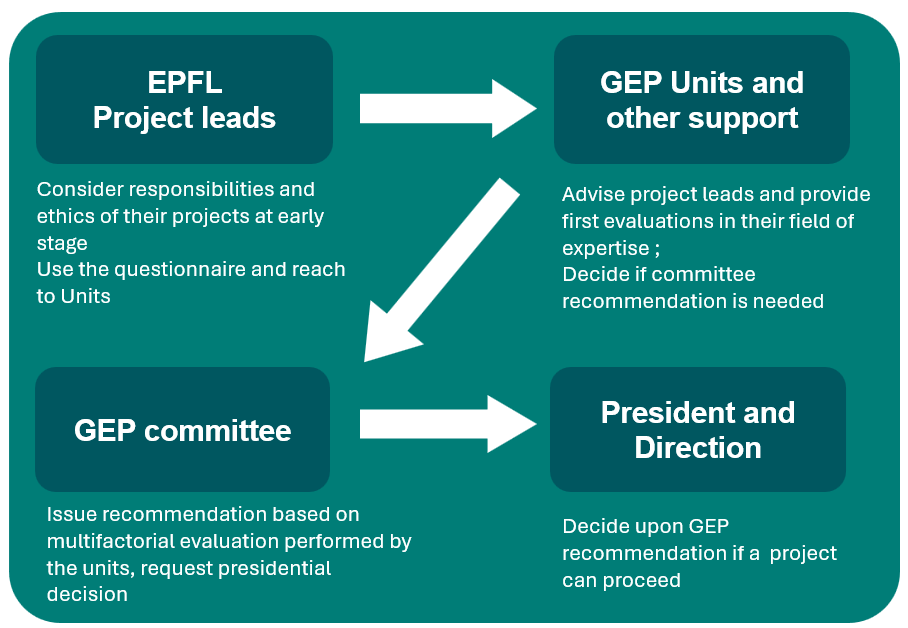
- community members who initiate collaborations and partnerships, guided by a self-assessment questionnaire
- support teams who provide expertise and advice to community members.
- The Global Ethics and Partnership Committee: collaborations and partnerships involving several sensitive or high-risk factors are submitted to the committee by the support teams. The committee issues a recommendation, which is either confirmed or rejected by the chair. You will find the committee’s membership below.
I would like to establish a partnership or a responsible collaboration: how do I go about it?
From the very start of your project with an external organisation, it is very useful to assess it using the questionnaire provided by the GEP Committee and the support units.
Following this assessment, and if any sensitive issues are identified, it is advisable to contact these teams according to their areas of expertise:
for research matters, the Research Office: [email protected]
for the partner organisation, the Development Office: [email protected]
for the international context, International Affairs: [email protected]
For situations at the interface of several areas or general enquiries, please contact the GEP secretariat: [email protected]
What is the GEP committee and who is involved?
The “Global Ethics and Partnership” Committee is an advisory body to the President. It makes recommendations on collaborations and partnerships
involving ethical, political, security or reputational risks. Its role and functioning are set out in the “Terms of Reference”.
This committee comprises the following members (with voting rights):
- the Associate vice-President for research (co-Chair)
- the Director of the Development office (co-Chair)
- the vice president for innovation and impact ordelegate
- the Director of the Research Office
- the Director of International Affairs
- the Director of Legal Affairs
- the Director of the Technology Transfer Office
- an internal expert in Ethics of technologies
other internal experts (non-voting) may be invited to analyse collaborations or partnerships based on their expertise.
What is the assessment process?
This process involves the stakeholders and units described above in sequence; the responsibilities and working methods are set out in the GEP Committee’s Terms of Reference.
If you have any general enquiries, please contact the GEP Committee secretariat:
Flavie Robert, Deputy to the associate vice president for research
Pauline Bataillard, administrative assistant to the associate vice-president for research