
Ibrahim Beniffou

Description :
My project focused on the study of ammonia combustion using the RQL architecture in the SGT-800. Initially, we investigated an appropriate geometry for the primary zone, ensuring a self-sustaining flame, an efficient recirculation zone, and stable combustion. We provided best practices for designing this zone to achieve a favorable distribution of the quantities of interest. Subsequently, we shifted our attention to the aerodynamic study of the secondary zone, where we conducted optimization work on the injection angles to successfully maximize flow mixing at the outlet.
This experience has provided me with the opportunity to engage in a tangible industrial project, complete with well-defined goals and objectives that have practical applications in our daily lives. Throughout this internship, I have significantly enhanced both my communication and technical skills. Collaborating with professionals in a dynamic environment has allowed me to learn how to effectively tackle complex ideas and work as part of a team. Additionally, I have gained valuable insights into the technical aspects of combustion systems and the challenges associated with developing sustainable energy solutions. Overall, this internship has been instrumental in my professional growth and has equipped me with skills that will be beneficial in my future career.
Nur Cristian Sangiorgio

Description :
Richemont is a Swiss leading luxury goods group, committed to innovation and excellence. Its portfolio includes prestigious Maisons known for their craftsmanship and creativity (Jewellery, Specialist Watchmaking, Fashion & Accessories), alongside Online Distributors, employing over 40,000 people across more than 150 locations.
My internship was based within the Research & Innovation department at ValFleurier, one of Richemont’s factories dedicated to movements production, in Buttes, Switzerland.
During my internship, I focused on the implementation, testing, and validation of models and numerical methods designed to accurately reproduce the behavior of a mechanical watch movement. Initially, I dedicated time to gaining a comprehensive understanding of the operational principles of a watch movement and the underlying theory governing its subsystems. Subsequently, I translated this theoretical knowledge into the development of scientific code. Finally, I conducted numerical simulations, comparing the results against available experimental data to perform validation.
My work resulted in improved fidelity of watch movement numerical simulations. This advance is documented in an internal technical report, accompanied by a project presentation and the developed code. The dynamic and collaborative environment at Richemont contributed to the enhancement of both my modeling and simulation expertise, as well as my teamwork capabilities within a cross-functional and cutting-edge setting.

Figure: a mechanical watch movement
Maddalena Detti

Description :
Ezra Baup

Description :
MotionTech (Swiss Motion Technologies SA) is a medtech start-up launched in January 2017 and based in Lausanne. Its aim is to provide next generation mobility solutions to people living with disabilities. The first product, Your® Liner, is a custom-made prosthetic liner where each product needs to satisfy unique patient features; and it is the first 3D printed silicone liner. MotionTech is providing it to orthotic and prosthetic professionals throughout Europe, but also in Australia, New-Zealand and Canada.
The first step of the manufacturing operation consists of transforming a 3D scan of the limb into the 3D shape of the optimal prosthetic liner for the given user. To achieve this, the company has its own 3D toolkit, developed in C# with a user interface built using XAML Designer. The software is continuously updated to meet the needs of the designers, such as automating the modelling operations or adding new features to improve the liners quality.
My first task during the internship was to help enhancing this software by improving inspection analysis tools and optimizing some of the existing modelling operations – in terms of qualitative results on the liner’s shape and in terms of speed of use. In the second part of my internship, I developed a production planning tool to assist the manufacturing team in organizing their daily tasks, workload repartition, as well as estimating delivery times for new orders. This tool was developed in Python using constraint programming techniques.

Mathilde Simoni

Description :
LYO-X AG is a consulting company based in Basel, specializing in PK/PD modeling and Quantitative Systems Pharmacology. They assist pharmaceutical and biotech companies with modeling and simulation services throughout the drug development process, from target assessment to dose optimization. The focus is largely on biologics like monoclonal antibodies, as well as novel drug formats such as cell-based and gene therapies among others.
The objective of this internship was to investigate and model the distribution of monoclonal antibodies (mAbs) and antibody-drug conjugates (ADCs) in solid tumors, in order to better understand the key factors influencing tumor targeting and drug efficacy.
I began by working with the mechanistic compartmental model developed by Thurber et al. (2012), which describes antibody extravasation into tumors using a diffusion-based approach. I extended the model by incorporating additional biological mechanisms, including full antibody–receptor binding kinetics and intracellular label retention. The extended model demonstrated good agreement with experimental mouse data across multiple studies.
In the second part of the project, I developed a minimal physiologically based pharmacokinetic (mPBPK) model which describes the whole-body distribution of ADCs and their released payloads in humans. This model classifies healthy organs and tumors into compartments. It also includes mechanistic representations of the drug’s transport in plasma, lymph and tissues, receptor-mediated internalization, ADC’s deconjugation, as well as payload transport and clearance. It was calibrated using clinical data from two FDA-approved HER2-targeting ADCs and revealed differences in tumor toxin exposure between the two drugs, consistent with their differing mechanisms of action.
Figure: Extended mPBPK Model for ADCs
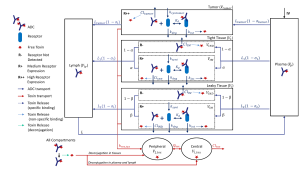
Source: Thurber, G. M., & Wittrup, K. D. (2012). A mechanistic compartmental model for total antibody uptake in tumors. Journal of theoretical biology, 314, 57-68.
Léa Gainon

Description :
The Kudelski Group is a leading Swiss company based in Cheseaux-sur-Lausanne (CH) and Phoenix (US), providing core digital security technologies and solutions for a wide range of customers in the fields of media, cybersecurity, and the Internet of Things (IoT). I joined the IoT Advanced Research Team for a six-month internship, focusing on the exploration of agricultural solutions using satellite imagery.
After an initial month dedicated to review existing work on precision agriculture and remote sensing, we decided to implement a tool to monitor crop growth using satellite data. The core of my internship consisted of building this project from scratch, ranging from data collection and scientific computations to the development of a user interface. I applied several mathematical algorithms from various fields, performed data analysis, and evaluated results.
Among the methods used were interpolation techniques, noise filtering, function fitting, trend detection, autoregressive and Bayesian models. This internship provided a great opportunity to apply the skills acquired during my master’s courses at EPFL in a real-world industrial context.
Last but not least, my team decided to initiate a patenting process for the idea I developed, which gave me valuable insight into intellectual property strategies and the steps involved in protecting innovation within a corporate setting.

Figure 1: User Interface for crop growth monitoring
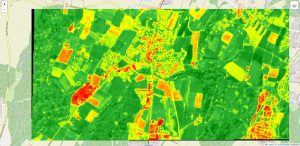
Figure 2: Vegetation index map over Cheseaux from Sentinel 2 data. Red color refers to low index, green to
high.
Adrien Joliat

Description :
The European Space Agency (ESA) is Europe’s gateway to space. Founded in 1975, it is a 23-member intergovernmental organisation devoted to space exploration. My internship took place at ESTEC—the European Space Research and Technology Centre—in Noordwijk, the Netherlands. Within ESTEC, I worked on CHIME (Copernicus Hyperspectral Imaging Mission for the Environment), an Earth-observation mission planned around 2030 to advance food security, sustainable agriculture, and raw-materials monitoring.
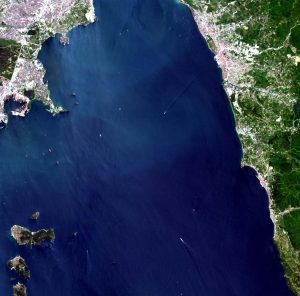
During my internship, I developed an onboard AI model that detects marine anomalies over open ocean (e.g., floating plastics, oil spills, and sargassum). I carried the project end to end: dataset creation, model training, evaluation and validation, and implementation in CHIME’s dedicated simulator (CHEES). The outcome is a flight-practical linear SVM that can be used for onboard Marine Anomaly Detection within CHIME’s constraints.
Beyond the technical work, the CHIME team at ESTEC was the standout of my internship. Diverse in background yet perfectly aligned in mission, the group balanced scientific rigor with an inclusive, supportive atmosphere. Colleagues took time to follow my project, encouraged initiative, and celebrated small wins. Their guidance turned a demanding project into an energizing learning experience. In addition of this, meeting many other interns and young professionals is part of the ESA journey and adds real fun to the process. I highly recommend joining ESA for both the professional growth and the vibrant community it fosters.

Davor Dobrota

Description :
Julie Charlet

Presentation of the company :
Alpiq, headquartered in Lausanne, is a Swiss company specializing in electricity production and energy services. The company operates throughout Europe and has a workforce of around 1,200 employees. Its portfolio includes hydropower facilities as well as solar, wind and gas power plants. Company services are splitted into three main pillars: Assets, Trading and Origination.
Description of results :
The main outcome of this internship is a data analysis workflow and Python library designed for vibration monitoring of Pelton turbines during their runup phase. The library provides essential tools for:
– Reading and processing vibration data.
– Automatically analyzing and annotating runups in the time-frequency domain using the Short-Time Fourier Transform (see Figure 1).
– Generating ensemble averages to track the evolution of natural frequencies.
The results are visualized through a surveillance dashboard, which demonstrates how such a tool could be implemented for real-time or near-real-time monitoring during runup phases. This serves as a proof of concept for future operational monitoring solutions and lays the groundwork for predictive maintenance strategies that can minimize unplanned outages, extend turbine lifetime, and maximize asset availability.

Figure 1: Annotated runup sequence with fitted B-spline
Max Brodeur

Description :
My project at the Max Planck Institute for Brain Research in Frankfurt was focused on the connectomic analysis of the cuttlefish optic lobe – the entry point in the nervous system of a sophisticated camouflage system. My team’s aim was the reconstruction of a synaptic-level connectivity graph (the connectome) obtained from two volume Electron Microscopy (vEM) datasets of the optic lobe cortex. This is where the earliest steps of visual processing take place, similar to the vertebrate retina. To get the connectome, these datasets are first segmented into small fragments of cells that are iteratively merged to obtain reconstructions of entire neurons.
However, this automatic segment agglomeration process produces merger errors between different cells that drastically affect the quality of the connectome. My task was to train a contrastive learning model to predict segment cell types (e.g. Neurons vs. Glial cells) to prevent these common errors during reconstruction.

Federico Nicolo’

Description :
Bending Spoons is a technology company that develops and scales digital products. My internship took place within the Data & AI team working on Komoot, one of the company’s products, a platform dedicated to outdoor activities.
Over the course of six months, I worked on the analysis of product experiments, monetization initiatives, and supporting data infrastructure, contributing to data driven decision making across different stages of the product lifecycle. A significant part of my work involved product analytics, including the evaluation and automation of A/B experiment analyses, as well as more in depth analyses of complex experiments, focusing on the statistical evaluation of effects across multiple metrics and on the interpretation of competing signals between engagement and monetization.
In parallel, I worked on monetization related analyses, including user segmentation and clustering based on activity patterns. The internship also included a data engineering component, involving work on ETL pipelines and tracking events, with a focus on improving data quality and optimizing data processing workflows. Overall, this experience allowed me to apply statistical and analytical methods to real world product data, while gaining practical insight into how data driven systems are built and maintained in a production environment.
Kleon Karapas

Description :
Emilia Farina

Description :
The Lausanne University Hospital (CHUV) is one of the leading university hospitals in Switzerland and an important center for clinical research, medical innovation, and education.
My internship was carried out within the Translational Machine Learning Laboratory, part of the Department of Medical Radiology at CHUV. The laboratory focuses on the development of machine learning methods for the analysis of complex, heterogeneous and multi-modal clinical data, with the aim of supporting disease understanding and clinical decision-making. During my internship, I worked on the HeartMagic project, which studies the heart failure syndrome, with particular emphasis on Heart Failure with Preserved Ejection Fraction (HFpEF). The goal of the project is to apply machine learning techniques to identify meaningful patient subgroups among HFpEF, with the objective of enabling more effective, personalized treatments.
My contribution to the project was to build an open data repository for large-scale, multimodal heart-failure data by integrating clinical, omics, and advanced cardiac and renal MRI data. In particular, I worked on preparing datasets for submission to FAIR (Findable, Accessible, Interoperable, and Reusable) data repositories. This involved organizing complex data, defining and harmonizing metadata, and producing clear documentation to ensure full FAIR compliance and long-term data reusability.
One of the main challenges encountered during the project was the heterogeneity between the datasets from different cohorts, such as different naming convention and DICOM tag usage. These inconsistencies limited the possibility of applying a fully unified processing pipeline.
Through this experience, I developed strong skills in managing large and heterogeneous datasets, working with both tabular and advanced MRI data. I also become familiar with open data repositories and best practices for metadata organization.
Francesco Carlo Genito

Description :
Procter & Gamble (P&G) is a leading global consumer goods company founded in 1837, renowned for its commitment to science-driven innovation.
My six-month experience within P&G’s R&D division in Germany was exceptional, characterized by a highly collaborative yet structured environment where I was given significant autonomy and full ownership of my project. This empowerment was key to bridging the gap between academic theory and industrial practice, pushing me to develop not only technical skills but also crucial professional skills in project management.
The scientific goal of the project was to develop a machine learning model to predict functional performance deviations in consumer products, thereby accelerating the R&D cycle. By synthesizing data from user characteristics, product specifications, and novel image-based metrics, an XGBoost model was trained. Using a rigorous Leave-One-Study-Out validation method, the model demonstrated strong predictive power, consistently outperforming baseline metrics. Crucially, the use of SHAP for explainable AI provided actionable insights into the key drivers of product performance, connecting specific design choices and user traits to real-world outcomes.

Leonardo De Novellis

Description :
Sony is a leading Japanese technology group in the image sensor market, with strong expertise in image processing and sensor algorithms, supported by advanced research and development centers worldwide.
My internship took place at the Stuttgart Technology Center, Sony’s research laboratory in Stuttgart, Germany. The task of my internship was to develop machine learning-based tone mapping algorithms, with the goal of comparing their performance against classical signal-processing-based approaches. The first phase of my internship was conducting a literature review to familiarize myself with the theoretical foundations and existing methods in tone mapping. After this, I adapted and modified the existing literature to design new models and approaches. Finally, I performed extensive experimental evaluations, comparing the proposed methods against baseline algorithms and achieving improvements in image quality.
My work contributed to validating the effectiveness of machine learning for tone mapping applications. The collaborative and research driven environment at the Stuttgart Technology Center greatly helped the development of my technical skills in scientific research, while also strengthening my ability to work effectively within a multidisciplinary research team.
Siyuan Cheng

Description :
Adonite SA is an autonomous manufacturing company focused on using data and machine learning to automate machining processes. My internship involved two main tasks: exploring reinforcement learning algorithms for a contour fitting problem, and investigating graph neural networks for defect detection on geometric data. In the first task, several RL methods were implemented and tested in simplified contour alignment scenarios. The second led to a full pipeline based on a graph autoencoder, which performed well in unsupervised defect detection—successfully highlighting structural anomalies without relying on labeled data.
Corentin Genton

Alix Benoit

Description :
The Swiss Federal Laboratories for Materials Science and Technology (EMPA) is a leading Swiss research institute focused on applied materials science and engineering. My internship was carried out in the Laboratory for Advanced Materials Processing, within the Intelligent Manufacturing Group. The internship focused on accelerating high-fidelity simulations of laser-based manufacturing processes using AI-driven surrogate models. Traditional thermo-fluid simulations of laser welding are computationally expensive, limiting their use in optimization and real-time applications. I developed surrogate models capable of predicting three-dimensional temperature fields and melt-pool geometries directly from process parameters. To achieve robust performance across a wide range of operating conditions, I developed novel strategies to improve the generalization capabilities of the models. The resulting approach achieved accurate predictions across both conduction and keyhole welding regimes while providing speedups of several orders of magnitude. This work demonstrated the potential of AI-based surrogate modeling for fast, physics-consistent simulation of complex manufacturing processes.

Thibault Schiesser

Description :
Contrinex is a Swiss-based global leader in smart sensors for industrial automation and smart factory applications. With more than 50 years of experience in intelligent sensing solutions, the company develops a wide range of sensors and systems used in demanding industrial environments and is active in over 60 countries worldwide.
Within this context, Contrinex develops a 3D smart camera based on Time-of-Flight (ToF) technology, designed for real-time depth acquisition. The camera is operated through a dedicated no-code application that allows end-users to select and configure predefined applications by choosing a use case. Each use case relies on a dedicated set of algorithms running on the embedded system. During my internship, I worked on this algorithmic layer. My tasks focused on improving the robustness of existing algorithms and exploring new directions to extend the range of applications supported by the camera.
Through this experience, I developed strong skills in computer vision for embedded systems, including depth-image and point-cloud processing of ToF data. I also gained experience with API-based communication between a host system and the embedded device, which was central for testing, debugging, and integration. In addition, I strengthened my software engineering skills in an industrial context, notably through a GitLab-based CI/CD pipeline, Docker environments, and cross-compilation workflows for embedded deployment.

Alexandre Mayer

Description :
INRAE (National Research Institute for Agriculture, Food and Environment) is a French public research institute founded in 2020 that conducts research on sustainable farming, food systems, natural resources, biodiversity, climate change and associated risks.
My internship was based within the lakes modelling program, in the CARRTEL unit in Thonon-les-Bains, a joint research unit of INRAE and University of Savoie Mont Blanc.
The objective of this internship was to develop a Machine Learning (ML) model in Lake Geneva to forecast deep phytoplankton blooms that satellite remote sensing cannot detect.
Only abiotic factors were used to allow the deployment of such a model to areas where in-situ measurements are either scarce or non-existent.
After spending a couple of weeks reviewing existing literature on lake and phytoplankton dynamics, my task was to clean data by deriving robust criteria to remove unreliable chlorophyll-a profiles and correct daytime profiles affected by Non-Photochemical Quenching, a side effect of fluorescence-induced sensors for chlorophyll-a, a proxy for biomass.
The implemented algorithms showed good consistency with existing methods, which allowed me to move on to in-situ chlorophyll-a vertical profiles labelling based on satellite water transparency measurements and various feature augmentation techniques for temporal data.
Finally, I designed and trained several classification ML models and artificial neural networks to select the one which showed the best results, which correctly classified a vast majority of deep blooms.
Many technical skills acquired at EPFL were used during this internship, which showed me the inner workings of a scientific team.
Finally, my team decided to publish a scientific paper using my results, which gave me valuable insight into the publication process.
Mathieu David Salz

Description :

Riccardo Rota

Description :
Logitech is a Swiss-American provider of software and computer peripherals, with its Swiss headquarters situated at the EPFL Innovation Park. The company is a global leader in designing products that connect people to digital experiences, with a diverse portfolio spanning gaming, video collaboration, music, and smart home devices. It offers a valuable internship experience, hosting a diverse group of 25-30 interns each semester.
During my internship, I operated at the intersection of the Audio ML team and the Technology Office. My primary objective was to investigate Differentiable Digital Signal Processing (DDSP) techniques, specifically targeting the enhancement of audio for gaming scenarios. I developed a flexible codebase and a hybrid architecture where a machine learning model dynamically controls traditional audio filters for real-time, on-device application.
This experience allowed me to explore theoretical research while remaining driven by tangible product applications. I also participated in two global Logitech events, which involved presenting to management and testing products with professional gamers. Following promising results on some applications, I concluded my internship by co-authoring a conference paper that is now ready for submission. Throughout this internship, I improved my technical skills in Python and PyTorch and learned to effectively communicate technical concepts within a global corporate environment.