
! Cleanroom humidity warning !
Control of the relative humidity (RH) in photolithography zones is extremely critical. Stable and reproducible photolithography is expected within 38% to 48% RH range.
- In case of low RH (< 38%), the resist sensitivity and development rate decreases. It is then recommended to increase the exposure dose.
- In case of high RH (> 48%), the resist adhesion decreases. It is then recommended to do an additional bake (>10 minutes @ 150°C) before loading the wafers in the HMDS or coating equipment.
Wafer surface preparation
In order to obtain maximum process reliability and bonding performances, wafers should be cleaned beforehand, to remove organic and particle contaminations:
- Silicon wafers: RCA cleaning in Plade RCA (staff service)
- Glass wafers: Piranha cleaning in UFT Piranha
Prior to the coating of Cyclotene polymers, optimal adhesion will be obtained with the surface preparation recommended in the following table. AP 3000 silanization is applied by spincoating, before in the Sawatec MISC coater (see next section).
| Surface material (larger area) | AP 3000 | Plasma O2 | Thermal dehydratation |
|---|---|---|---|
| Si | √√ | √ | √ |
| SiO2, fused silica, SiN, Si3N4 | √√ | √ | √ |
| Float glass, pyrex | √√ | √ | √ |
| Metals: Al, Au, Pt, Ti | … | √ | √ |
| Metals: Ag, Cu, Cr, Fe | … | X | √ |
| III/V semiconductors (GaN, GaAs) | … | X | √ |
Legend: √√ Strongly recommended / √ Alternative process / … Not effective / X May affect or destroy underlaying material
Spincoating
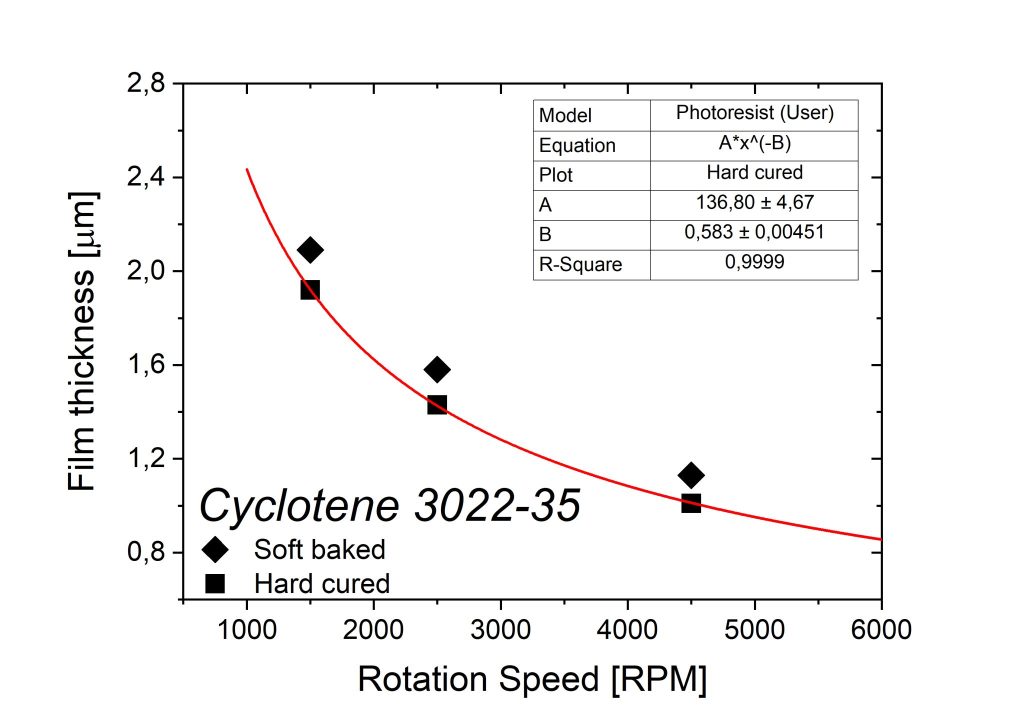
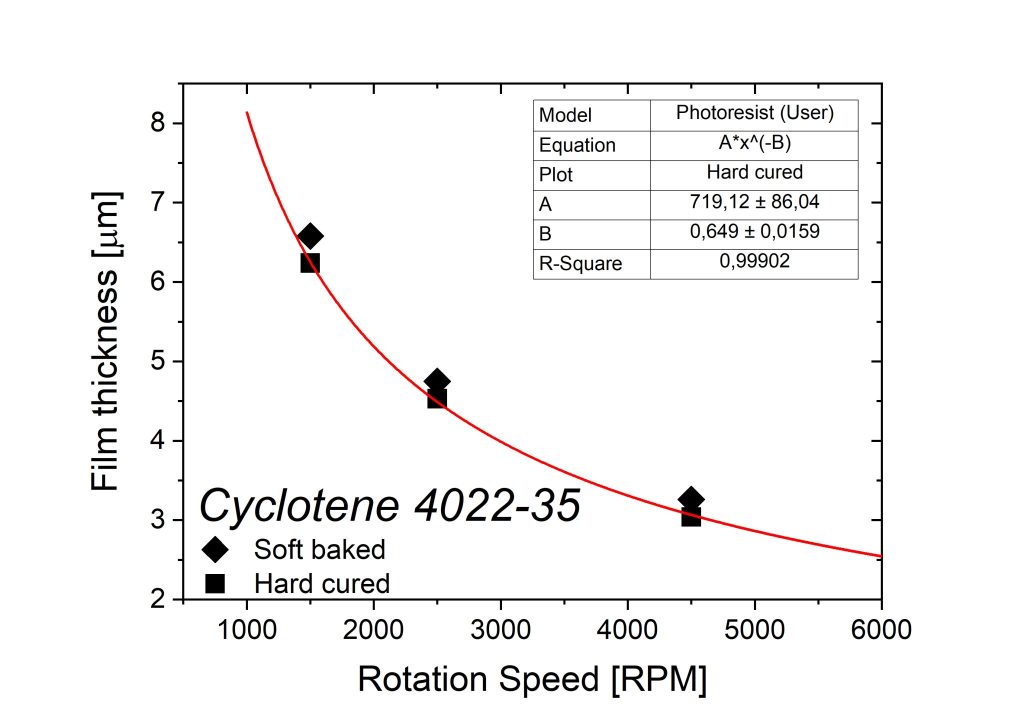
Spincurves for the Cyclotene 3022-35 (thin, non-photosensitive) & 4022-35 (thick, photosensitive) series are shown below, as well as process details on the Sawatec “MISC” manual coater. Other Cyclotene grades can be used on the Sawatec “MISC” by following the recommendations from the supplier’s technical datasheet.
Note: The Cyclotene 4022 serie doses are stored at -15°C to preserve their lifetime. Make sure to take a dose out of the freezer at least 1 hour before use in order to let it warm up to room temperature. Put it back in the freezer after use.
- AP 3000 silanization: Dispense ~3mL of AP 3000 to cover the wafer surface, wait ~ 20 seconds then run the “AP3000 / AP 3000 CMI” spin-dry recipe. Bake at 150°C, 30 seconds.
- Find the spin-coating speed “XXXX” [RPM] matching your target thickness from the Cyclotene spincurves. In general, if used for adhesive bonding applications, we recommend to target a thickness that allows to compensate for the wafers TTV.
- When coating on wafers, use the “BCB / Cyclotene CMI” recipe, which includes a 5 seconds 500 RPM spreading step and 30 seconds of main coating step.
- Cyclotene 3022-35: Spinning at 1000 RPM results in a 2.5um thick film.
- Cyclotene 4022-35: Spinning at 1000 RPM results in a 8um thick film.
- Softbake:
- Cyclotene 3022-35: 150°C, 60 seconds (not critical – for clean handling only)
- Cyclotene 4022-35:
- Film thickness <4.5um: 60°C, 90 seconds
- Film thickness 4.5um – 6.5um: 65°C, 90 seconds
- Film thickness 6.5um – 8.5um: 70°C, 90 seconds
Exposure (Cyclotene 4022)
The following table lists some exposure doses for Cyclotene 4022-35 coated on silicon wafers.
The Cyclotene 4022 serie is sensitive to i-, g- and h-line illumination configurations and can be exposed either with a mask-aligner @ 365nm or with a laser writing equipment.
Depending on your applications (high resolution patterning, wafer bonding with BCB adhesive), the optimal dose will need some adjustments. High resolution / aspect ratio will require a lower dose, while bonding will require a higher dose (see bonding section below).
| Illumination: | i-line (365 nm) | i-line (375 nm) | |
|---|---|---|---|
| Equipment: | MA6 Gen3 (filter), EVG 610 | MLA 150 | |
| Resist grade | PR thickness [µm] | Dose [mJ/cm2]++ | Dose [mJ/cm2]+ |
| Cyclotene 4022-35 | 8 | >700 | >800 |
+ Based on MLA150 internal dose measurements / ++ Based on intensity readings from Süss optometer i-line CCD
Development (Cyclotene 4022)
The Cyclotene 4022 serie uses DS 3000, a propriety solvent blend developer (based on 1,3,5-triisopropylbenzene). Two beakers of DS3000 are used, one heated to 40°C for active development, and one at room temperature for rinsing.
IMPORTANT: Cyclotene is a negative-tone resist. Although not strictly required, a post-development bake (PDB) is recommended before development, to improve the process stability and reproducibility. For manual development, make sure to perform the PDB as indicated in the section below!
- ! Important! Make sure to perform the PDB before development:
- Film thickness <4.5um: 50°C, 30 seconds
- Film thickness 4.5um – 6.5um: 55°C, 30 seconds
- Film thickness 6.5um – 8.5um: 60°C, 30 seconds
- Recommended developer: DS 3000
- Development time (in heated 40°C DS 3000): ~3′ (for high aspect ratio, add 50% development duration to the time to clear) / agitate by hand
- Rinsing time (in RT DS 3000): ~1′ / agitate by hand
- Dry: N2 blow, several minutes (both wafer front & backside)
Observations:
- The development sequence may require multiple cycles or rinsing and drying to clean polymer residues from both the front and backside of the wafer. 1,3,5-triisopropylbenzene has a very low vapor pressure (2.42 Pa at 25°C). Its evaporation is extremely low and drying at room temperature with N2 blow will be extremely tedious and time consuming.
- After development, the resist profile will be slightly negative and some resist footing (contamination at the surface/resist interface) might be difficult to develop & clear properly, especially for high-aspect ratio structures (see image below).

Post-development bake & Descum (Cyclotene 4022)
After development, two additional steps are recommended before trying to bond:
- Post-development bake: 150°C for 30 minutes, under N2 ambiant to dry & eliminate the residual solvent content from the Cyclotene film.
- Descum: A short plasma etch step is recommended to clear remaining resist footing and surface contamination. Pure O2 chemistry is not recommended. Instead, users can use the APS etcher “BCB” recipe (O2/SF6, 20/5 sccm, 1000W) for ~15-20 seconds. Etch rate is ~500nm/min
Wafer bonding
If Cyclotene (both series) is used as an adhesive layer for wafer bonding, it is recommended to spin-coat the polymer on one of the two wafers only, while the second wafer should be silanized with AP 3000.
The wafers will be placed in contact after the softbake and the temperature in the bonding chamber will rise to 150°C – 210°C to initiate the bonding. Partial or complete curing of the polymer can be performed in the bonding chamber (although using a convection oven will multiple wafer stacks will be better for throughput).
Here is a summary of the bonding sequence steps, implemented in the EVG 510 wafer bonder, to bond 4inch wafers:
- Establish vacuum and wait until P < 5×10⁻⁴ mbar (high vacuum)
- Nitrogen purge
- Ramp the pressure plates temperature to 150˚C (ramp 20°C/min)
- Establish vacuum and wait until P < 0.5 mbar (low vacuum)
- Apply a piston force of 0.5 kN (~60 kPa)
- Ramp the pressure plates temperature to 180˚C (ramp 5°C/min)
- Ramp the piston force to 2.5 kN (ramp 300 N/min) and the pressure plates temperature to 210˚C (ramp 5°C/min)
- Release the piston force
- Soft Cure for 40 minutes (optional)
- Cooldown
- Release vacuum
- Remove bonded wafers
| Wafer Size | Resist Thickness | Temperature | Force |
|---|---|---|---|
| [inch] | [µm] | [°C] / [sec] | [kN] |
| 4 | 8 | 150 to 210 @ 5°C/min | ramp to 2.5 |
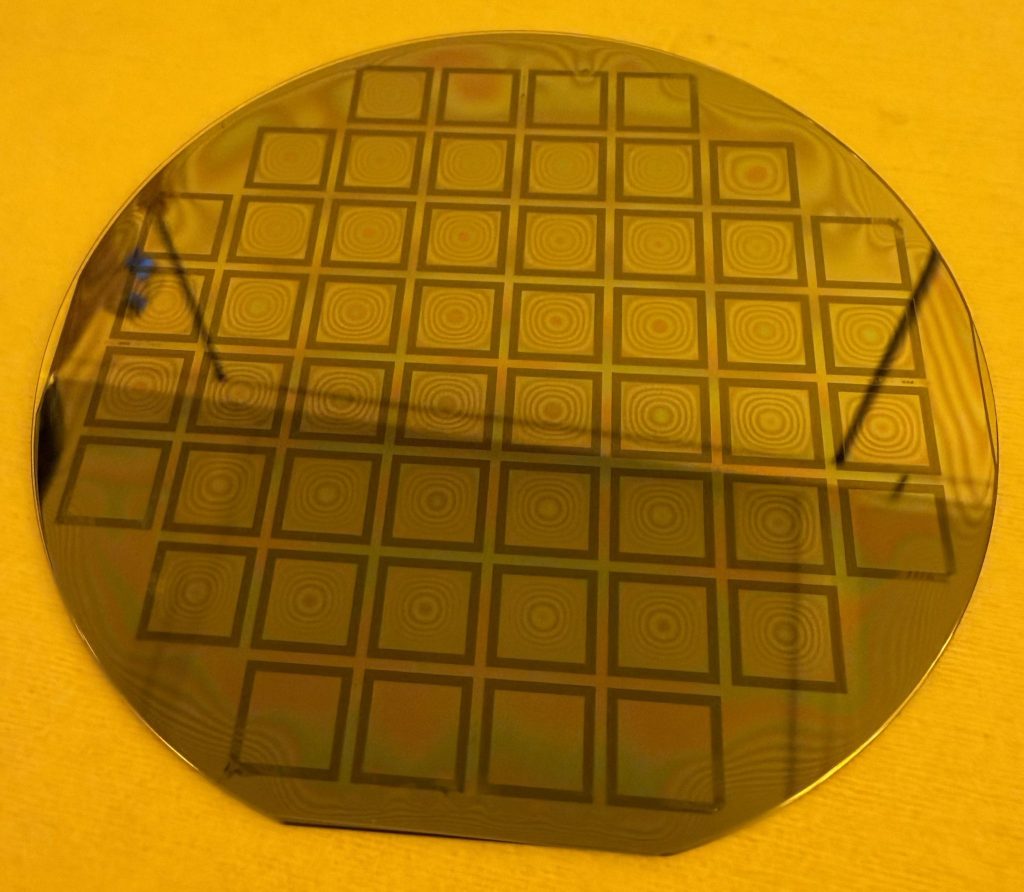
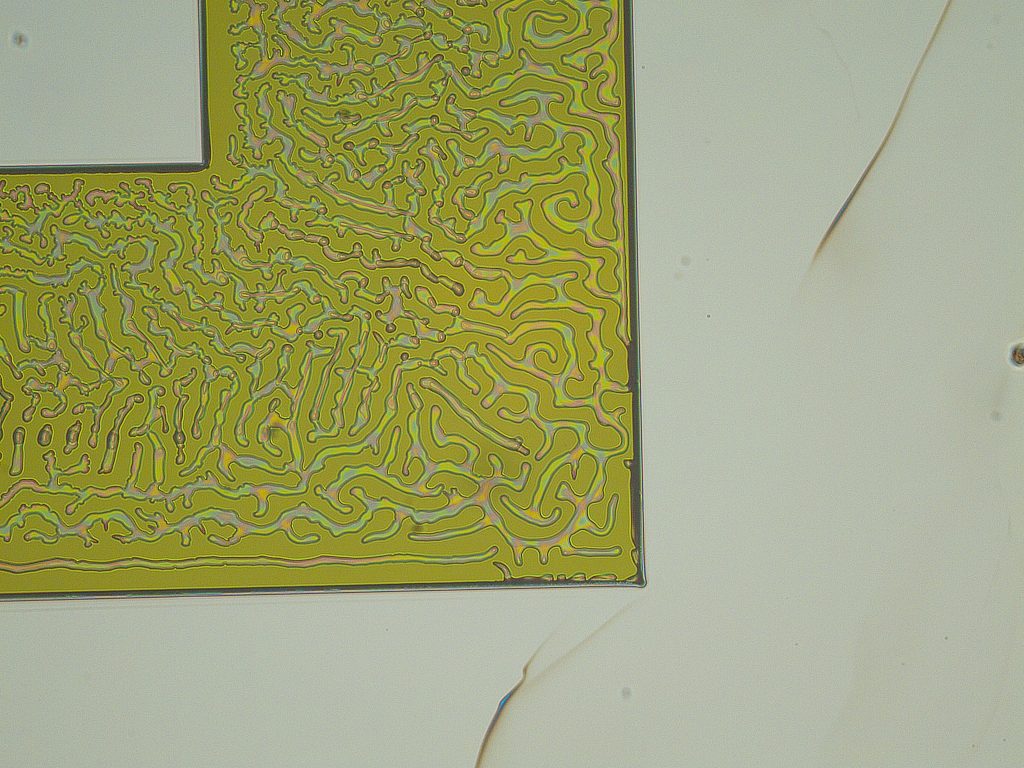
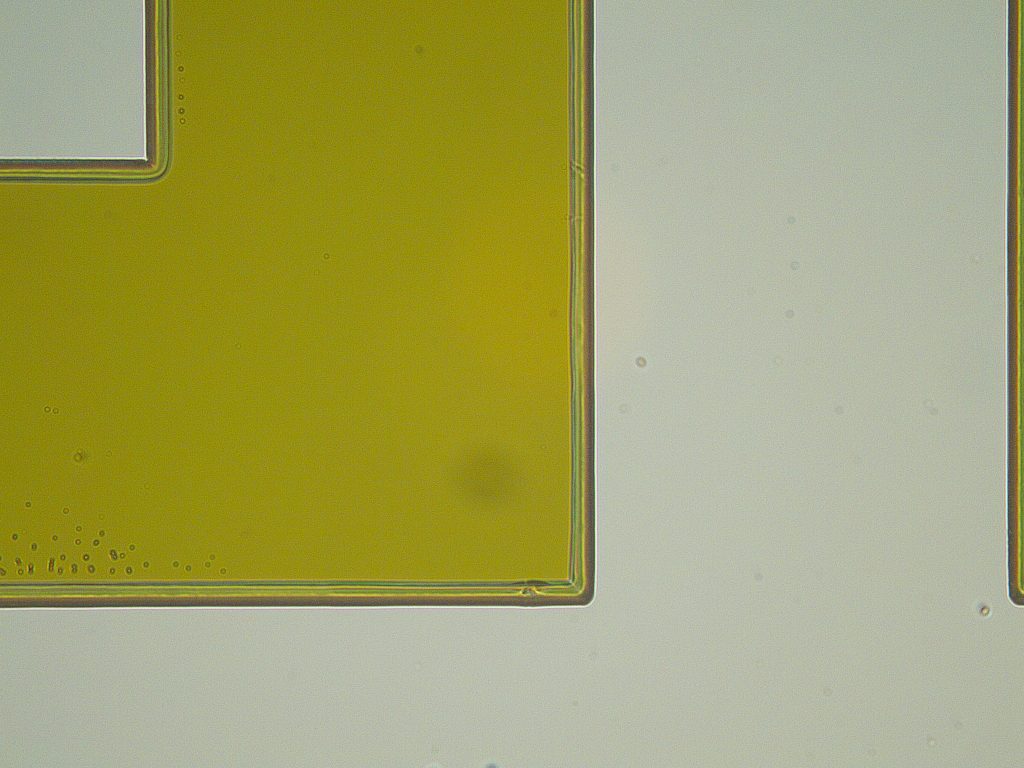
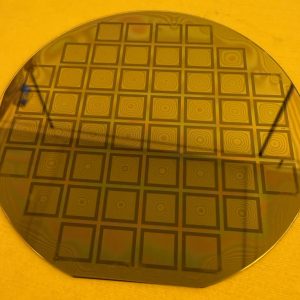
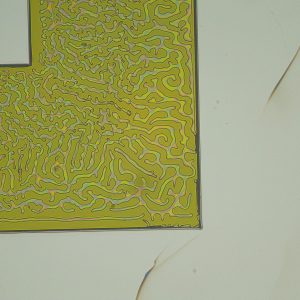
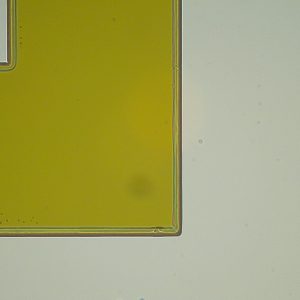
Note: When using the photosensitive Cyclotene 4022-35 as a bonding adhesive, the exposure dose should be increased to ~1400 mJ/cm2 (for a 8 um thick film) to achieve uniform polymerization of the film. Make also sure to perform the post-development bake as describes above. Non-optimal exposure and bake conditions will result in “wrinkling” of the film at the glass interface and potentially will lead to debonding of the wafers.
Curing
Two curing profiles can be used for Cyclotene. The soft cure (@ 210°C) is recommended to mitigate stress for processes that includes multiple stacks of BCB. The hard cure (@ 250°C) is used to reach the final chemical, mechanical and electrical properties of the film.
The films are cured under N2 flow. The Heraeus T6060 or Despatch LCD1-16NV-3 ovens of Zone 11 are used for that process.
| Step N° | Soft Cure | Hard Cure |
|---|---|---|
| 1 | Ramp to 150°C @ 10°C / min | Ramp to 150°C @ 10°C / min |
| 2 | Maintain 150°C for 15 minutes | Maintain 150°C for 15 minutes |
| 3 | Ramp to 210°C @ 5°C / min | Ramp to 250°C @ 5°C / min |
| 4 | Maintain 210°C for 40 minutes | Maintain 250°C for 60 minutes |
| 5 | Cooldown to RT | Cooldown to RT |