
We investigate how indoor pollutants are emitted, transformed, transported, and inhaled, and how these processes shape human exposure and their health relevance.
Indoor environments contain complex mixtures of particles, gases, and bioaerosols. Their concentrations and health relevance depend on sources, ventilation, indoor chemistry, occupant activities, surfaces, and building operation. HOBEL studies these processes to better understand what people breathe indoors and how exposure can be reduced.
Key questions
- What are the dominant sources of indoor air pollutants in different building types?
- How are particles and gases generated, transformed, and removed indoors?
- How do indoor factors, such as surfaces, occupant behavior, and indoor chemistry influence pollutant fate?
- How can laboratory experiments, field studies, and exposure models be combined to better understand human inhalation exposure?
- Which pollutant properties and exposure metrics are most meaningful for assessing health relevance?
Example topics
- Ultrafine particles and indoor aerosols
- Indoor sources and secondary pollutant formation
- Human emissions and human-associated indoor chemistry
- Bioaerosols and respiratory exposure
- Personal cloud and near-person exposure
- Particle deposition, resuspension, and transport from clothing and surfaces
- Inhalation exposure in the breathing zone
- Links between pollutant dynamics, exposure, and biological response
Featured projects
[Ongoing] INDOAIRTOX — Indoor ultrafine particles, exposure, and toxicity
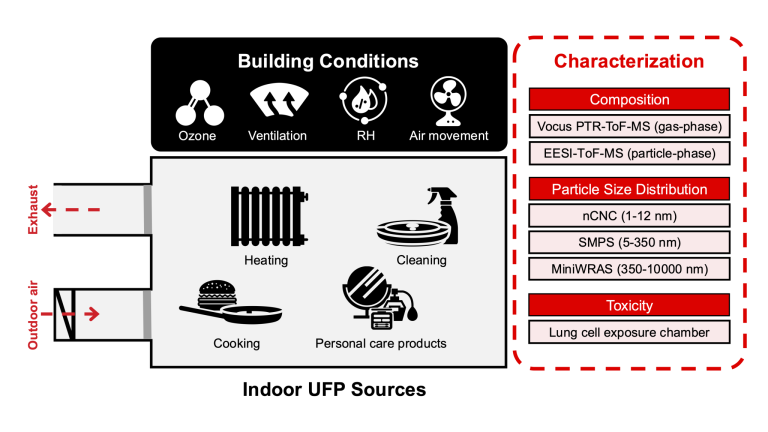
Ultrafine particles are emerging pollutants whose indoor sources, transformations, composition, and health relevance remain insufficiently understood. INDOAIRTOX investigates how indoor ultrafine particles are generated, evolve under different building and environmental conditions, and interact with human lung tissue.
The project combines controlled chamber experiments, real-time aerosol and chemical characterization, and advanced in vitro lung-tissue exposure models. By linking indoor UFP sources, dynamics, composition, and toxicity, the project aims to generate mechanistic knowledge that can inform healthier building operations, ventilation, filtration, air-cleaning strategies, and future exposure assessment.
People: Ruijie Zhu, Khadija Din Sharaf, Kristen Yeh, Dusan Licina
Partners: Paul Scherrer Institute, Adolphe Merkle Institute, Max Planck Institute for Chemistry
[Ongoing / Completed] Human emissions and indoor air chemistry
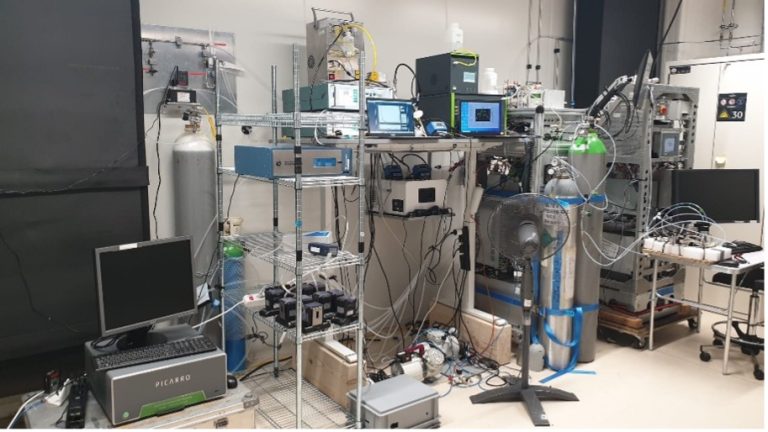
People are not only occupants of buildings; they are also active sources of particles, gases, microbes, and reactive chemicals. HOBEL studies how emissions from breath, skin, clothing, personal care products, and everyday activities modify indoor air composition and contribute to human exposure.
This research includes work on human-associated aerosols, nanocluster particle formation, personal care product emissions, ozone–human chemistry, and the role of physiological and behavioral factors in shaping indoor air chemistry. The goal is to better understand how human presence changes indoor air and how this knowledge can support healthier indoor environments.
People: Shen Yang, Tianren Wu, Han-Yun Jhang, Akila Muthalagu, Dusan Licina
Partners: Technical University of Denmark, Finnish Institute for Health and Welfare, Duke University, Max Planck Institute for Chemistry, IVL Swedish Environmental Research Institute
[Ongoing / Completed] Personal cloud and inhalation exposure assessment
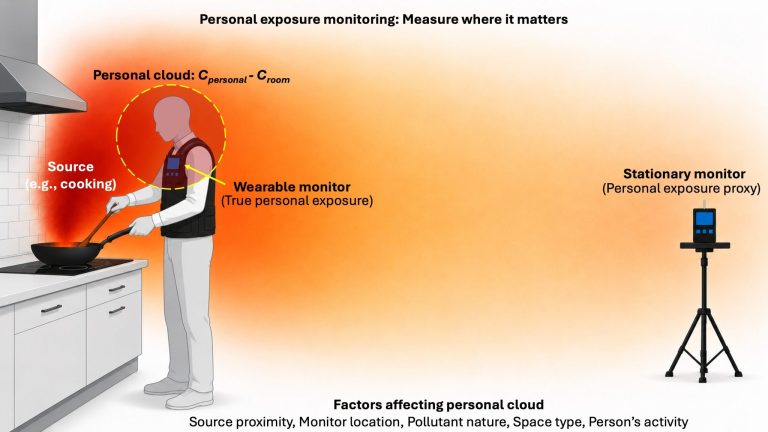
Air pollutant concentrations measured by stationary monitors do not always represent what people actually breathe. HOBEL has studied the “personal cloud” phenomenon — the excess concentration of pollutants near a person compared with room-average levels — in homes, offices, and controlled environments.
This work has examined how personal exposure varies with monitor location, space type, occupant density, behavior, source proximity, and pollutant type. It supports improved methods for estimating inhalation exposure and for designing monitoring strategies that better represent the breathing zone.
People: Khadija Sharaf Din, Seoyeon Yun, Viviana Gonzalez, Shen Yang, Dusan Licina
Partners: Yale University, Technical University of Denmark