
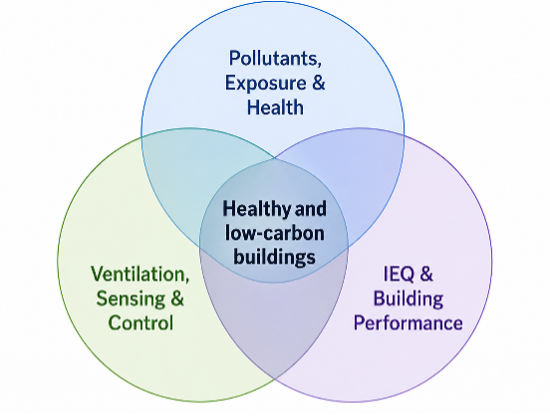
HOBEL advances the science of healthier and lower-carbon indoor environments. Our research focuses on indoor air pollutants, inhalation exposures, ventilation, sensing, and building operation to better understand indoor environmental quality and the impacts buildings can have on people.
We combine laboratory experiments, field studies, environmental monitoring, modeling, data analysis, and simulation across multiple scales: from the human breathing zone to rooms, buildings, building portfolios, and urban environments.
Our research is organized around three interconnected pillars.
1. Pollutants, Exposure & Health
We investigate how indoor pollutants are emitted, transformed, transported, and inhaled, and how these processes shape human exposure and their health relevance.
Indoor environments contain complex mixtures of particles, gases, and bioaerosols. Their concentrations and health relevance depend on sources, ventilation, indoor chemistry, occupant activities, surfaces, and building operation. HOBEL studies these processes to better understand what people breathe indoors and how exposure can be reduced.
2. Ventilation, Sensing & Control
We study how buildings can sense, ventilate, and adapt to deliver clean air efficiently, reliably, and in response to occupant needs.
Ventilation is central to healthy buildings, but its performance depends on how air is supplied, distributed, exhausted, filtered, controlled, and used by occupants. HOBEL develops and evaluates ventilation, sensing, and control strategies that respond to real indoor conditions while minimizing unnecessary energy use and unintended exposure risks.
3. Building Performance: IEQ, Health & Environment
We develop metrics, datasets, and assessment methods to evaluate indoor environmental quality, health relevance, resilience, and low-carbon performance in real buildings.
Healthy buildings require evidence. HOBEL studies how indoor environmental quality varies across buildings, climates, technologies, and occupant behaviors, and how air quality, ventilation, energy use, carbon emissions, and health-relevant outcomes can be assessed together. This pillar connects field measurements, large datasets, performance metrics, and decision-support tools to help buildings become healthier and lower-carbon in practice.