
We study how buildings can sense, ventilate, and adapt to deliver clean air efficiently, reliably, and in response to occupant needs.
Ventilation is central to healthy buildings, but its performance depends on how air is supplied, distributed, exhausted, filtered, controlled, and used by occupants. HOBEL develops and evaluates ventilation, sensing, and control strategies that respond to real indoor conditions while minimizing unnecessary energy use and unintended exposure risks.
Key questions
- How much ventilation is needed, where, and when?
- How can ventilation systems respond to occupancy, pollutant sources, outdoor air quality, pathogen risk, and energy constraints?
- How can indoor and outdoor sensing support smarter ventilation, filtration, and air-cleaning decisions?
- Sensing optimization: What to measure, where to measure, how many sensors, at what accuracy?
- How can ventilation be optimized in challenging contexts such as schools, detention facilities, retrofitted buildings, and climate-stressed environments?
- How can control strategies improve indoor air quality without creating avoidable energy or carbon penalties?
Example topics
- Smart and demand-controlled ventilation
- Sensor-informed HVAC operation
- Indoor and outdoor air quality sensing
- Ventilation effectiveness and air distribution
- Natural and hybrid ventilation
- Air filtration and outdoor-air-aware ventilation
- Infection-risk-informed ventilation
- Ventilation in schools, homes, offices, and public buildings
- Ventilation and IAQ in detention facilities
- Ventilation–energy–health trade-offs
Featured projects
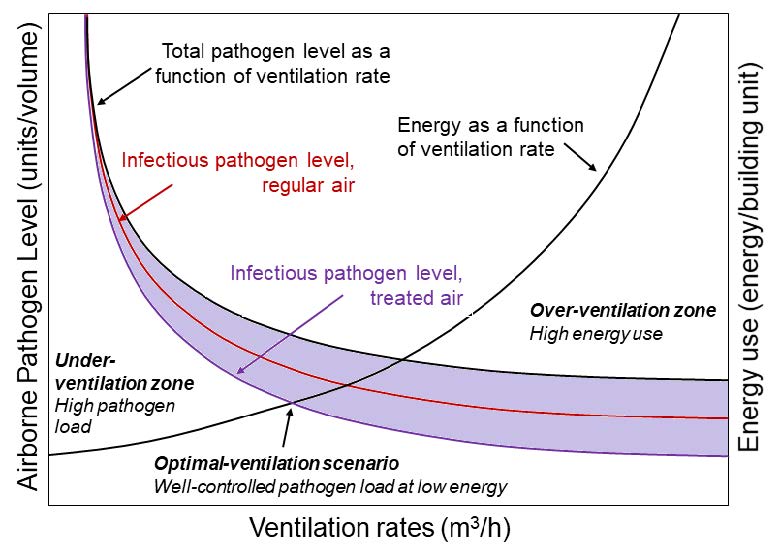
[Ongoing] ICARUS — Indoor pathogen dynamics, ventilation, and energy-efficient control
ICARUS investigates how indoor climate regulation can reduce respiratory pathogen risks while limiting energy use. The project combines experimental and modeling approaches to understand the dynamics and persistence of airborne respiratory pathogens indoors and to identify indoor climate-control strategies that are both healthy and energy efficient.
This work contributes to improved models of pathogen dynamics, exposure, and health risk, while supporting more effective ventilation and pollution-control strategies for building designers and operators.
People: Hui Dong, Taylor Medina, Tamar Kohn, Dusan Licina
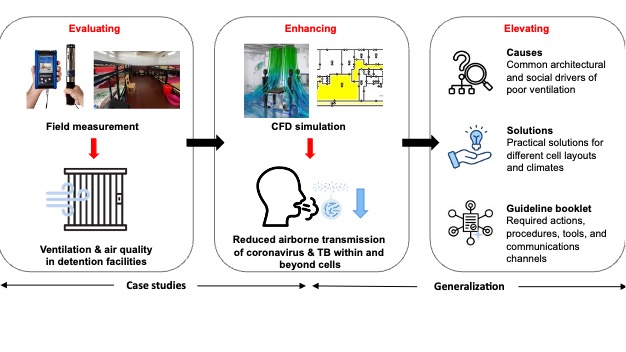
[Ongoing] Beyond Bars: Fresh Air Matters
In collaboration with humanitarian partners, this project addresses indoor air quality and ventilation in detention facilities, where overcrowding, limited access to fresh air, humidity, unpleasant odors, and airborne disease transmission can create serious environmental health concerns.
The project evaluates IAQ and ventilation conditions in selected detention facilities and develops practical, low-cost architectural and engineering interventions to improve access to fresh air and reduce airborne disease transmission. The broader goal is to support healthier and more dignified living and working conditions in detention environments across different designs and climates.
People: Alex Mendel, Bowen Du, Dusan Licina
Partners: International Committee of the Red Cross, IVL Swedish Environmental Research Institute, University of Toronto
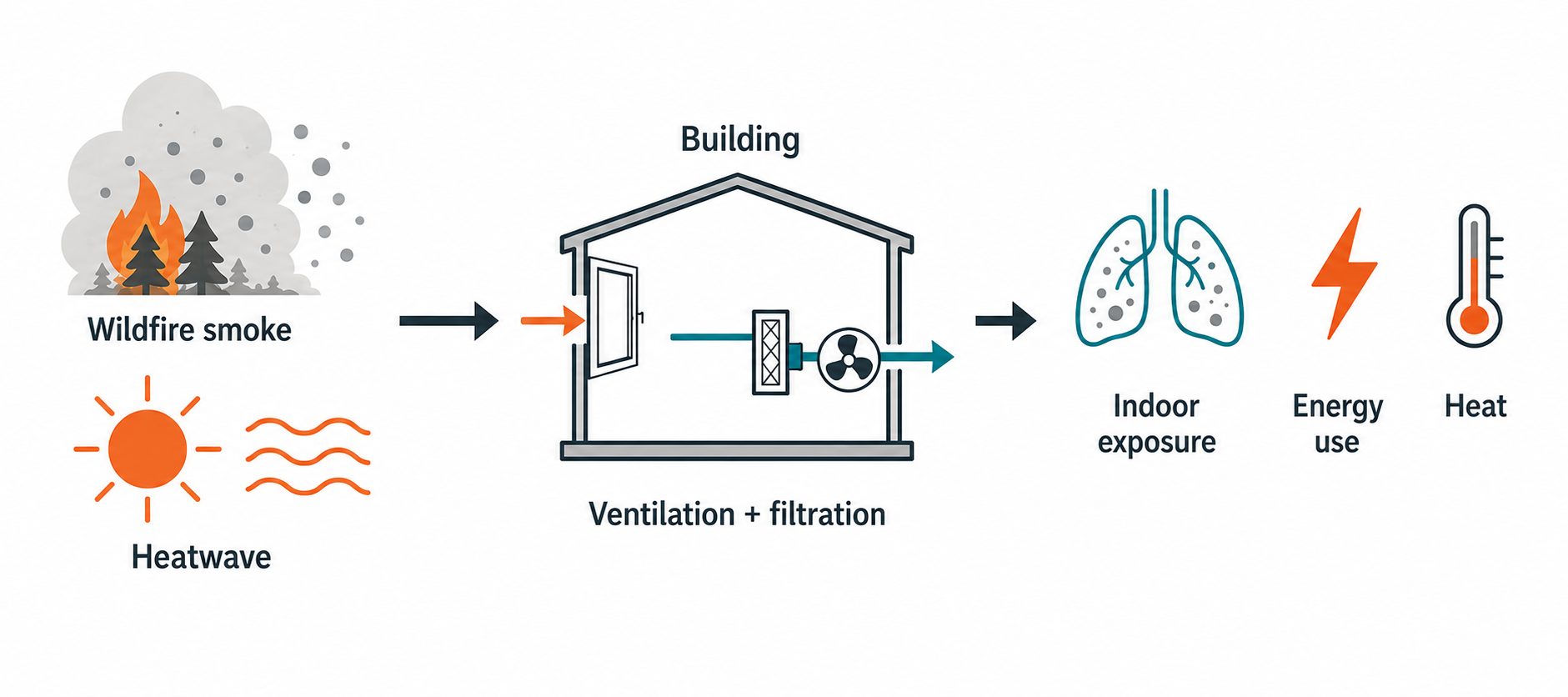
[Ongoing / Completed] Outdoor-air-aware ventilation and filtration
Outdoor air is essential for ventilation, but it can also introduce pollutants and heat into buildings. HOBEL studies how information on outdoor air pollution and extreme events such as wildfires and heatwaves can improve the design and operation of ventilation and filtration systems.
This research has explored how ventilation and filtration strategies can be adapted to local outdoor pollution patterns, meteorology, building characteristics, and energy constraints. The aim is to reduce indoor exposure to outdoor-origin pollutants while avoiding unnecessary energy penalties.
People: Enes Gusinjac, Sandra Dedesko, Evangelos Belias, Dusan Licina
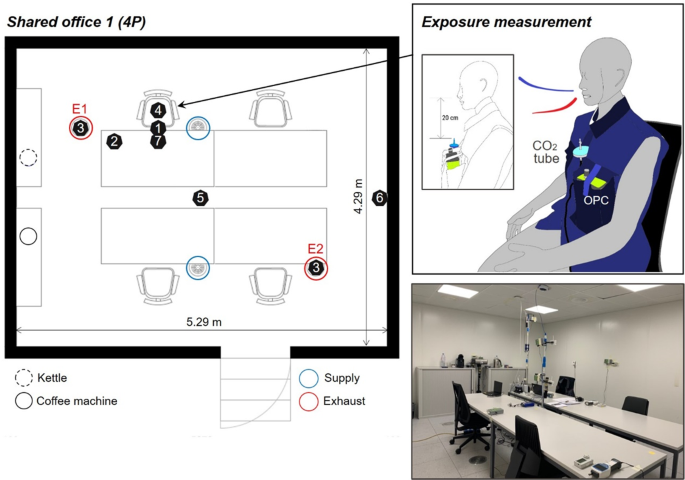
[Ongoing / Completed] Low-cost IAQ sensing and optimal sensor deployment
The rapid expansion of low-cost indoor environmental sensors creates new opportunities for continuous, human-centric monitoring and control of indoor air quality. However, the usefulness of these systems depends strongly on sensor accuracy, the parameters measured, and whether sensor placement adequately represents occupants’ actual exposure.
HOBEL has evaluated low-cost IAQ monitors and develops data-driven methods to identify sensing parameters and placements that better capture conditions experienced by occupants. By linking room-level measurements with personalized exposure and occupant responses, this work supports more meaningful IAQ assessment, ventilation control, and occupant-centered building operation.
People: Tianqi Liu, Joan Rey, Seoyeon Yun, Dusan Licina