Meeting in Motion

nameinfame © iStock
To support the physical and mental well-being of its community, EPFL invites staff and students to practice walking meetings whenever possible. This format is especially effective for brainstorming or deep conversations in small groups of two or three.
Several studies have shown that prolonged inactivity harms metabolic health. Introducing more movement into work and study routines is therefore essential. Moreover, walking and physical activity in general have been proven to stimulate memory, creativity, and cognitive functions. Taking the opportunity of bilateral or trilateral meetings to walk outdoors is also an excellent way to strengthen interpersonal relationships and approach topics from a different perspective.
The EPFL campus is particularly well suited to this practice thanks to its privileged access to natural areas. In collaboration with the Well-being and Inclusion domain (VPH-WINC), the Mobility and Outdoor Spaces team (VPO-DC-MOBEX) prepared three walking routes lasting 45 to 60 minutes.
Objectives
- Protect health
- Promote well-being
- Explore new ways of collaborating
Benefits
- Improves concentration and creativity
- Enhances listening quality
- Reduces stress
- Encourages more authentic exchanges and better mutual understanding
- Being outdoors helps to see certain issues from a different perspective
Recommendations
- Prepare the agenda in advance
- Note key points on a post-it if needed
- Avoid digressing into unrelated topics
- Favor this type of meeting for brainstorming and decision-making
- Know the route beforehand
- Bring suitable equipment depending on the weather (good shoes, two umbrellas)
- Switch your phone to airplane mode
- Welcome moments of silence, take time to reflect
- Record voice notes if necessary
- Provide a written follow-up after the walk if needed
- Communicate openly about this practice within your team
Suggested walking paths

- Lakeside Escape to the south, following the lake at Saint-Sulpice
- Countryside Escape to the northeast, skirting the sports fields and passing by the Vortex
- Belvedere Escape to the west, climbing up the hill in Ecublens
Nice to add
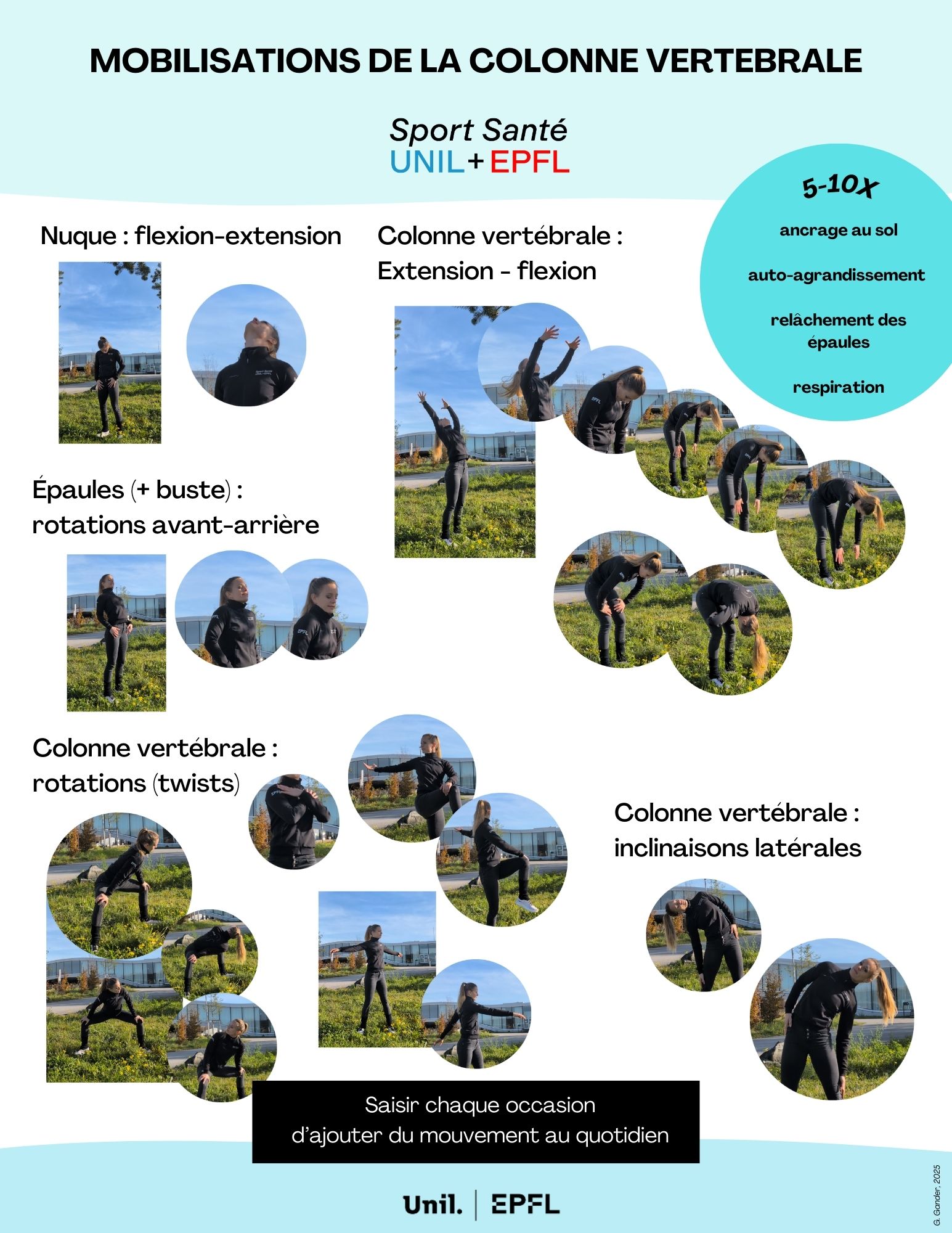
Collective exercises can help establish a shared rhythm, strengthening cohesion and collaboration. Participants may thus feel more confident in sharing their ideas.
Thanks to Gaëlle Gander from the UNIL+EPFL Sport Health Service for these suggestions and the illustration below.
-
Gentle mobilization of the spine helps awaken the body’s axis, stimulate circulation, free the breath, and release possible tensions, while bringing awareness to movement before starting to walk—especially after long periods of sitting. A relaxed body fosters fluid and constructive discussions. For this exercise, it is essential to mobilize the body along its three axes (see image below).
-
Breathing focus (ventilatory): through the technique of cardiac coherence (inhale for 5 seconds, exhale for 5 seconds → a breathing frequency of 6 per minute). This rhythm induces balance between the sympathetic and parasympathetic systems, helps reduce stress levels, and improves concentration. It also allows for a kind of mini-meditation, since one follows a rhythm, a sound, or an image, thus remaining in the present moment. Just a few minutes can already bring benefits.
-
Physiological sigh: maximum inhalation, very brief hold, an additional inhalation, then a relaxed exhalation. Deep breathing improves brain oxygenation, helping to maintain concentration.