
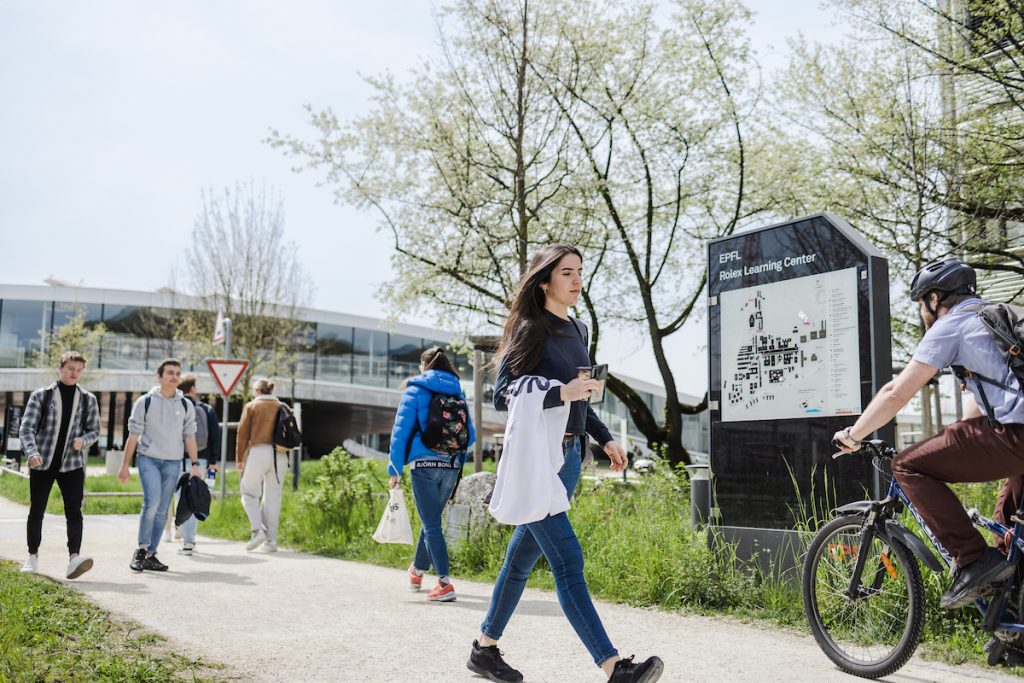
Since 2003, a biennial mobility survey has been conducted by the EPFL Mobility team within the EPFL community in order to understand changes in mobility practices, assess the need for new infrastructure, evaluate satisfaction with the mobility services offered, and estimate the environmental impact of commuting.
Key results 2025
In 2025, approximately 28% of respondents (27% in 2023) completed the survey, representing some 5,100 people. The study reveals that 78% of commuters in the EPFL community use sustainable modes of transport, i.e. public transport and/or active mobility: 93% of students and 63% of staff.
- Attendance: The proportion of staff members present five days or more per week stands at 50%, representing an increase of 4% compared to the 2023 edition. This proportion remains significantly lower than in 2019, when it reached 78%, which can be explained by the development of flexible working arrangements. In contrast, this proportion has remained stable among students. Furthermore, in 2025, only 10% of students visit the campus three times a week or less, compared to 28% of staff.
- Peak hours: In the morning, 38% of students arrive on campus between 7:45 and 8:15 a.m. Although this proportion is down from 2023 (46% in 2023), the number of people arriving during this time slot remains the same due to the increase in the number of students. However, this year there has been a sharp increase in student arrivals between 8:45 a.m. and 10:00 a.m. Staff arrivals are more spread out than those of students, with the 7:45 a.m. to 8:15 a.m. time slot accounting for 22% of arrivals. Departures are more spread out: for students, there are three peaks at 5:00 p.m., 6:00 p.m. and 7:00 p.m. For staff, there are four major peaks, occurring every half hour between 5:00 p.m. and 6:30 p.m.
- Origin-Destination: As in previous surveys, the vast majority of respondents (99% of students, 90% of staff) indicate the main EPFL campus in Ecublens as their main destination. The remaining destinations are spread between EPFL Valais/Wallis (2%), Microcity in Neuchâtel (1%), the Biotech campus in Geneva (1%) and other associated campuses, such as BlueFACTORY in Fribourg and the Geneva Observatory (all less than 1%). The most frequent departure points are located near the main EPFL campus. For example, 58% of respondents live in Lausanne or one of the four surrounding municipalities.
- Busiest stations: The vast majority of participants who take the train to the main campus pass through Renens station (87%), which is an increase compared to 2023 (+9%). The second most frequented station is now the LEB station at Flon (6%), followed by Lausanne station (4%).
- Distance and travel times: The average and median distances travelled per journey are 17 km and 5.8 km for journeys made. The average distance has increased compared to 2023 (15.1 km). In terms of journey time, the average and median are 31 and 22 minutes, which is very similar to the figures for 2023.
Overall, public transport remains the most widely used mode of transport, and its modal share has increased by 5% since 2023. Active modes of transport such as cycling and walking have declined over the same period, from 22% to 18% and from 11% to 9% respectively. Car use has increased slightly since 2023, from 3% to 5% among students and from 34% to 37% among staff. The rate of motorised two-wheeled vehicle users remains unchanged (2%). As a result, the proportion of students and staff opting for sustainable modes of transport has fallen slightly compared to the previous survey, from 95% to 93% for the former and from 63% to 61% for the latter.
As in previous editions, the 2025 results show that, unlike staff, students make very little use of private motorised transport (7%). This proportion is up compared to 2023 and 2021. While the proportion of cyclists and pedestrians peaked among students in 2021 (30% and 22% respectively), it has been falling since 2023, reaching 20% for cyclists and 14% for pedestrians in 2025, which is below the pre-Covid-19 pandemic levels measured in the 2019 survey (22% and 15%). As for public transport, its use in 2025 has increased further compared to 2023 (59% versus 54%).
While 93% of the student community uses sustainable means of transport, this proportion rises to only 61% for EPFL staff. Staff are more likely to use private motor vehicles (34% for cars and 3% for motorised two-wheelers). This share has increased slightly since 2019 (32%), rising from 37% to 39% between 2023 and 2025. The proportion of staff using public transport as their mode of transport has been increasing since 2021, rising from 33% to 37% in 2023 and reaching 41% in 2025, exceeding the pre-Covid-19 pandemic levels measured in the 2019 survey (40%). Despite this growth in public transport, the share of active mobility is down compared to 2023 (21% versus 26%).
The proportion of people who regularly use several modes of transport has remained stable compared to 2023, representing nearly a quarter of respondents (23%). In general, among those who reported using multiple modes of transport during the winter and summer seasons, intermodality is more common (52% in winter, 56% in summer) than multimodality (48% in winter, 44% in summer). However, when looking at differences according to status, students are more likely to combine several modes of transport on the same journey (58% intermodality in winter, 64% in summer), while staff tend to alternate modes of transport for their commutes (54% multimodality in winter, 52% in summer). The most popular intermodality is walking combined with public transport, except in summer for staff, when it is cycling combined with public transport. The most common multimodality is alternating between cycling and public transport, regardless of the season or status.
2003-2025 trend
The mobility survey has been conducted at EPFL for over 20 years, providing insight into mobility habits which have evolved significantly over the last few decades.
Note: 2017 has been excluded from some figures due to the different nature of the questions.


Between 2003 and 2025, the use of active mobility (cycling and walking) as a primary mode of transport has increased significantly (from 17% to 27%), with a modal share in 2003 of 4% for walking and 13% for cycling, compared to 9% and 18% in 2025. This overall increase in active modes of transport over the last two decades has been encouraged by the promotion of cycling at EPFL, with, for example, more than 1,100 new bicycle racks installed between 2017 and 2025. In addition, the revision of the parking policy in 2017 and the construction of student residences near the campus have also encouraged the transition to sustainable modes of transport. However, the boom in these modes of transport during the Covid-19 pandemic seems to be running out of steam, as they have returned to levels close to thos ly observed in 2019. This decline could be explained by a combined effect of the high occupancy rate of student residences near the campus and the increase in the number of students at EPFL, which is prompting them to seek accommodation outside the campus perimeter.
The modal share of public transport as a means of travelling to campus increased between 2003 and 2013 (when its highest proportion of use was 58%) and has gradually declined since then, reaching 46% in 2023. This decline is more pronounced among students (falling from 63% to 57% between 2017 and 2019) than among staff. This decrease can be linked to the saturation of public transport and the new appeal of active mobility. However, public transport use is on the rise again in 2025 (51%), returning to the level observed in 2019 after a sharp drop in ridership during the Covid-19 pandemic.
The use of private motorised transport has fallen sharply at EPFL over the last two decades, from 38% to 22%. This change in habits is particularly marked among staff, who reduced their car journeys between 2003 and 2025, with the proportion falling from 51% to 37%. Among students, this proportion also fell significantly from 17% to 5% during this period. However, the modal share of the car is up compared to 2023, among both students and staff (an increase of 2% and 3% respectively). The modal share of motorized two-wheelers, meanwhile, has remained stable since 2011 (2%).
It is also important to note that the proportion of the population using multiple modes of transport (multimodality or intermodality) has increased significantly (up 19 points in 22 years, from 4% to 23%) and is now the second most common mode of transport after public transport as the sole mode of transport (37%).
Mobility services on campus
The mobility survey has conducted a satisfaction survey among the mobility services offered at EPFL.
Among the mobility services offered by EPFL, the Point Vélo remains the most widely used service in 2025, with 27% of respondents using it, a stable proportion and slightly up on 2023. It remains the most used service by both students and staff, ahead of PubliBike (17%) and the Lausanne public transport ticket office (13%). Overall satisfaction with the Point Vélo is high in terms of the welcome and organisation of the site (8.0), as well as the advice and expertise of the staff (7.8). On the other hand, opening hours (4.9) and waiting times (6.3) are once again the main points of dissatisfaction, as they are considered incompatible with class and work schedules, which leads to peaks in traffic.
Other mobility services associated with cycling, namely PubliBike and EPFL cargo bikes, are more popular among students than staff (22% versus 12% and 6% versus 2%), who are more likely to use car-related services: Mobility car sharing (11%) , and GO FAST or Eaton (formerly GreenMotion) charging stations. Another mobility service is the Lausanne transport (tl) sales point: 13% of respondents said they had used it, mainly to purchase regional and national travel passes (94%), making it the third most popular mobility service.
- When it comes to bicycle and motorbike parking, the aspect that respondents are most satisfied with is the proximity of parking spaces to their destination, the accessibility of spaces and their quality (lighting, size, etc.). Protection against theft, protection against the weather and the number of spaces available are the areas where the highest number of respondents expressed dissatisfaction.
- Users concerned with electric vehicle charging stations are satisfied with the types of sockets available, the charging speed and their location. However, the level of satisfaction is lower for their availability and reliability, as well as for the pricing applied.
Carpooling is still struggling to catch on, as the majority (75%) of people who drive to EPFL do so alone in their vehicle. This trend is more pronounced among staff (79%) than among students (51%). Among staff who indicated that they travel to campus by car as a driver with passengers or as a passenger, almost all share the journey with family (71% for staff and 58% for students) or through informal carpooling arrangements (27% for staff and 41% for students). Carpooling via platforms accounts for 2% of journeys for staff and 1% for students.
*Surveys conducted in association with the Swiss Centre of Expertise in the Social Sciences (FORS).
- Summary Analysis – Mobility Survey 2025.pdf (PDF, 2 MB, English)
- Summary Analysis – Mobility Survey 2023.pdf (PDF, 899 KB, in French only)
- Summary Analysis – Mobility Survey 2021.pdf (PDF, 429 KB, in French only)
- Summary Analysis – Mobility Survey 2019.pdf (PDF, 448 KB, in French only)
- Summary Analysis – Mobility Survey 2017.pdf (PDF, 4 MB, in French only)
Results 2003-2025
The Swiss Centre of Expertise in the Social Sciences (FORS) has compiled a database containing all the results of mobility surveys conducted at EPFL between 2003 and 2025.
This database can be made available to the EPFL community exclusively for analysis projects with clearly defined objectives, and only upon the signing of a data usage agreement between EPFL and the relevant users.
Contact
Informations et citations: [email protected]