
INSTRUCTIONS FOR MASTER AND SEMESTER PROJECTS
Please find below the links towards the instructions for the master or semester projects.
Note : the registration to the Instant-Lab secretary has to be done 3 weeks prior to the semester beginning
and the model sheet for the project resume
All the student projects of the section SGM are available in this link
Instant-Lab available projects:
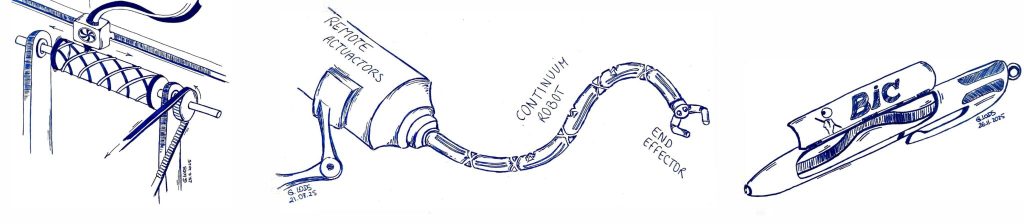
The projects listed below are proposed by the postdoctoral researcher Guillaume Lods for the next semester (September 2026 to January 2027). Some of these projects can be carried out as a semester project or a master’s thesis. The project will take place at the EPFL Associated campus of Neuchâtel.
If interested, please contact Guillaume by email ([email protected]), including the desired project, your resume, and transcripts.
Please feel free to contact him even if the presented projects are no longer available or if you would like to propose your own research subject.
BICStable – Mechanical modeling (already taken)
- Description : Development of an analytic-numeric modeling of a novel flexure-based bi-stable mechanism
- Required skills : Differential mathematics, Numerical optimization, Image processing
- Application fields : Mechanical computing, Watchmaking
CRFlex – Actuation unit mechatronic design (already taken)
- Description : Development of a mechatronic actuation unit for a continuum robot
- Required skills : Mechanical design, Electronic design, Programming, Prototyping
- Application fields : Minimally invasive surgery robotics
FlexCyl – Flexure-based mechanism design (already taken)
- Description : Development of out-of-plane flexure-based mechanisms
- Required skills : Mathematics, Mechanical design, CAD, FEM, Prototyping
- Application fields : Aerospace
Rotoprinter 1 – Interface material for 3D printing
- Description : Experimental comparison of interface materials for 3D printing
- Required skills : Material sciences, Experimental protocol, Prototyping
- Application fields : Additive manufacturing
Rotoprinter 2 – Mechanical Design (already taken)
- Description : Development of a variable-radius cylindrical mechanism
- Required skills : Mechanical design, CAD, Prototyping
- Application fields : Additive manufacturing
Mechanical analog computation with flexures mechanisms

Recent technological developments in micro-manufacturing reopen the possibility of fully mechanical and miniaturized computational devices. This project aim at developing new modules that might one day be an alternative for electronics and transistor based computing, for applications in extreme environments like space or remote locations on earth. Although mostly centered on analog, new digital families can also be developed with this technology.
Project contains:
Mechanical design, modeling, simulations, and prototyping
Location: EPFL Associated campus of Neuchâtel
Section: SGM or other interested
Contact email: [email protected] to obtain a detailed list of available projects (confidential)
Design of a new musical instrument: acoustic simulation and modeling of sound generation through stick and slip, followed by prototyping

Nowadays, the development of new musical instruments happens mostly in the digital space. However, some physical principles still hold great potential to open a new world of mechanical sound, and remain largely unexplored. This project focuses on the simulation of a new type of musical instrument. Depending on the student’s profile, a design and prototyping part can also be made to test the theoretical predictions of the sound gerneration.
Project contains:
Modeling, simulations, mechanical design, and prototyping
Location: EPFL Associated campus of Neuchâtel
Section: SGM or other interested
Contact email: [email protected]
Surgical knot tension measurement device

A previous study [1], led by the EPFL fleXLab, in collaboration with plastic surgeon Samia Guerid, examined the mechanical strength of surgical knots and how multiple factors such as pretension, friction, and the number of throws influence their performance. The plastic deformation of the surgical filaments tied by the surgeons ensure its knot strength and shape. The results showed that the tension applied during knot tying procedure (pretension) permanently deforms the filament, creating a holding force. Insufficient pretension can cause the knot to untie, while excessive tension may break the filament.
By analyzing numerous knots tied by the surgeon, the results showed that the surgeons are capable of tying systematically safe knots by consistently setting a pretension in the functional range. However, mastering this safe range typically requires years of experience for surgeons. Besides, actual evaluation methods to assess the security of knots are based on visual observation and manual haptic feedback. Taking advantage of the acquired understanding of knot strength, the goal of this project is to design a device that can be integrated into training and evaluation programs for surgeons.
[1] (https://www.science.org/doi/10.1126/sciadv.adg8861)
The project consists of:
- Literature + Mechanical Design Review: Conduct a comprehensive review of existing research on the strength and mechanics of surgical knots. Evaluate and discuss existing designs of force measurement tools.
- Tool Design and Prototyping: Improve (or invent) and prototype a mechanical system capable of measuring the force exerted during knot tying. The tool that can be handheld by the surgeon (similar to a dynamometer key) or attached to a table.
- (Force Limitation System): Develop a tunable system that can limit force (or torque) to help regulate knot tension.
- (Ergonomic Design): Incorporate ergonomic principles into the tool design, ensuring user comfort and simplicity of use.
- (Validate Prototype Performance): Test the prototype with different types of filaments and knots to measure its accuracy and reliability in capturing pretension forces.
Required background:
- Interest in mechanical design, robotics, and their applications in medicine.
- Interest in flexure mechanisms (commonly used in the design of micro-tools and comonly used in the laboratory).
- Interest in prototyping using laser cutters, 3D printers or any other means.
- CAD drawing, interest in FEM simulations
Expected deliverables:
- Final report
- Two oral presentations (mid and end of semester)
- Mechanism design, 3D files
- Manufactured prototype
This project can be carried out either as part of a semester project or as part of a master’s thesis. The tasks and deliverables will be adjusted according to the project’s duration.
Location: EPFL Associated campus of Neuchâtel
Sections: SGM or other interested
Contact email: [email protected]; [email protected]
Biomimetic Mechanical Sound Generation 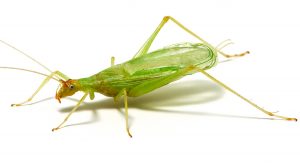
The goal of this project is to design a new type of biomimetic sound producing mechanism inspired by the stridulation of crickets. The well known sound chirping of crickets is very pure in tone, loud, consumes very little energy and is low volume. Several applications like mechanical watch alarms or musical instruments can be imagined.
Project consists of:
Two subjects depending on student background:
- Mechanical design and manufacturing of a prototype (Sections: MT, ME)
- Physical modelling of the stridulation principle in crickets (Sections: MT, ME, MA, PH)
Location: EPFL Associated campus of Neuchâtel
Contact email: [email protected]
Flexure based surgical tool
Growing life expectancy goes together with improvement of healthcare. New threatment methods are becoming less invasive, allowing for shorter recovery time. Following this trend we would like to propose a new micro-surgical tool.
Project will focus on development of flexible structure for flexture based surgical tool. It will allow for 2DoF of rotations. End effector integrated in such flexure will be a gripper, or other depending on medical application.
Whole structure should be open for either manual or robotic actuation.
Required background :
- Mechanical design
Location : EPFL Associated campus of Neuchâtel
Sections : SGM or other interested
Contact email : [email protected]
Flexure-based pick-and-place robot (Already taken)
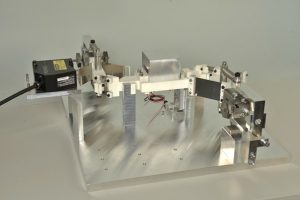
The goal of this project, in collaboration with Mikron, is to actuate and control a new type of 2-DoF flexure-based pick-and-place robot close to its eigenfrequency. The flexure-based implementation, in addition to the voice coil actuation, allows for energy-efficient trajectory planning strategies.
The project consists of:
- Familiarizing yourself with the TI LAUNCHXL-F28379D Development kit.
- Control the 2-DoF pick-and-place robot close to its eigenfrequency.
- Realizing a pick-and-place operation with an electromagnet attached to the end-effector.
Required background:
- Control
- Mechanical design
Location: EPFL Associated campus of Neuchâtel
Sections: SGM or other interested
Contact email: [email protected]