
Fast Particles
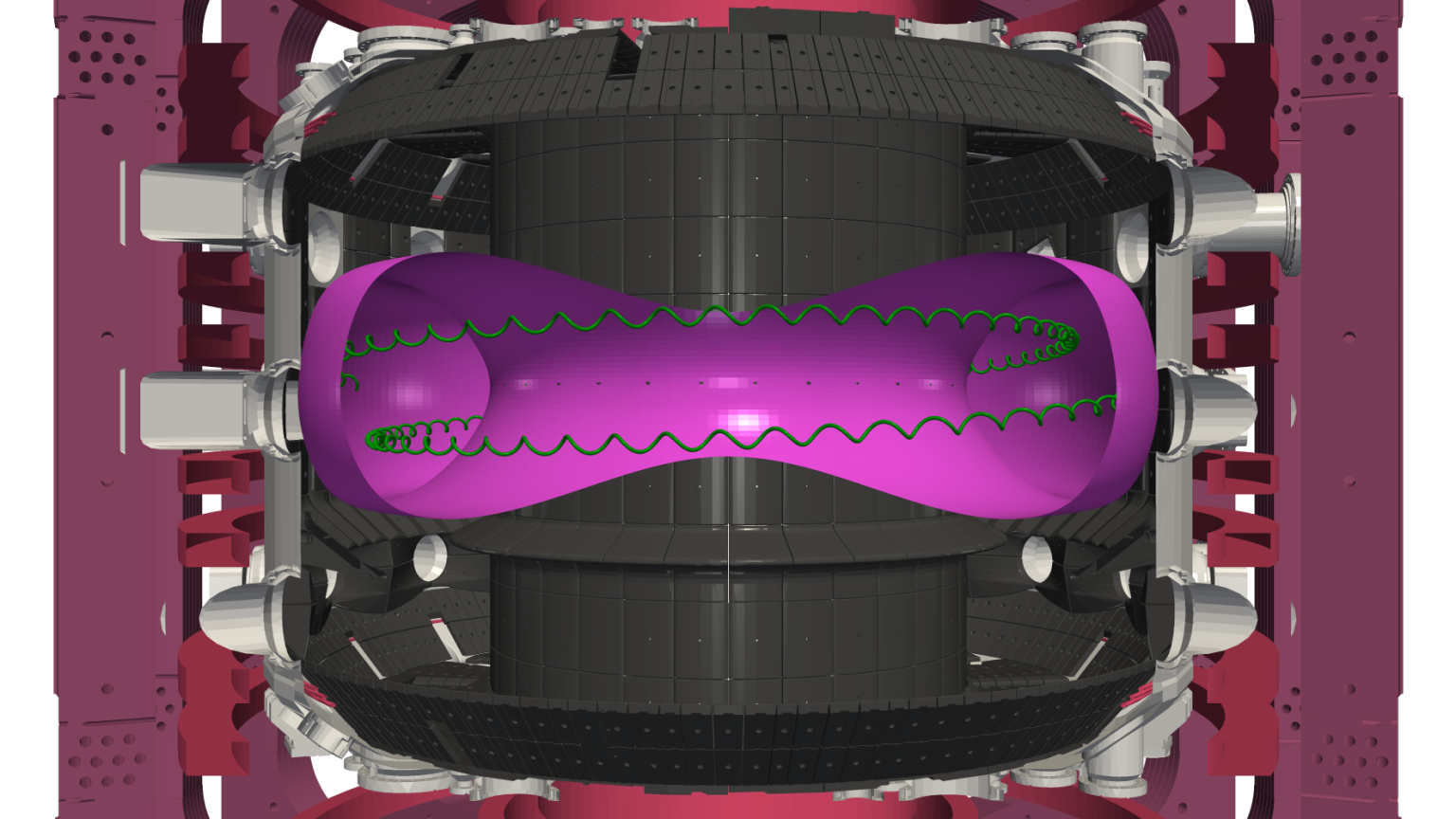
Computer generated image of TCV showing the TCV structure, the carbon first wall in black, a surface representing the magnetic field in purple and a fast ion trajectory in green
Fast particles in fusion plasmas are energetic ions or electrons with energies significantly higher than the bulk plasma. A key example are the fusion-born alpha particles, which carry 100 times more energy than the bulk plasma.
These energetic particles pose a challenge for fusion devices, as they can impact a relatively small area of the first wall, causing severe damage to plasma-facing components. Consequently, understanding their confinement properties is crucial. Unlike the bulk plasma, which is often treated as a fluid, fast particles have a lower probability of colliding and exchanging a significant amount of momentum due to their high velocities, meaning their behavior is better described by single-particle dynamics.
Under certain conditions, fast particles can also drive plasma instabilities. By interacting resonantly with various electromagnetic plasma fluid (Magneto HydroDynamic, MHD) modes, they can destabilize the plasma, leading to the redistribution or loss of fast ions.
Research on fast particles in fusion devices, including TCV, remains an active area of research. Key areas of study include improving the understanding of fast-ion confinement and developing control strategies for instabilities that could pose risks to future fusion reactors.

Fast ions in fusion plasmas originate from two primary sources: fusion reactions and auxiliary heating systems, such as neutral beam injection (NBI).
The deuterium-tritium (D-T) fusion reaction generates 3.5 MeV alpha particles (4He2+) travelling at 4% the speed of light and 14.1 MeV neutrons. Unlike fast ions from auxiliary heating, fusion-born alphas travel in a random direction and are predominantly produced in the plasma core, where temperatures are highest. In a burning plasma, these energetic alphas will serve as the primary plasma heating mechanism, transferring energy to the background plasma via Coulomb collisions.
NBI generates fast ions by injecting high-energy neutral particles into the plasma. These neutrals are subsequently ionized via charge exchange and collisions, producing fast ions whose energy and velocity distribution are determined by the beam acceleration voltage and injection geometry. On TCV, fast ions are generated using two NBI systems, each delivering 1.3 MW of power with injection energies of 28 keV and 53 keV, respectively. These systems serve a dual purpose: heating the plasma and creating large fast-ion populations that act as proxies for fusion-born alpha particles expected in future reactors.
Experimental studies on TCV focus on characterizing fast-ion confinement, assessing their transport properties, and identifying potential loss mechanisms. These experiments also play a crucial role in validating numerical models, helping to refine predictions for fast-ion behavior in next-generation fusion devices.

Fast electrons in tokamak plasmas play a significant role in heating, stability, and potential damage to plasma-facing components.
The main production mechanisms are:
- Heating and current drive – Heating techniques such as Electron cyclotron resonance heating (ECRH) or current drive (ECCD) accelerate electrons to significantly higher energies. The result is often a high energy component in the electron velocity distribution, where these new supra-thermal electrons can have energies many times higher than the bulk population.
- Electric Fields – Strong toroidal electric fields, especially during plasma startup, can directly accelerate electrons to high energies.
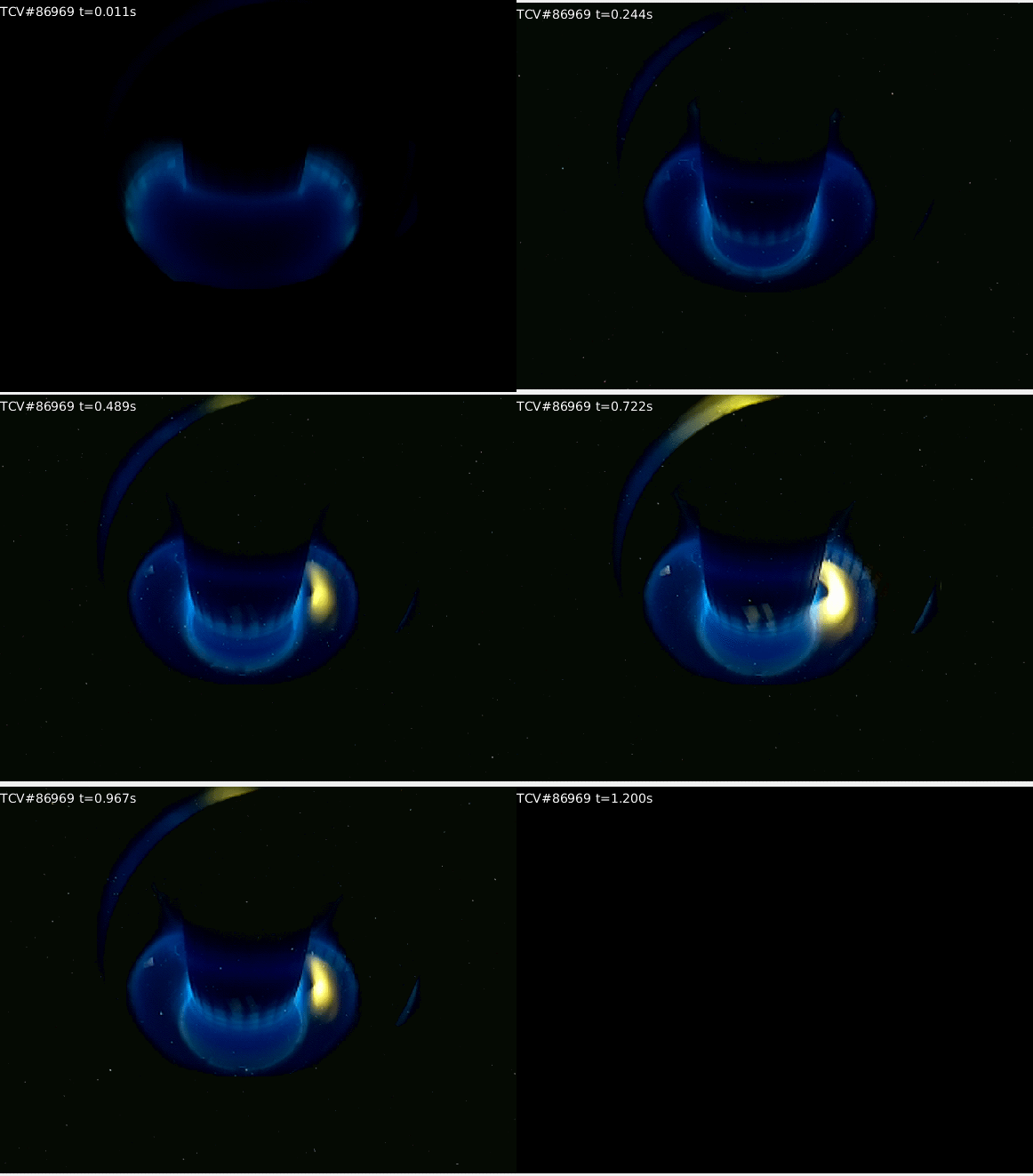
Fast electrons contribute significantly to plasma heating by transferring their energy through collisions with bulk electrons and ions. This is particularly relevant in scenarios with resonant lower hybrid waves or electron cyclotron waves, which enhance energy absorption and improve the current drive efficiency. The interaction between fast electrons and background plasma plays a crucial role in non-inductive current drive methods, which are essential for steady-state tokamak operation. See the Plasma Heating section for more details.
While fast electrons can be beneficial for heating and current drive, they are also connected to certain plasma instabilities:
- Electron Fishbone Instabilities – Driven by energetic electrons, these oscillations can redistribute fast electron populations and impact current drive efficiency.
- Whistler and Alfvén Waves – Fast electrons can excite electromagnetic waves, leading to enhanced transport and potential energy loss.
Understanding and controlling fast electron dynamics is crucial for optimising tokamak performance, enhancing heating efficiency, and mitigating the risks associated with disruptions and instabilities. Devoted experiments and modelling form a recurring topic of research at SPC, with many dedicated diagnostics installed to characterise these particles.