
Plasma Control

Graphical representation of control of magnetic field surfaces inside the TCV tokamak. From https://deepmind.google/discover/blog/accelerating-fusion-science-through-learned-plasma-control/
At the heart of TCV operation lies its sophisticated control system, designed to establish, maintain, and control the plasma. This system uses different actuators, such as poloidal field coils, gas fuelling valves, microwaves, and neutral beams to control the plasma shape, position, density, and temperature. It integrates data from various diagnostic tools to provide real-time feedback, allowing the team to optimise plasma conditions and access scientifically relevant plasma configurations and operational regimes. Safety features and protection systems are also integrated to safeguard operations and enable safe shutdown procedures in view of future reactor operations. The capabilities of TCV’s control system are further enhanced by the integration of advanced AI algorithms, which have been developed and tested on the tokamak in collaboration with some of the most prominent players in the field.

TCV has a large set of Poloidal Field coils, offering unique flexibility in exploring exotic and unconventional plasma shapes. As part of this, one of our key research goals is to develop and test innovative algorithms for plasma magnetic control. These algorithms aim to determine the optimal currents in the TCV coils, based on real-time measurements, to bring the plasma as close as possible to the desired configuration. Plasma shape control at TCV relies on a state-of-the-art suite of tools, including the Matlab EQuilibrium toolbox (MEQ), which integrates scenario optimization, discharge simulation, and real-time equilibrium reconstruction. These advanced tools enable our researchers to deliver cutting-edge solutions, whether using traditional control methods or deploying AI agents.
During a plasma discharge in a tokamak, the plasma temperature and density profiles of the main ions and electron populations evolve over a timescale of a few ms as microwaves and neutral particles are injected into the plasma to provide external heating and fuelling. These physical quantities, referred to as kinetic profiles, affect many important aspects of the plasma, such as its stability, confinement properties, efficiency in the fusion reactions, the accumulation of impurities, and the heat flux that has to be dissipated.
Different diagnostics are available on TCV to measure the kinetic profiles in real time, such as infrared lasers (FIR), the Thomson Scattering diagnostic, and soft X-ray detectors. A set of real-time capable codes has been programmed, tested, and deployed in the TCV plasma control system to incorporate all the real-time measurements and reconstruct the plasma kinetic state. RAPTOR, the RApid Plasma Transport simulatOR, and its density-specialised counterpart RAPDENS, RApid Plasma DENsity Simulator, are control-oriented models that leverage the available measurements and the input of magnetic equilibrium codes to reconstruct plasma kinetic profiles for:
- Pre-shot discharge optimisation
- Real-time reconstruction of kinetic profiles with state observers
- Post-shot interpretative reconstruction of the plasma discharge, incorporating offline measurements and data
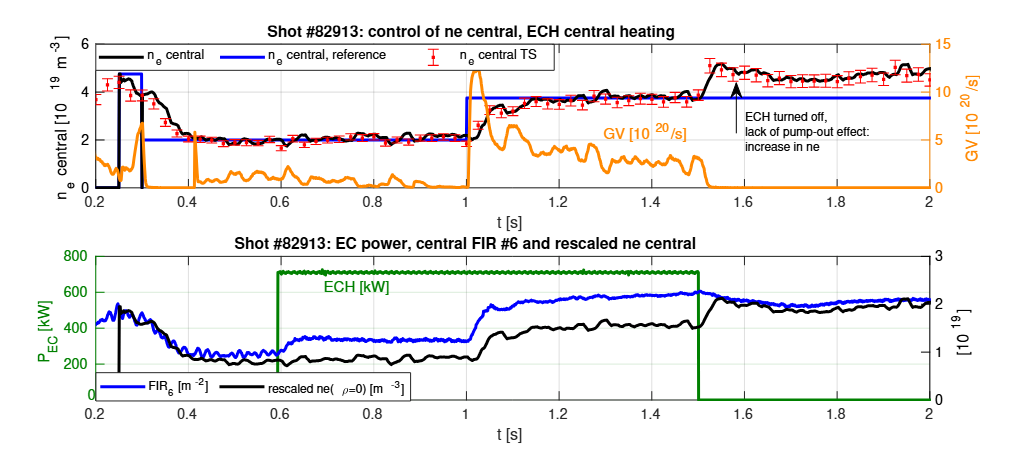
On the bottom figure, the applied ECRH power is reported, in green, as well as the Far-infrared Interferometer (FIR) signal, in blue, and the rescaled value of ne central over the value of FIR at t=0.25s, in black. The changing ratio of the FIR signal as ECRH is turned on indicates a change in shape of the density profile driven by the external injected power, in this case resulting in a flattening of the ne profile.
Regarding real-time applications, simultaneous control of the safety factor-profile and plasma kinetic pressure with multiple electron cyclotron current drive launchers has been achieved using a Model Predictive Control approach built upon the RAPTOR model. The generation of internal electron transport barriers and fully non-inductive operation demonstrated on TCV, has paved the way for studies on long pulses, advanced scenarios and steady-state operations of other tokamak reactors.
Recently developed density control schemes based on estimations of the electron density profiles with RAPDENS support detachment studies by keeping the upstream density controlled as plasma edge conditions vary. Additionally, local control of the density profile, where the density at a given location is controlled using gas valve fuelling in the presence of external heating actuators, in low- and high-confinement plasmas has been recently demonstrated.
The employment of such control techniques can be used to operate more accurately at specific operating points, to localise and suppress MagnetoHydroDynamic (MHD) modes that degrade the plasma confinement, optimise the plasma scenario for high-performance operation, and sustain the discharge within safe, stable limits.