
Disruptions + Runaway Electrons
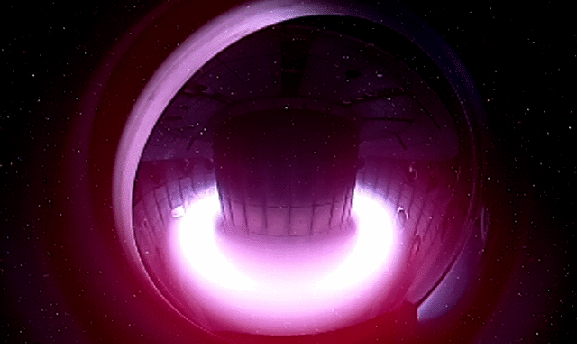
Fish eye camera view of an experiment on Runaway Electrons in TCV Discharge #84695
Disruptions and runaway electrons are among the most critical challenges in tokamak research. If unmitigated, these events can cause severe damage to plasma-facing components, leading to costly repairs, extended shutdowns, or even premature retirement of a fusion device. For ITER—the world’s largest fusion experiment—avoiding and mitigating disruptions is a top priority, as its high-energy plasmas could generate forces and heat loads capable of damaging its inner walls.
Through experiments on tokamaks like TCV, researchers are developing comprehensive strategies to predict, avoid, and mitigate these events. Our approach combines cutting-edge experimental work with advanced computational modeling with codes including JOREK, DREAM and LUKE to unravel the fundamental physics and develop predictive capabilities. This tight integration of experiments and simulation allows us to observe and fundamentally understand the relevant physics, thus accelerating the development of reliable solutions that will ensure future reactors like ITER and DEMO can operate safely and reliably.
A disruption occurs when the plasma suddenly loses stability, leading to a rapid collapse of its energy and current. This process unfolds in four key phases:

- Pre-Thermal Quench (Pre-TQ) – The plasma begins to destabilise due to instabilities, excessive impurities, or reaching its operational limits. In this phase, real-time diagnostics and control systems work to predict the disruption and adjust actuators (like heating or magnetic fields) to stabilise the plasma and avoid a full collapse.
- Thermal Quench (TQ) – If stabilisation fails, the plasma loses its thermal energy in less than a millisecond, releasing intense heat onto the reactor walls. While some energy radiates away, most impacts the plasma-facing components, risking melting or erosion.
- Current Quench (CQ) – The plasma current decays over several milliseconds (1–10 ms in TCV, 50–100 ms in ITER), inducing powerful electromagnetic forces. These forces generate eddy currents and halo currents in the vessel, which exert mechanical stresses on the tokamak structure.
- Runaway Electron Beam – During the current quench, strong electric fields can accelerate electrons to near light-speed, forming a destructive, high-energy electron beam. If unchecked, these electrons can strike the vessel walls, causing localized damage.
To prevent disruptions, researchers focus on two key approaches:
- Disruption Prediction: Real time diagnostics analyse plasma behavior to identify early warning signs (like growing instabilities) to trigger countermeasures before a disruption occurs.
- Disruption Avoidance: Active control systems adjust heating, magnetic fields, or gas injections to keep the plasma stable. For example, neoclassical tearing modes (NTMs)—a common cause of disruptions—can be suppressed using precise radio-frequency heating. Another example is using a rapid transport code like RAPTOR to predict the kinetic and current density profiles in real-time and control the plasma discharge away from operational limits (proximity control), like a faster than real-time plasma simulator

When a disruption becomes unavoidable, mitigation techniques are used to reduce their impact. The goal is threefold:
- Rapidly radiate the plasma’s thermal energy to avoid extreme heat loads.
- Increase the plasma density before and during the disruption to suppress runaway electron formation by increasing the collisionality of the electrons
- Control the current decay rate to minimize electromagnetic stresses.
The primary method being tested on TCV and planned for ITER is Massive Material Injection (MMI)—flooding the plasma with gases or shards of solid pellets to cool it uniformly. Techniques include:
- Massive Gas Injection (MGI) – Rapidly injects noble gases (e.g., neon or argon) to increase radiation and dissipate energy.
- Shattered Pellet Injection (SPI) – Fires cryogenic pellets (e.g., deuterium and neon mixtures) that fragment and penetrate deep into the plasma, improving mitigation efficiency.
TCV uses a versatile MGI system, capable of using multiple injectors and gas species. This system has become instrumental in advancing our physics understanding of mitigation dynamics, particularly in studying runaway electron mitigation. The insights gained from TCV‘s MGI experiments are directly contributing to the development and optimization of ITER‘s SPI system, helping to bridge the gap between current experiments and future reactor needs.
Runaway electrons present a formidable challenge for tokamak operations. These relativistic particles, accelerated to energies of up to tens of MeV (near light speed), concentrate their destructive potential into extremely small regions – unlike thermal plasma particles that distribute their energy more broadly. During plasma start-up, disruptions or other transient events, the combination of strong induced electric fields and plasma instabilities can create dangerous electron beams capable of damaging plasma-facing components.
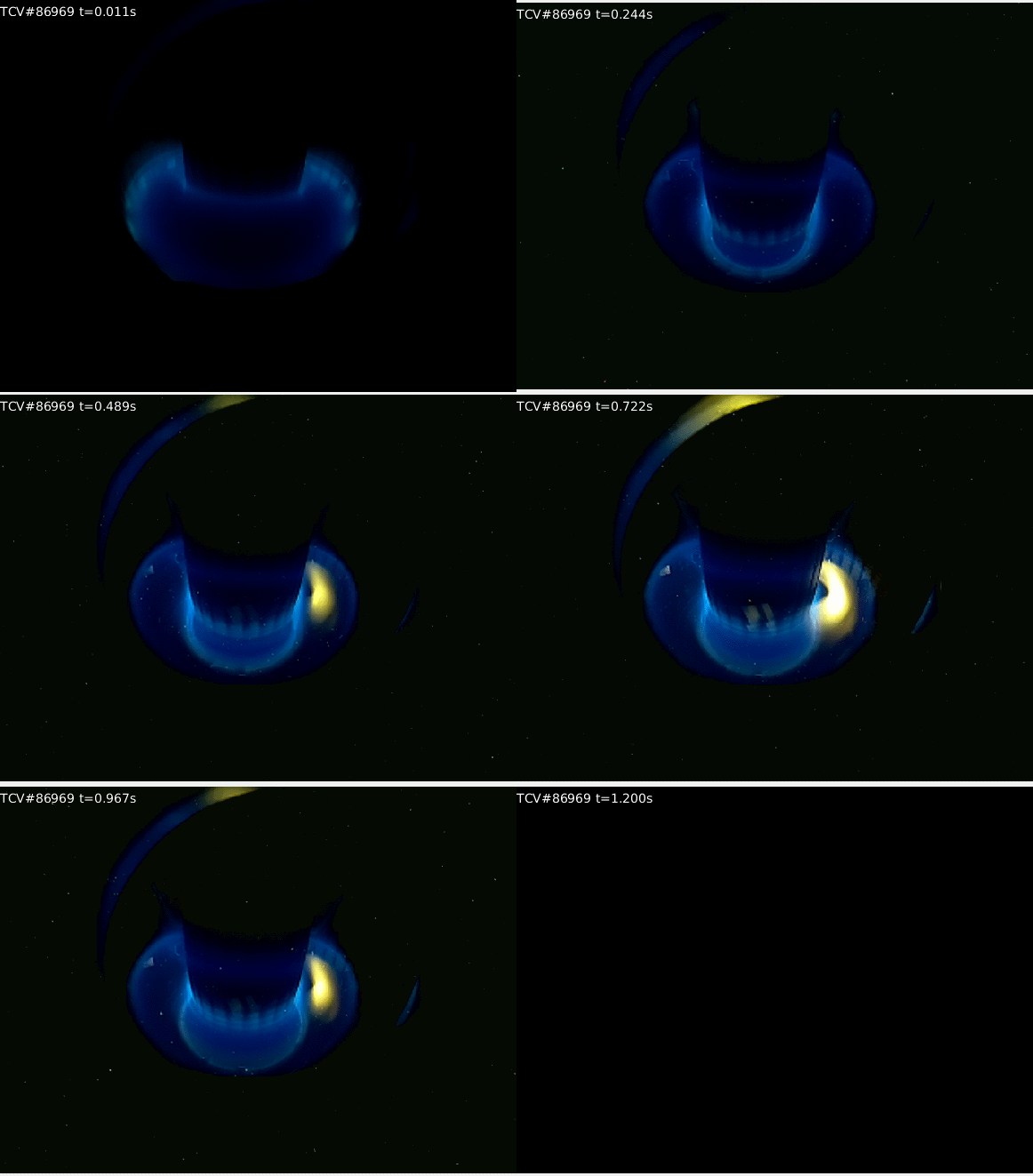
The generation process occurs through two primary pathways:
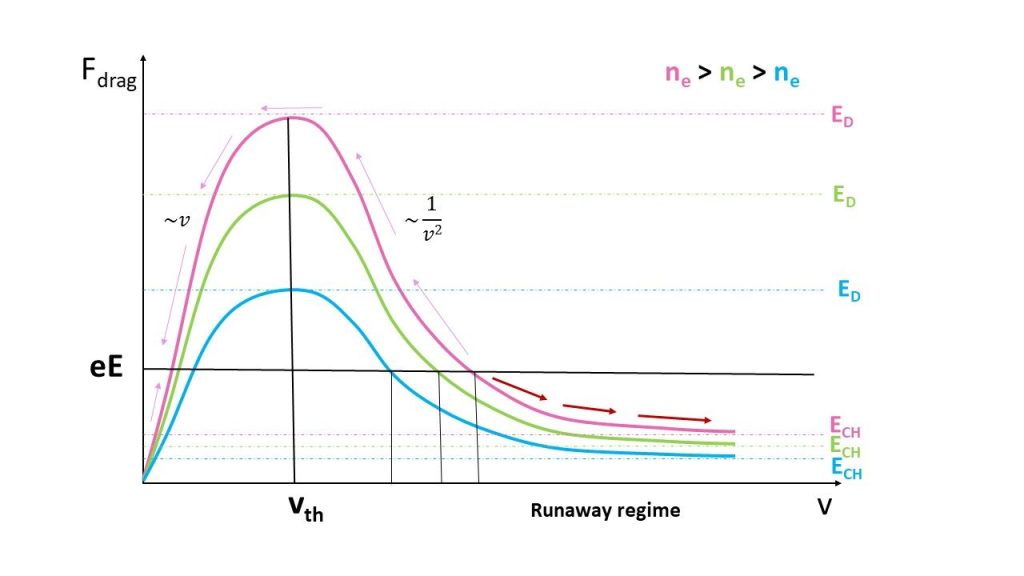
- Dreicer Mechanism: When disruption-induced electric fields exceed the critical Dreicer field, they overcome collisional drag, accelerating electrons continuously to relativistic energies.
- Avalanche Effect: Existing runaway electrons multiply exponentially through knock-on collisions, where each high-energy impact can liberate additional runaway electrons from the bulk plasma.

TCV‘s unique capabilities – including its flexible plasma control system, carbon-based components, and ability to operate at low densities – make it an ideal platform for runaway electron studies. Our research focuses on three critical areas:
- Generation Physics: Investigating how plasma parameters and impurity injections influence runaway electron formation thresholds and growth rates.
- Transport Dynamics: Studying how turbulence and MHD affect runaway electron confinement.
- Mitigation Strategies: Developing and testing proven suppression techniques including:
- Benign Termination: Combining MHD triggering with massive injection to safely dissipate beams – the scheme currently envisaged for ITER
- High-Z Gas Injection: Using gases such as argon and krypton to increase collisionality and attenuate the runaway electrons
- Passive Magnetic Perturbations: Special coils that passively destabilise runaway electron beams during formation
- Benign Termination: Combining MHD triggering with massive injection to safely dissipate beams – the scheme currently envisaged for ITER
TCV‘s experimental results, supported by advanced diagnostics and modeling with codes are directly shaping mitigation strategies of larger projects like ITER and SPARC. Notably:
- Benign termination techniques developed here are foreseen for ITER‘s disruption mitigation system. Thus, our MGI studies are informing ITER‘s SPI system design.
These efforts exemplify how TCV‘s medium-scale experiments provide crucial insights for scaling solutions to reactor-class devices, bridging the gap between fundamental physics and practical fusion energy applications.