
Boundary Plasma + Exhaust

Diverted plasma operation in TCV clearly showing the plasma emission boundary
Successful operation of a fusion reactor depends critically upon the boundary plasma. Adequate confinement of the extremely hot, 100 million ºC plasma core must be ensured whilst removing the helium produced by the fusion reactions and avoiding damage to the plasma facing components (PFCs). Leveraging TCV’s unique magnetic shaping capabilities, operational flexibility and excellent diagnostic access, the TCV Boundary Group works on advancing the fundamental understanding of the complex, turbulent boundary plasma and developing solutions for a reactor.
Power exhaust is the management of the heat and particle fluxes escaping from the confined plasma that strikes the reactor walls. Reactor solutions must limit plasma fluxes onto material walls and the plasma in contact with the PFCs must be sufficiently cold, effectively “detaching” the hot core plasma from the plasma-wall interface. This is facilitated by specific plasma shaping of the outer exhaust region of the plasma called the divertor.
While ITER will test the standard divertor solution in fusion reactor conditions, on TCV, we explore novel ideas, such as alternative magnetic geometries of the boundary plasma. Some of the alternative divertor solutions studied at the Swiss Plasma Center are shown below:
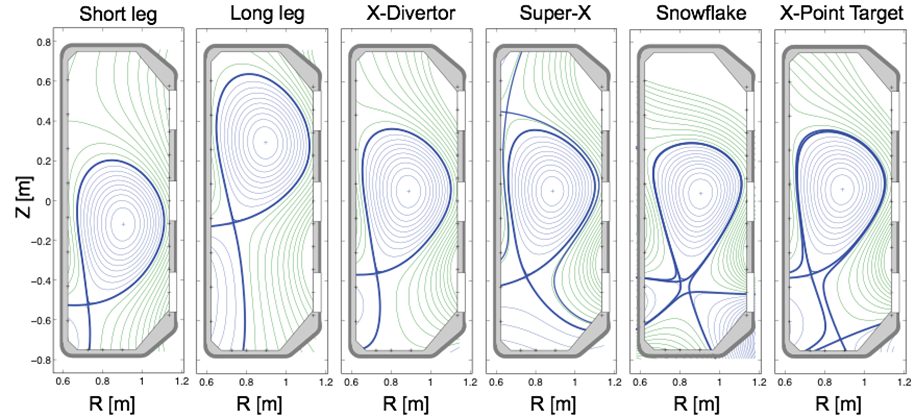
Long-legged, large flux expansion divertors are based on the standard single-null (SN) configuration but modify the magnetic geometry of the divertor leg by increasing its length, the poloidal (X-Divertor) or total (Super-X) flux expansion, thereby enlarging the contact area between the plasma and the wall. Dedicated experiments in TCV showed that increasing the leg length and increasing the poloidal connection length has a strong facilitating effect on achieving detachment.
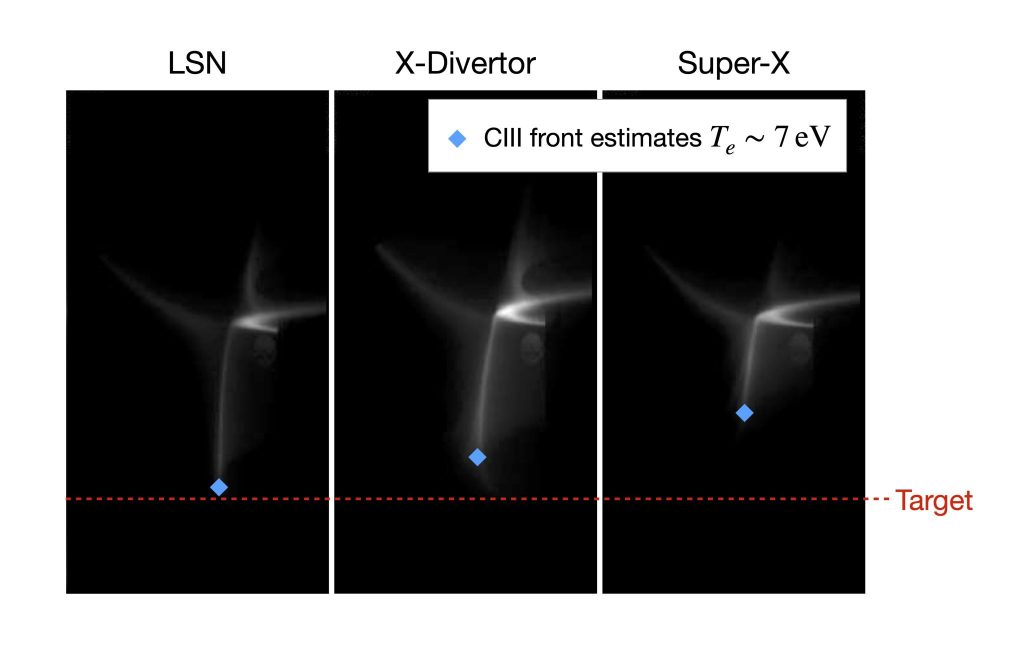
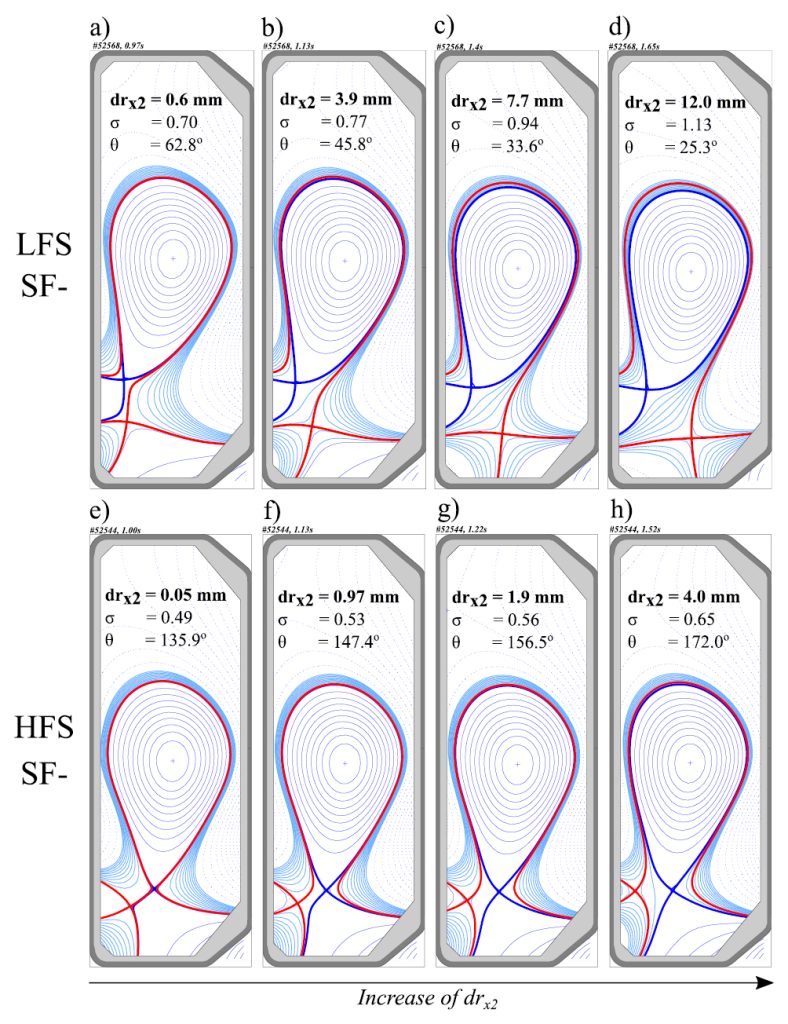
First created and studied on TCV this geometry features a second-order null point, forming six separatrix branches and four divertor legs. This configuration splits the power and particle loads to four different strike-points on the wall, enhancing flux expansion and connection length and more easily enabling plasma detachment. Although it remains more challenging to control and integrate into a reactor design than standard single null divertors, it remains a promising avenue for continued research due to its favorable exhaust properties.
A recently developed topology with three closely spaced X-points, creating an extended low-field region that enhances heat dissipation, TCV has successfully demonstrated the formation and control of jellyfish plasmas.

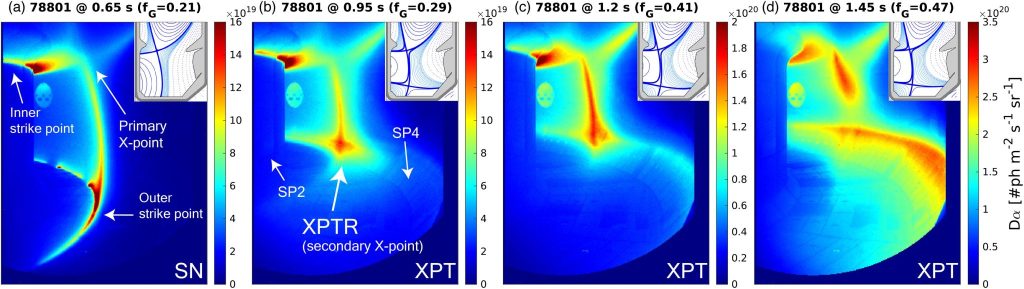
By leveraging strong radiative cooling near the magnetic X-point, heat is dissipated before it reaches the divertor plates. Similarly, X-point target radiators introduce radiating regions near the divertor targets to improve power handling. TCV has extensively studied these configurations, showing that they can enhance power dissipation and improve plasma detachment control.
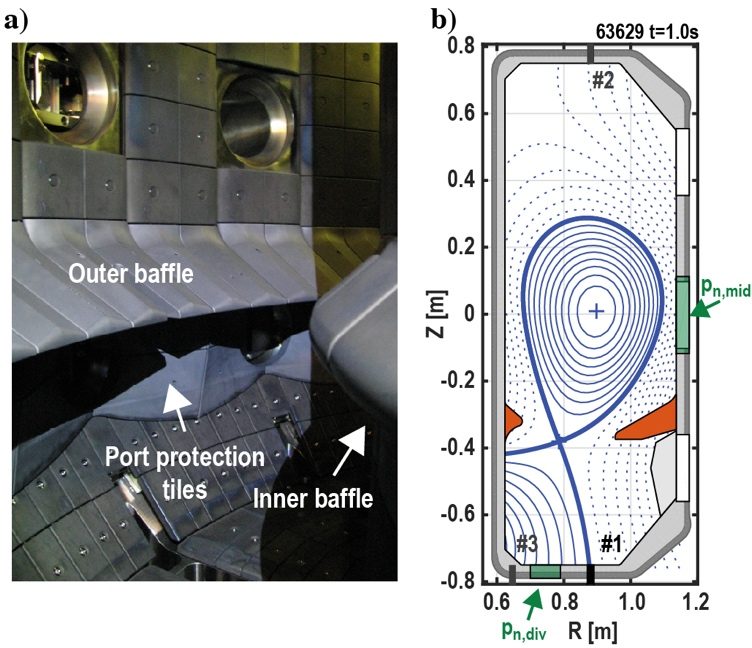
Photo showing the inside of the TCV vacuum vessel with inner and outer baffles alongside a poloidal cross-section of TCV showing the position of the baffles in red
A key part of the research of TCV has been the Power Exhaust (PEX) upgrade, which included the installation of removable divertor baffles. These are structures designed to modify the divertor shape and improve heat dissipation by enhancing neutral compression and radiation, whilst still allowing for wide magnetic flexibility. This upgrade also offers a unique test-bed for the validation of numerical models used for the design of next-generation fusion reactors.
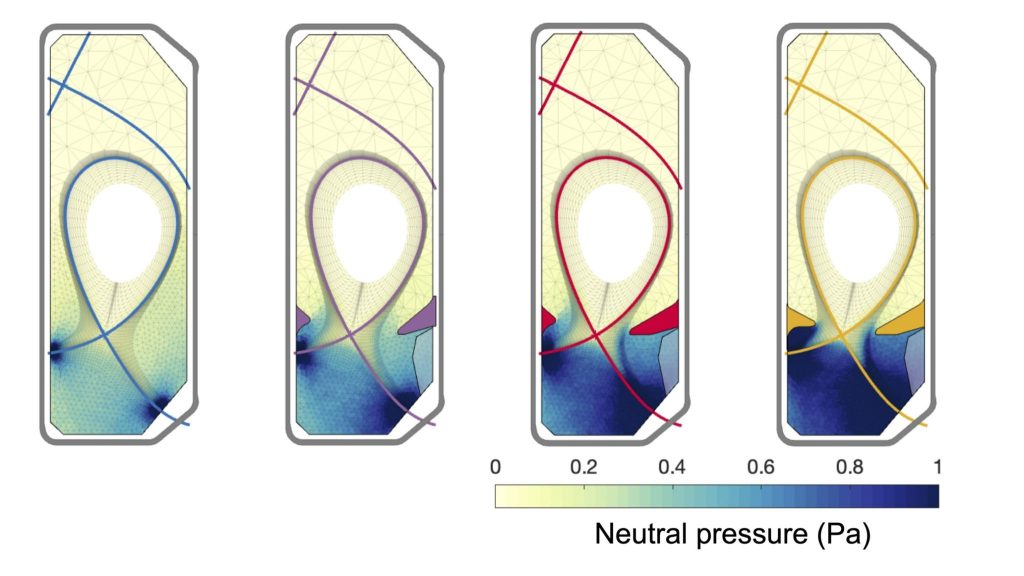
At the Swiss Plasma Center, the challenge of power exhaust in tokamaks is tackled both through experiments on TCV and advanced simulations. By pioneering research on advanced divertor configurations and validation of state-of-the-art numerical tools, TCV is making vital contributions to the development of robust power exhaust solutions for future fusion reactors.