
This page offers a practical guide on how you can use generative AI (GenAI) tools to support and enhance feedback in your teaching. You’ll find:
- Why feedback matters
- How GenAI can help you provide timely, personalized, and scalable feedback
- Examples of EPFL in-house tools and strategies
Students don’t just learn from hearing new ideas but from trying to use them, making mistakes, and getting feedback on those mistakes to improve their understanding. However, as a teacher this can be very demanding since you are likely facing a familiar set of challenges: large class sizes, limited time, and students who are increasingly relying on AI tools in their learning. In this context, continuous feedback becomes more important for students’ learning yet more difficult to deliver effectively.
If you are looking for how to give meaningful feedback to all your students during the semester and reflect on how you can do it in a manageable way for you and your teaching team, this guide is here to support you. It offers strategies, examples and specific tools to make feedback more timely, more formative, and more engaging without adding much to your workload.
Feedback is one of the most powerful tools we have to support student learning. According to a synthesis of 12 meta-analyses (Hattie & Timperley, 2007), feedback has an average effect size of 0.79 on student achievement, placing it among the most impactful strategies for learning (Hattie, 2020). In addition, it helps students:
- Understand what they’re doing well and where they need to improve
- Reflect on their thinking and learning strategies
- Stay motivated and engaged
- Develop autonomy and confidence
How does effective feedback look like?
Hattie and Timperley (2007) emphasize that the most powerful feedback helps students answer three key questions:
- Where am I going? (clarifying learning goals – what are the students expected to be able to do/learn?)
- How am I going? (insight into current performance – what are they already doing correctly and where are their blocks/weaknesses?)
- Where to go next? (guidance for improvement – how can they get from where they are to the achievement of the learning goal?)
This model encourages students to reflect, self-regulate, and take ownership of their learning. In STEM education, where iteration and problem-solving are central, this kind of feedback is especially valuable.
At least 12 previous meta‑analyses have included specific information on feedback in classrooms (Table 1). These meta‑analyses included 196 studies and 6,972 effect sizes. The average effect size was 0.79 (twice the average effect). To place this average of 0.79 into perspective, it fell in the top 5 to 10 highest influences on achievement in Hattie’s (1999) synthesis
GenAI can support feedback in ways that are scalable, flexible, and student-centered. Here are three ways you can use it and what EPFL tools are available for you to put that in place (see section below for more information on the tools).
- Feedback on student continuous work: generate periodical tests or quizzes
GenAI tools help you to provide instant, low-stakes feedback to your students throughout the semester. This helps both the students, to practice and improve before passing their exams or providing a final submission and you, as a teacher, to analyze patterns in student responses, identify common errors or misconceptions to address them in class. Check the EPFL tool below: aiaiapps. - AI as a tutoring support
GenAI can help you to create a “tutor chat bot” for students to ask questions, test ideas, or get clarification—especially helpful outside of class hours. The chatbot would be fed exclusively with the content of your course and/or EPFL courses to make sure the data it is taking into account comes from reliable sources. Check the EPFL available tools below: Graph Chat and Ed Discussion. - Feedback on student work
Generative AI tools can support you in providing qualitative feedback on student work — including essays, math solutions, open-ended responses, or code. They can help you offer an additional, objective perspective, highlight strengths and weaknesses, and formulate feedback that is both constructive and engaging.
CEDE is exploring ways to integrate formative AI-supported feedback into teaching, and EPFL offers funding opportunities for teachers interested in co-developing such solutions with CEDE, by means of the DRIL fund (Digital Resources for Instruction and Learning).
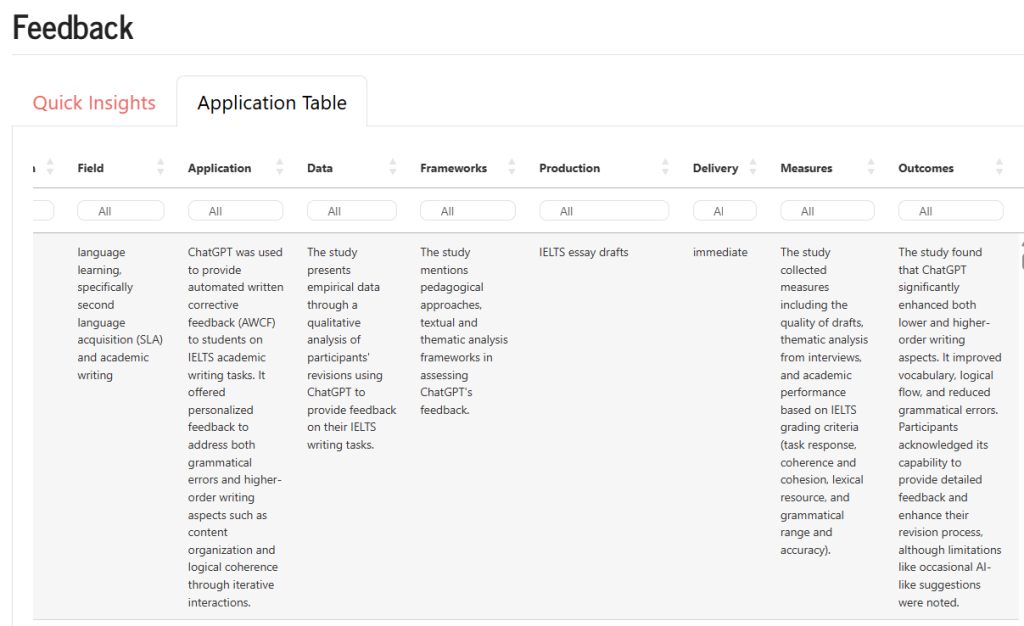
You may also find inspiration in the growing body of empirical use cases compiled by the Center for Learning Sciences at EPFL. The application of GenAI to support student learning is already being actively explored and documented across various educational settings. To learn more about implementation, observed outcomes (e.g., learning gains, student motivation), limitations, and recommendations, consult the available research here: Catalog of Emerging Practice.
We offer AI-based tools for education on multiple platforms:
aiaiapps
aiaiapps is a web platform developed by the Center for Digital Education (CEDE) that provides Generative AI-based tools for education with a simple web interface. Within a set of provided tools, it makes it possible for teachers to generate quizzes and exercises for their classes based on their course material, configuring parameters such as the AI model used, the number of quizzes or exercises generated per lecture, or the cognitive level targeted. Try it here: https://aiaiapps.epfl.ch/
Tutor chatbots
To support teaching and learning, the Center for Digital Education (CEDE) offers AI-powered tutor chatbots with different pedagogical styles. These tutor chatbots can provide pedagogically sounding answers ranging from Socratic tutoring to direct answers or following an intermediary approach by scaffolding learning by offering hints and guidance. They can be integrated directly into course websites or on course discussion forums and are based on Retrieval-Augmented Generation (RAG) technology. This means students do not get generic AI answers, but responses rooted in the provided course materials (slides, notes, exercises, exams, lecture transcripts, FAQs, etc.) and with links to the sources for a deeper understanding. This technique also reduces the risk of the tutor bot answering with plausible nonsense (i.e., hallucinations), e.g. Maleki, Padmanabhan & Dutta, 2024; Hardebolle & Ramachandran (2023)
Tutor chatbots can provide judgment-free manner (e.g. Bassner, Frankford & Krusche, 2024) to ask questions for students (Graph Chat) and, when implemented within moderated discussion forums (Ed Discussion), they can help get frequently asked questions answered faster. The teaching team can choose a safer, human-in-the-loop approach that consists of reviewing the chatbots’ answers before making them visible to the students. For more information, contact: [email protected]
There are two available tutor chatbot versions:
- Graph Chat: Try it out https://graphsearch.epfl.ch/chat/
- Ed Discussion (How to get started): https://www.epfl.ch/education/educational-initiatives/cede/providing-feedback/ai-tutors/

Potential Risks
- Even though these tutor chatbots and tools for generating quizzes and exercises use documents from the course, they could occasionally provide inaccurate or incomplete answers. For these different scenarios, we recommend:
- In forum discussions, the safest approach is to delay the response and have a teacher or a teaching assistant verify or edit the answer proposed by the chatbot before making it visible to students. This could help teachers provide faster answers to students.
- In a one-on-one tutor chatbot, clearly communicate to students that the chatbot is not an infallible source and encourage them to cross-check answers with official course materials or ask follow-up questions in class.
- When generating quizzes and exercises, it’s essential that teachers verify the generated content before using it in their course.
- In all these scenarios, teachers and students need to be aware of automation bias (the tendency to favor recommendations from automated systems, e.g., Suresh, Lao & Liccardi (2020)).
Do you want to learn more about how to integrate GenAI in your teaching? Contact us:
- for pedagogical support: [email protected]
- for technical tool support: [email protected]
Resources:
- Guidelines
- Catalog of emerging practice
- AI and evaluation
- AI and accessibility
- Surveys AI at EPFL: Read the related news article (public) and access the survey reports of the students survey and the teachers survey (EPFL members only).