
Ethical issues with software released to the public are so widespread that some researchers have coined the term ethical debt to represent the unpaid cost of the negative impacts for individuals, societies and our environment.
A key to reduce ethical debt is to systematically assess ethical risks at all stages of the design and development process. However, previous research shows that it is particularly difficult for novice engineers to identify risks, to determine priorities and to design mitigation measures.
We have designed a visual tool called the “Digital Ethics Canvas” that guides students in assessing ethical risks with 5 “ethical lenses” specific to the digital domain: welfare, fairness, autonomy, privacy and sustainability.
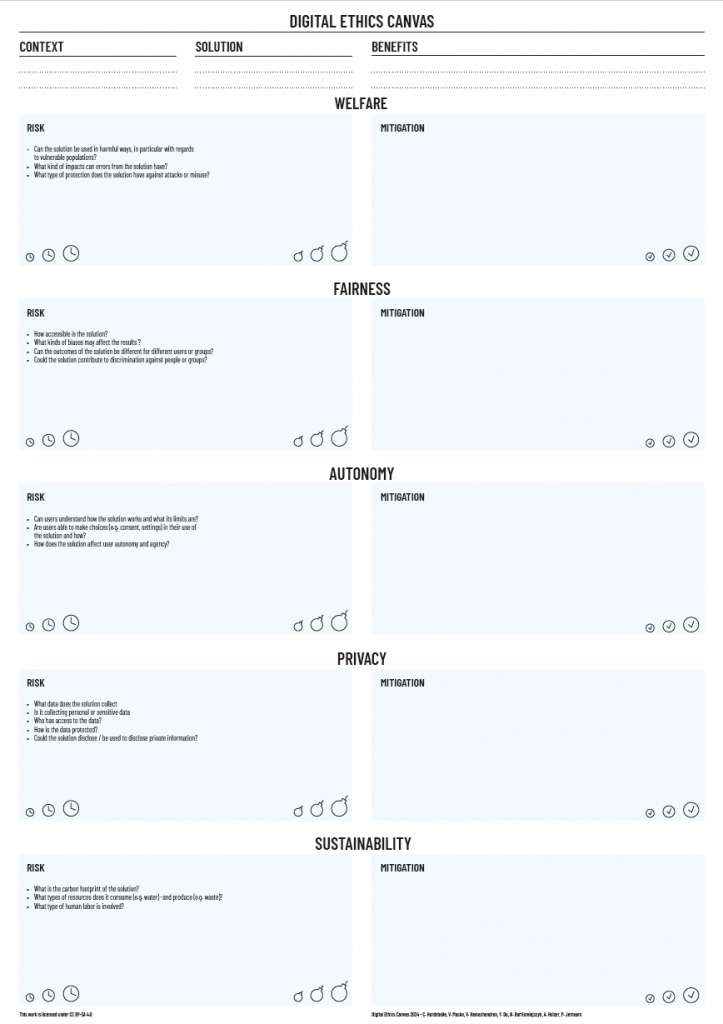
The canvas includes questions to help students surface elements in a digital solution that are likely to give rise to risks. Mitigation options can then be added and evaluated. Overall, the canvas implements a benefit-risk analysis which is adapted to approach ethical dilemmas.
You can learn more in our publications below.
Publications
Berney, M., Hardebolle, C., Ouaazki, A., Bartłomiejczyk, N., Macko, V., Ramachandran, V., Jermann, P., Knight, S., & Holzer, A. (2025). Ethics-by-Design Canvas: A Visual Inquiry Tool to Reduce Ethical Blindness in Digital Innovation Projects. ICIS 2025 Proceedings. https://aisel.aisnet.org/icis2025/ethical_is/ethical_is/1
Hardebolle, C., Macko, V., Ramachandran, V., Holzer, A., & Jermann, P. (2023). Digital Ethics Canvas: A Guide For Ethical Risk Assessment And Mitigation In The Digital Domain. European Society for Engineering Education (SEFI). https://doi.org/10.21427/9WA5-ZY95
Hardebolle, C., Jermann, P., Tormey, R., Dehler Zufferey, J., Gillet, D., Holzer, A., Felber, P., Bentel, K., Brändle, U., & Kortemeyer, G. (2022). A Canvas For The Ethical Design Of Learning Experiences With Digital Tools. Proceedings of the 50th SEFI Annual Conference 2022: Towards a New Future in Engineering Education, New Scenarios That European Alliances of Tech Universities Open Up, 2282–2287. https://doi.org/10.5821/conference-9788412322262.1237