
Key messages
▪️In late summer 2025, EPFL and Collectif Cambium sàrl signed an agreement extending the lease until January 31, 2030.
▪️This outcome follows a conciliation procedure initiated after the Collectif challenged the termination of the lease, which was set for January 31, 2026.
▪️Under the terms of the agreement, the Collectif has made an “irrevocable” commitment to vacate the premises by January 31, 2030, at the latest.
▪️The Bernoulli Interfaculty Center for Fundamental Sciences will move into the Bassenges buildings once they have been renovated. The architectural project chosen by EPFL management in January 2025 will be completed in 2030-31.
▪️The heritage and land use planning departments have given positive preliminary opinions on the change of use of the buildings. The land will remain dedicated to food crops and the preservation of biodiversity.
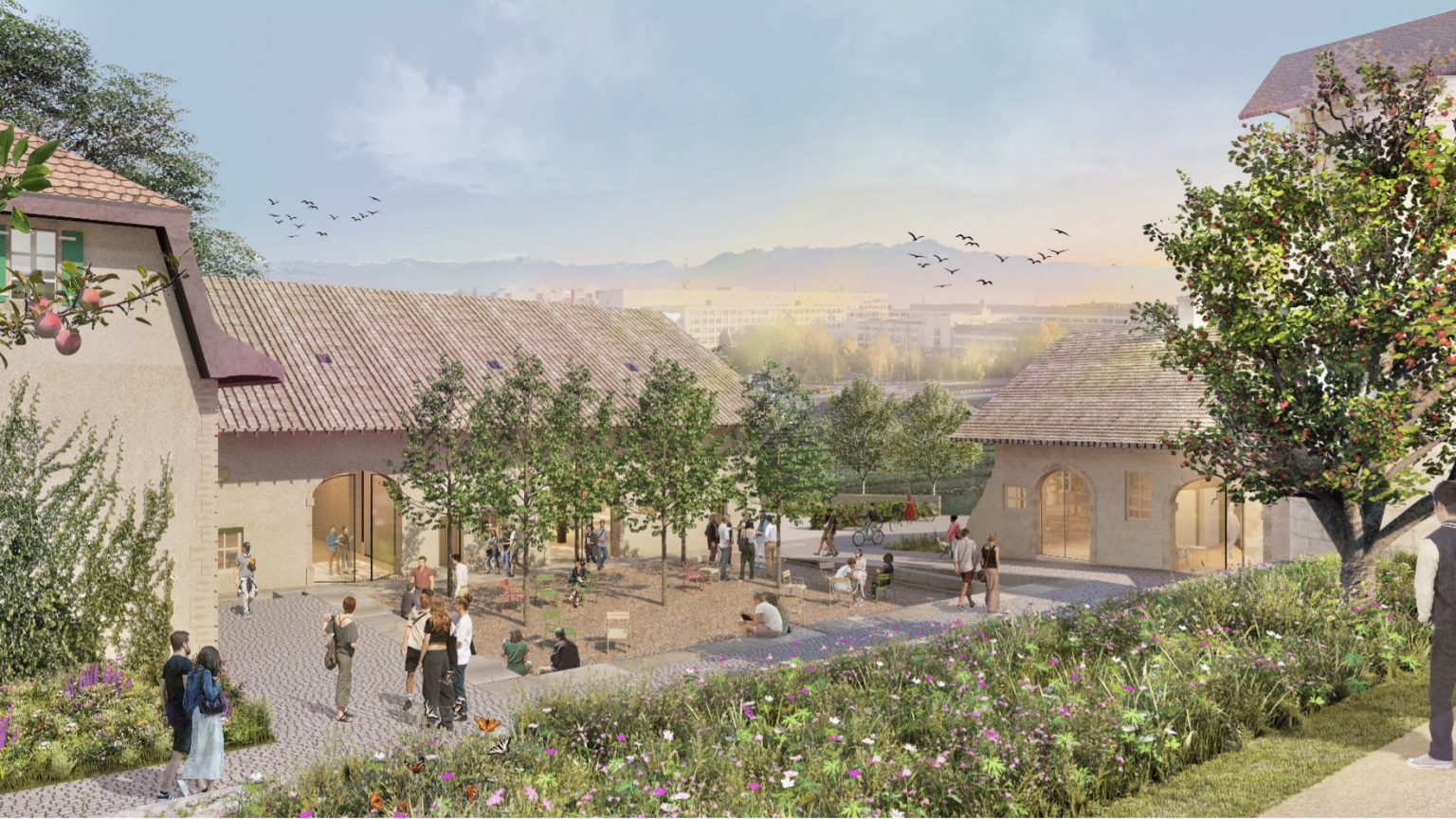
Future courtyard of the Bernoulli Centre. ©Donald Insall Associates
Communication of September 9, 2025
EPFL and Collectif Cambium agree on a four-year lease extension
Renovation work on the buildings at the Bassenges site on EPFL’s Lausanne campus will begin in 2030. Following a conciliation procedure, Collectif Cambium sàrl has had its lease extended by four years.
The lease agreement between EPFL and Collectif Cambium sàrl for the use of buildings and agricultural land at the Bassenges site, on the western part of EPFL’s Lausanne campus, has been extended until January 31, 2030. This is the result of an agreement negotiated through a conciliation procedure. This followed the Collectif’s challenge to the termination of the lease on January 31, 2026, which had been notified to it by the School within the contractual time frame.
Under the terms of the agreement, the farmers undertake to vacate the site by January 31, 2030, at the latest. This new schedule allows EPFL to maintain its plan to develop the Bassenges buildings in order to house the Bernoulli Center for Fundamental Studies, an international teaching and research institute currently occupying temporary premises within the School. “For us, it was essential to reach an agreement that was satisfactory to both parties. Although this delays the Center’s move, we are prioritizing a long-term vision for the School and harmonious coexistence with society,” emphasizes Anna Fontcuberta i Morral, President of EPFL.
The land currently cultivated by the Collectif Cambium will continue to be used for agriculture and biodiversity preservation after the farmers leave. EPFL has developed a concept combining market gardening, conservation gardens, and areas of high ecological value. The buildings, which are listed as heritage sites, will be renovated and adapted to best serve the interests of the Bernoulli Interfaculty Center. The relevant municipal, cantonal, and federal authorities have already issued favorable preliminary opinions on the reallocation of the premises.
Context
Our core missions at EPFL are education, research and technology transfer, as set forth in the Swiss Act on the Federal Institutes of Technology. This Act also requires us to maintain close ties with the general public.
We’re pleased to see how successful our School has been over the years, but this has come with a clear drawback: our campuses are saturated and we need more space for holding classes, seminars, public speaker events and other activities. For the first time in EPFL’s history, we had to initiate a consultation on a sort of numerus clausus to stem the growth in our student body.
Our School needs more space for carrying out its core missions. The buildings at the Bassenges site, adjacent to our main Lausanne campus, are currently being used for a purpose that isn’t tied to one of those missions. The buildings are being leased at a symbolic fee of one franc per year to a farming cooperative that’s operating the site’s 7.3 hectares of farmland, which belong to EPFL and the University of Lausanne (UNIL) (see below).
The buildings are listed as a Vaud Canton heritage site and need major renovation work. We want to use this opportunity to restore these buildings and turn them into new facilities for the Bernoulli Center, thus creating a hub for fundamental-science research with an international impact.
The Bernoulli Center
The Bernoulli Center was founded as a forum for leading fundamental-science researchers to pool their efforts and share their discoveries, helping to disseminate knowledge across Switzerland and beyond. The Center draws in part on the reputation of its professors, including Maryna Viazovska and Martin Hairer – both winners of the Fields Medal (the equivalent of the Nobel Prize, but in mathematics).
These types of centers have given rise to a number of major intellectual breakthroughs in the 20th and 21st centuries. For instance, Albert Einstein developed his theory of general relativity at the Institute for Advanced Study in Princeton – the theory that makes GPS possible – and Claude Shannon invented the basics of encryption, the technology that lets us bank online securely, at Bell Labs.
A site better suited to the Center’s needs
Today the Bernoulli Center is operating out of temporary offices and doesn’t have a place where it can deploy its full potential. The Center would like to hold more activities for primary- and secondary-school students, for example, but can’t because of a lack of space.
That’s why, over the past three years, EPFL has been reviewing various options to give the Center the kind of facilities it needs.
Of these options, the most suitable one is to repurpose the Bassenges site, which currently has the following buildings:
- An old manor house (Château de Bassenges) with approx. 530 m2 of total floor space
- A winemaking building (approx. 330 m2)
- A “square house” (approx. 515 m2 with annexes)
- A large farm building with room for up to 630 m2 of floor space
These buildings, located very near each other, belong to the Swiss federal government and are listed as a Vaud Canton heritage site (class 2). Given their historical value, the renovation work will consist of remodeling the interior without fundamentally compromising their outside appearance.
The plans are to build a world-class complex with classrooms, meeting rooms, research labs, and workspaces for visiting scientists. It will also include areas for holding research seminars and workshops, and for running programs for EPFL students. The new site could host EPFL’s Euler Course and Turing Course, for instance, as well as science outreach events for the general public.
A green future for the farmland
These plans will require relocating EPFL’s Energy Center, currently housed in the Château de Bassenges, and terminating the farming cooperative’s lease on 31 January 2030 – as agreed in the course of a negotiation that took place in Summer 2025. The cooperative, called Collectif Cambium, won a request for proposals issued jointly by EPFL and UNIL in 2019 to operate the 7.3 hectares of farmland spread across several sections of the adjoining campuses.
In its proposal, the cooperative outlined a micro-agroforestry concept that includes various types of crops along with animal breeding. It began to implement its concept in early 2020. Today the farm produces vegetables, grains and cheese that are sold through produce baskets, an on-site market and a local distribution network. It pays the symbolic fee of one franc per year for the use of the farmland and buildings. The cooperative was informed of EPFL’s plans for the buildings in July 2023.
But that doesn’t mean the farmland will be covered with buildings or concrete. Quite on the opposite, the management of EPFL has approved a project including market gardening and arboriculture activities as well as the creation of ornamental and conservation gardens around the buildings.
An “edible garden” for biodiversity and the landscape
The project for the agricultural land at the Bassenges site aims to create a multifunctional space that continues the efforts made over several years, in particular by integrating a vegetable garden, an orchard, biodiversity and awareness-raising, in line with the architectural project developed for the Bernoulli Centre.
By promoting interaction between different areas, it will offer a harmonious and functional layout, promoting both human use and the preservation of ecosystems.
A vegetable garden for the EPFL community will be created next to the hangar. The existing orchard will be expanded to include both tall and small trees to help produce fruit and structure the landscape.
The eastern part of the orchard will be managed by late haymaking in order to provide pollen resources for the existing apiary. The western part will be grazed to limit manual maintenance and reinforce the site’s historical agricultural roots.
To the north-east, a wetland biotope will occupy the lowest point of the plot. Throughout the site, additional small structures will reinforce the existing ecological corridors, and the existing living hedge will be extended and thickened. A pleasure garden will be developed in contact with the buildings, taking up the historic landscape structures.
General maintenance will be provided by contracted market gardening, arboriculture and grazing services.

Reviving “The Three Natures”
The architectural vision for the Bernoulli Centre draws from the natural and cultural history of the site in the Lac Leman basin to create a biodiverse landscape that will broaden the EPFL Campus offer, strengthening its academic reputation while enhancing its connections with the local community.
The project concept is to re-instate the idea of ‘The Three Natures’ on the site: wilderness, agriculture, and the garden. The three natures will work together as a palimpsest to maximise spaces for people, wildlife and food production, revealing the sedimental layers that shaped the landscape through the years.
The selected design transforms the Bassenges estate into a dynamic and fully accessible campus for students and researchers, whilst maintaining some agricultural functions. The overall masterplan returns the site to its historic arrangement, restoring the hierarchy of buildings and direct connections between them and the open spaces. The new interventions celebrate the individual and collective architectural features and qualities of the buildings. The appropriation of the buildings for their new use adds a third dimension where the interface between the historic fabric and contemporary insertions will be read through changes of materiality, textures and details. The new open spaces will include an agora for students and researchers to meet and exchange ideas, a lushly planted pleasure garden and a new market square.
Future-proofing, full accessibility and flexible use of spaces for continued adaptation are key principles to allow for resilience of the historic buildings, so that they may continue to withstand the test of time.