EPFL Neuchâtel

At the heart of the Microcity pole of innovation, the Canton of Neuchâtel is hosting an important part of EPFL’s Electrical and Microengineering Institute (IEM). This institute’s research activities covers topics such as health, microsystems, photovoltaic or watchmaking.
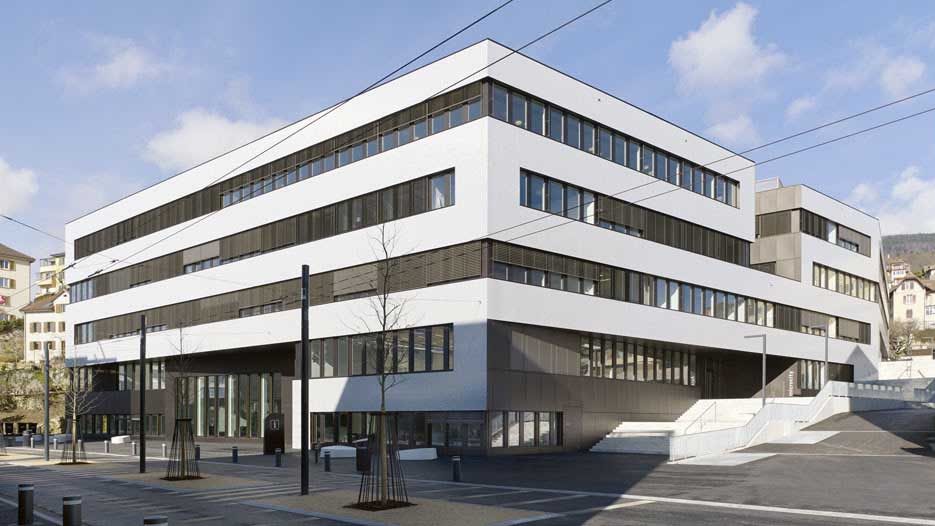
Microcity Neuchâtel EPFL

News

The smart sensor on the wireless tag reader. 22025 EPFL/LMTS CC-BY-SA 4.0

A biodegradable smart sensor to monitor sensitive goods

— Researchers from EPFL, Empa, and CSEM have developed a sustainable smart sensing tag that can be used to signal when shipments of medicines or food have exceeded a safe threshold temperature. It is the first such tag to be fully compostable.

© 2025 EPFL

Christophe Ballif wins ERC Synergy Grants for Ultimate PV

— On 6th of November, the European Research council announced the selection of 66 ERC Synergy Grants for a total 684 m€ ! Fantastic news: our "Ultimate PV project", with EPFL PV-lab (Christophe Ballif) , Stefan Glunz at University of Freiburg, and Stéphane Collin at CNRS has been selected as one of the winning project 

© 2025 EPFL

Zeno Karl Schindler Award 2025 goes to Dr. Christian Wolff of PV-Lab

— Congratulation to Christian for getting the prestigious Zeno-Karl Schindler Award 2025 (20’000 CHF) ZKS-EPFL – Zeno Karl Schindler Fondation during the “Doctorale 2025”, at the Forum Rolex on Oct. 27th Christian receives the award “For his multiple contributions to the field of perovskite and perovskite-silicon solar cells, allowing among others the first worldwide demonstration of tandem perovskite-silicon solar cells with over 30% efficiency, world record triple junction solar cells, as well as perovskite solar cells with remarkable stability. His achievements open key pathways for providing low-cost clean electricity beyond standard silicon solar cells”. Prix Zeno Karl Schindler – 2025 – Christian Wolff – EPFL

Cross-section of a copper-infused hydrogel. ALCHEMY EPFL CC BY SA

New 3D printing method 'grows' ultra-strong materials

— EPFL researchers have pioneered a 3D printing method that grows metals and ceramics inside a water-based gel, resulting in exceptionally dense, yet intricate constructions for next-generation energy, biomedical, and sensing technologies.

© iStock

Qubits are a computer's best friends

— Quantum computing could revolutionize information technology by harnessing the strange principles of quantum mechanics. While there is growing hype surrounding its potential, the reality is a mix of groundbreaking progress and persistent technical challenges.

© 2025 EUPVSEC

Best poster award in EU PVSEC 2025 Bilbao!

— Big congratulations to Umang Desai from EPFL PV-lab for winning a Best Poster Award at #EUPVSEC2025 in Bilbao for his work on "Façade Application of Light-Weight Glass-Free Colored PV Modules: Reliability Testing of the Large-Format Modules and Monitoring of the Demonstration Site''.

Monolithic flexure-based purely circular pivot with stiffness compensation. Design covered by EPFL and CSEM patents, 2024. Photo credits: S. Henein, Instant-Lab, EPFL.

Friction-free precision, from space to watchmaking

— From your wrist to orbiting the Sun, compliant mechanisms are designed to live for many decades without maintenance. At EPFL and CSEM, scientists are working on this type of mechanism that has a large variety of applications, including space and high-precision metrology.

© 2025 EES Solar

Perovskite-TOPCon tandems are catching up!

— Our article “Over 31%-efficient perovskite–TOPCon solar cells enabled by AlOx-based hydrogenation and front sub-micron texturing” is now published in EES Solar. In this work, we demonstrate high-efficiency perovskite–silicon tandem solar cells using double-sided tunnel oxide passivated contacts (TOPCon2) bottom cells, achieving 30.2% efficiency on both sides flat and 31.3% on front-textured devices. The former is enabled by high passivation quality on flat surfaces and the latter by enhanced optical performance. These results highlight that TOPCon2 is a promising platform for scalable tandem integration beyond silicon heterojunction-based bottom cells.'

Professor and IMT50 committee president Christophe Ballif. 2025 Michael Mitchell EPFL CC BY SA

Microcity Building celebrates 50 years of microengineering

— On September 4th, EPFL’s Neuchâtel campus celebrated the 50th anniversary of microengineering at the school with a milestone event uniting 450 alumni, engineers, and representatives from politics and industry.

© Martina Gini controls a simplified robotic arm with breathing. © EPFL / Alain Herzog - CC-BY-SA 4.0

High-tech “replacement parts” offer hope to millions

— From robotic hands and arms to soft heart pumps, biomaterials, 3D-printed muscles and more, rapid advancements in robotics and biotechnology are giving rise to new techniques for repairing the human body.

All news