
TORPEX: Toroidal Plasma Research

Picture of TORPEX with a steady-state plasma visible thought the central view-port.
The Toroidal Plasma Experiment (TORPEX) is a medium-scale toroidal device dedicated to the investigation of fundamental plasma physics in simple and controlled magnetic configurations. It is one of a few specialized facilities in Europe designed to study basic plasma processes in toroidal geometry. Research activities focus primarily on dynamical plasma phenomena relevant to magnetic confinement fusion, while the device is also well suited for investigations of space and astrophysical plasma physics.
TORPEX has major and minor radii of 1 m and 0.2 m, respectively. The device is equipped with a flexible set of magnetic coils capable of generating helical magnetic field lines around the torus axis with controllable pitch. This configuration, known as the Simple Magnetized Torus (SMT), represents the simplest toroidal confinement configuration incorporating pressure gradients and magnetic curvature—two essential ingredients for the development of drift-wave instabilities and plasma turbulence. More complex magnetic configurations can also be produced, including configurations with X-points. The characterization of their stability, turbulence properties, and transport dynamics constitutes a major focus of current research.


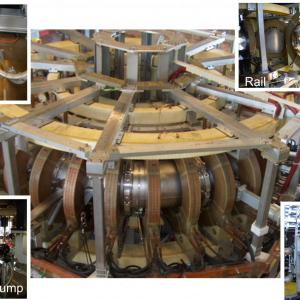
A central coil stack enables operation with a toroidal loop voltage, allowing the drive of plasma currents up to approximately 1 kA. In addition, a current of up to approximately 1 kA can be driven in an in-vessel toroidal copper conductor to generate a poloidal magnetic field component. This capability allows the exploration of magnetic configurations closer to those of tokamaks and the investigation of associated turbulence and instability mechanisms.
Highly reproducible plasmas are obtained in H, He, Ne, or Ar. Typical plasma parameters are:
- Electron density: ne∼ 1015–1017 m−3
- Electron temperature: Te∼5–10 eV
- Plasma potential: Vpl∼10–20 V
Plasmas are created and sustained by microwave heating at the electron cyclotron (EC) resonance. Key control parameters—including neutral gas pressure, EC resonance location, and injected microwave power—allow systematic control of density and temperature profiles.
Recently, a birdcage antenna was installed to enable helicon wave excitation in toroidal geometry. Plasma initiation and sustainment via RF excitation at 13.56 MHz have been demonstrated, largely independent of the toroidal magnetic field. This development opens access to magnetic field regimes that were previously inaccessible to TORPEX.

