
Introduction to TCV

An image of the TCV experiment
TCV (“Tokamak a Configuration Variable” or “Variable-Configuration Tokamak”) is a medium-sized device of the tokamak line, the most successful design thus far in the pursuit of thermonuclear fusion as an energy source for humankind. In this device, a gas composed of a mixture of isotopes of hydrogen is ionized, resulting in a “gas” of free electrons and ions, known as a “plasma”. Magnetic fields are used to keep the fuel confined away from the material walls of the device.


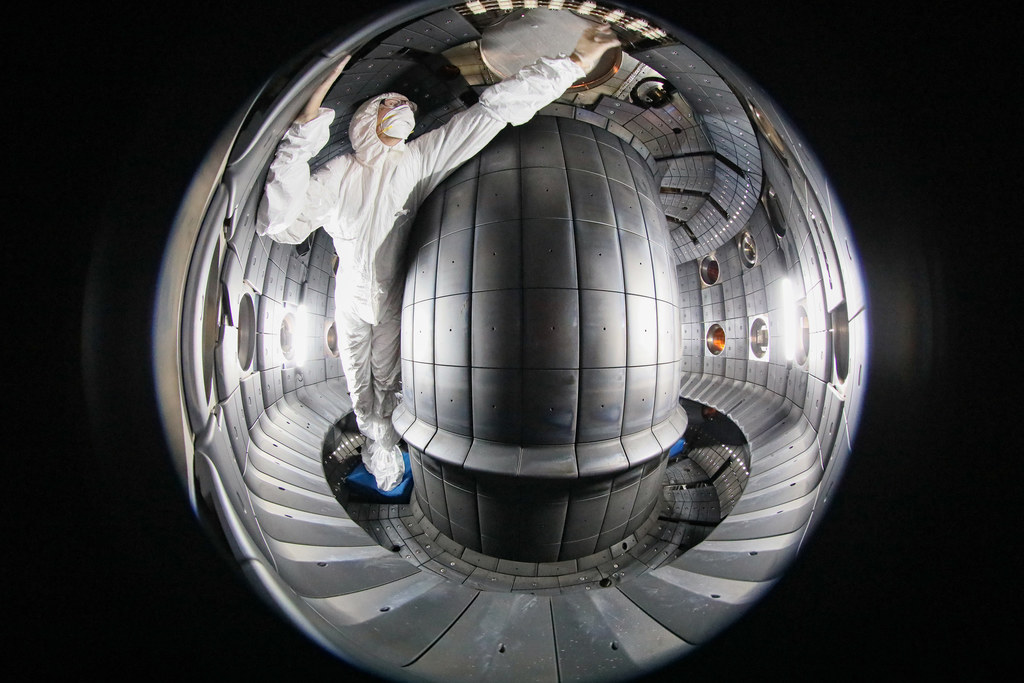


As its name attests, TCV was built with the goal of flexibility in particular in setting its plasma shape. As the plasma shape is governed by magnetic fields, TCV achieves this goal by having a much larger number of independently-powered magnetic field coils than any other comparable device. It also features a very elongated vacuum vessel (three times as tall as it is wide) to accommodate a great variety of shapes.
Another outstanding asset of TCV was and continues to be its high-power microwave heating system (Electron Cyclotron Resonance Heating or ECRH) designed to heat the electrons within the plasma. It also drives (localized) current (ECCD) and thereby can reduce the required induced current, control the current density profile and mitigate instabilities. With up to seven separate, real-time-steerable beams, this heating power can provide targeted heating of the plasma. This system has more recently been complemented by ion heating in the form of two neutral-beam injectors (NBI). Through advents in real-time control of these and other sub-systems, unprecedented scenarios have become practicable.
Explore further


Explore our labs
Virtual tours