
Category: Recent Publications
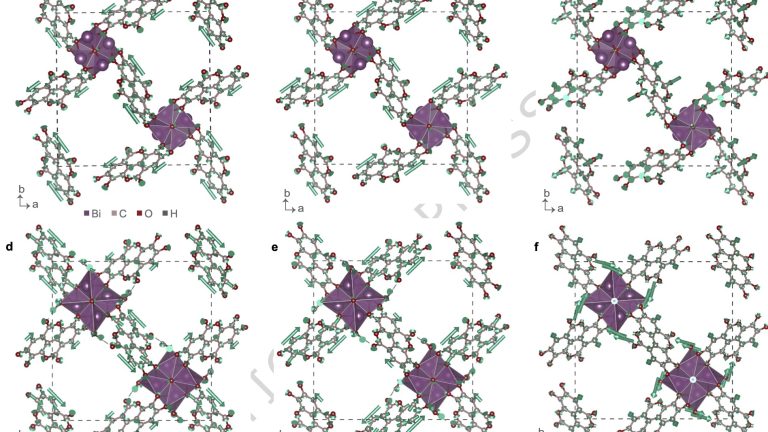
Hydration-dependent exciton-phonon coupling in a metal-organic framework photocatalyst
B. Mouriño, A. Alvertis, A. Smith, N. P. Domingues, F. M. Ebrahim, A. Champagne, J. B. Neaton, and B. Smit, Hydration-dependent exciton-phonon coupling in a metal-organic framework photocatalyst Nat Commun (2026) doi: 10.1038/s41467-026-76097-z Abstract: Metal-organic frameworks (MOFs) have potential for light-harvesting applications owing to their tunable optoelectronic properties via building block selection. The presence of (…)
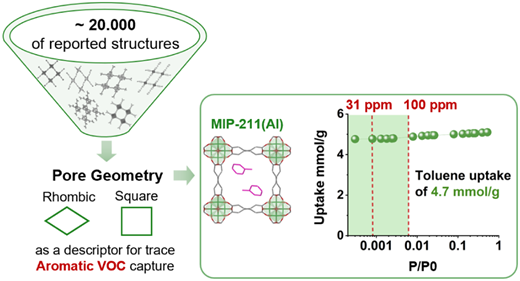
Pore Geometry–Driven Capture of Trace Aromatic Volatile Organic Compounds in Al-Based MOFs
A. Blokhina, Y. Li, I. Dovgaliuk, D. Chakraborty, A. Ozturk, N. P. Domingues, X. Zhang, F. M. Ebrahim, B. Baumgartner, C. Serre, G. Mouchaham, and B. Smit, Pore Geometry–Driven Capture of Trace Aromatic Volatile Organic Compounds in Al-Based MOFs ACS Nano 20 (27), 19548 (2026) doi: 10.1021/acsnano.6c05710 Abstract: Aromatic volatile organic compounds (VOCs) are toxic (…)
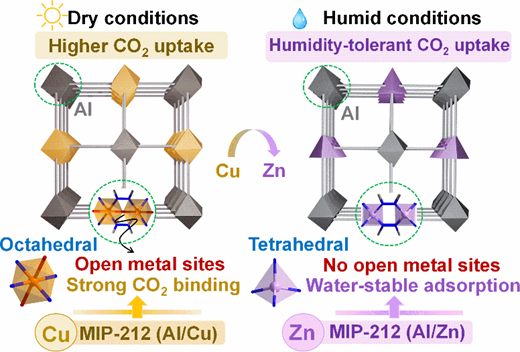
Tunable Microporous Bimetallic Carboxylate-Pyrazolate Metal–Organic Frameworks for CO2 Capture
A. Yurdusen, P. Malik, A. Mansouri, I. Dovgaliuk, M. Garvin, A.-Y. Song, A. Pourghaderi, X. Jin, L. Stuart, D. Chakraborty, S. Nandi, L. A. Fernando, A. Beauvois, V. Briois, J. A. Reimer, S. Garcia, B. Smit, G. Mouchaham, and C. Serre, Tunable Microporous Bimetallic Carboxylate-Pyrazolate Metal–Organic Frameworks for CO2 Capture J. Am. Chem. Soc. 148 (…)

The data-only illusion in materials discovery
B. Smit and S. Garcia, The data-only illusion in materials discovery, Nature Materials (2026) doi: 10.1038/s41563-026-02578-7 Artificial intelligence may have transformed image and language generation, but in materials science, data scarcity and synthesis complexity demand a different approach. Only by coupling artificial intelligence with deep chemical insight can we turn virtual predictions into real (…)

Machine learning potential for modelling dynamic hydrogen bond networks in MOF MIL-120
X. Jin, Y. Li, K. D. M. Gaedecke, X. Zhang, and B. Smit, Machine learning potential for modelling dynamic hydrogen bond networks in MOF MIL-120 Chem. Sci. (2026) doi: 10.1039/D5SC09058J Abstract: Metal-organic frameworks (MOFs) are porous materials with the potential for gas adsorption and separation technologies due to their tunable structural and chemical characteristics. However, (…)

Peer Review and AI: Your (Human) Opinion Is What Matters
J. M. Buriak, D. Akinwande, N. Artzi, S. Bals, E. M. Carreira, Y. Chai, W. C. W. Chan, C. J. Chang, C. Y. Chen, X. D. Chen, C. Crudden, V. Dusastre, M. C. Hersam, A. Ho-Baillie, T. Hu, P. V. Kamat, K. Kataoka, I. D. Kim, Y. Li, X. Y. Ling, L. M. Liz-Marzan, M. (…)

Thermal transport mechanisms in ZIFs
X. Q. Zhang, S. Barthel, Y. T. Li, B. Smit, and R. Cabriolu, Thermal transport mechanisms in ZIFs Nat Commun 16 (1) (2025) DOI: 10.1038/s41467-025-66510-4 Abstract: Zeolitic imidazolate frameworks (ZIFs), a subclass of metal-organic frameworks (MOFs), exhibit tunable thermal conductivity, which is crucial for applications such as gas adsorption, catalysis, and energy storage. Despite its (…)
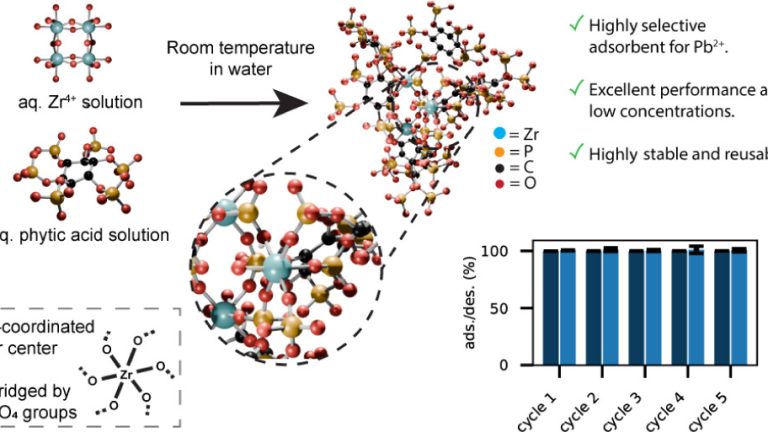
Lead, Locked Away: Porous Zr–Phytate Coordination Polymers for Rapid and Selective Removal of Pb2+ from Water
N. Taheri, T. Schertenleib, T. M. O. Felder, L. Piveteau, B. Mouriño, B. Smit, M. K. NAazeeruddin, and W. L. Queen, Lead, Locked Away: Porous Zr–Phytate Coordination Polymers for Rapid and Selective Removal of Pb2+ from Water J. Am. Chem. Soc. (2025) doi: 10.1021/jacs.5c11825 Abstract: Coordination polymers (CPs) often suffer from poor hydrolytic and chemical stability, (…)
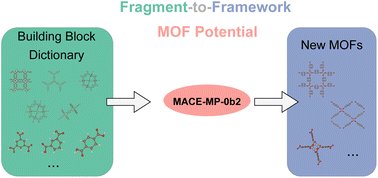
FFLAME: A Fragment-to-Framework Learning Approach for MOF Potentials
X. Zhang, Y. Li, X. Jin, and B. Smit, FFLAME: A Fragment-to-Framework Learning Approach for MOF Potentials Digital Discovery (2025)DOI: 10.1039/D5DD00321K Abstract: Metal–organic frameworks (MOFs) exhibit immense structural diversity and hold promise for applications ranging from gas storage and separation to energy storage and conversion. However, structural flexibility makes accurate and scalable property prediction difficult. (…)
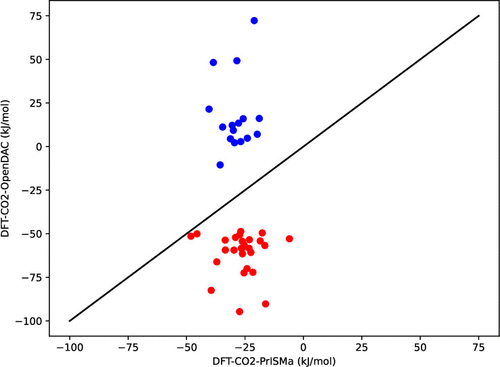
Correspondence on “The Open DAC 2023 Dataset and Challenges for Sorbent Discovery in Direct Air Capture”
X. Jin, S. Garcia, and B. Smit, Correspondence on “The Open DAC 2023 Dataset and Challenges for Sorbent Discovery in Direct Air Capture” ACS Cent. Sci. (2025) doi: 0.1021/acscentsci.5c00255 Abstract: This Correspondence provides a brief commentary on a recent ACS Central Science article that identifies metal–organic frameworks for direct air capture and suggests that the recommended structures (…)