
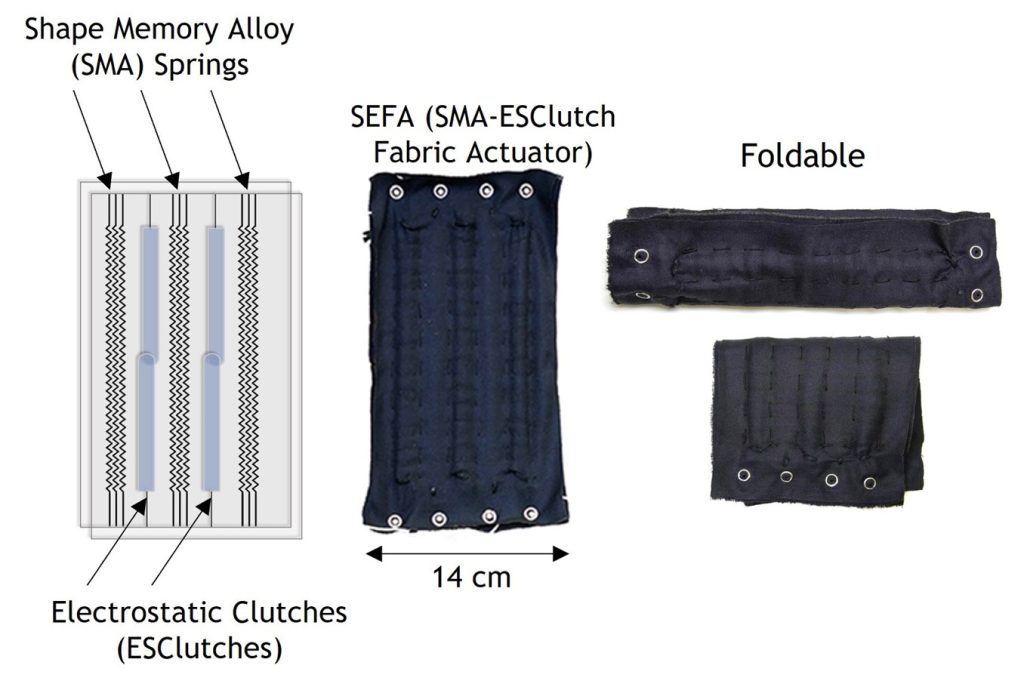
Imagine wearing clothes that can help you lift heavy boxes, support your arms, or assist with other daily activities — all without bulky motors or large batteries constantly draining. Researchers at EPFL soft transducers lab developed a fabric actuator (called SEFA, see our article in Advanced Functional Materials, by Huapeng Zhang et al), which is smaller than A4 paper, as lightweight as an egg. SEFA can lift several kilogram weight using the integrated SMAs, but consumes nearly zero electric power to holding this weight in a given position, thanks to electrostatic clutches.

SEFA encapsulates functional components in woven fabrics that compose daily-life clothes. SEFA’s functional components include electrostatic clutches (ESClutches), developed in the same lab (Refer to Ronan’s Clutch Paper), and shape memory alloy (SMA) springs. SMAs are great at creating powerful movement, but they’re power-hungry — they keep consuming huge power even when just holding positions. That’s where the ESClutches come in! Once the SMAs have generated motion, the ESClutch takes over and holds it in place using almost no electric power.
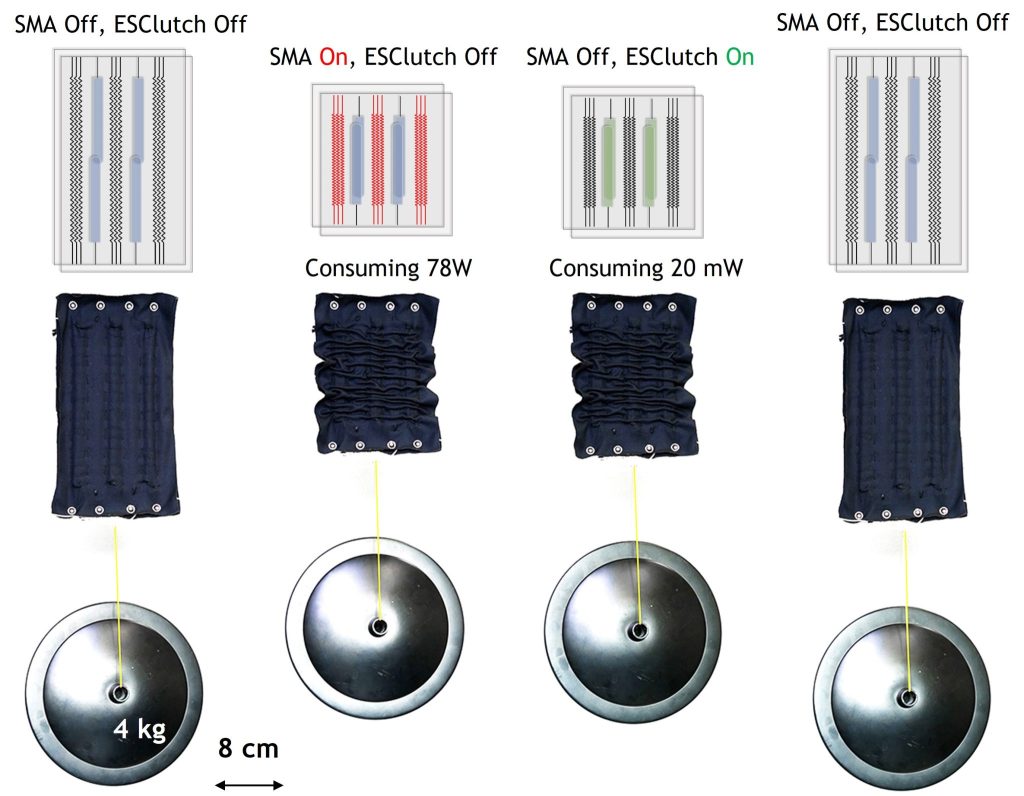
The working cycle of SEFA is shown below. When attached with a 4 kg weight, it is extended to a length of 21 cm. When SMAs are Joule heated with 78W electric power, contraction is generated up to 9 cm. To save the electric power of holding the weight, SMAs can be turned off and ESClutches can be turned on, using 20 milliwatts. Finally, if we turn off the ESClutch, SEFA is again extended by the weight.
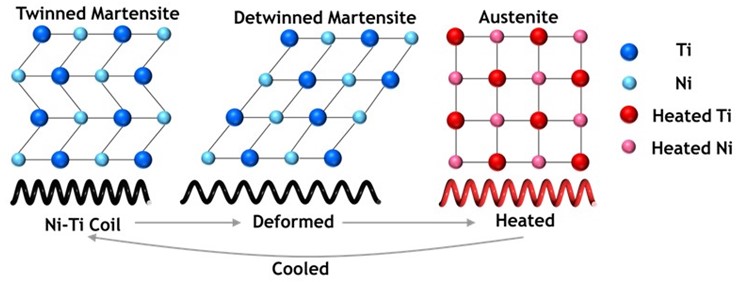
Why do SMAs consume so much power? They are thermal responsive active materials. they generate contraction due to phase change (microscopic lattice re-arrangement) as shown in Fig04, transforming thermal energy into kinetic energy. This energy conversion is usually accompanied with large heat loss, specifically, heat convection into air. Until now, the most commonly used SMAs are Ni-Ti alloys, with energy-efficiency as low as 3%.
Why ESClutches are so energy efficient? They are parallel plate capacitors composed of two electrodes with dielectric materials in-between (ideal capacitors consume zero power). As shown in Fig05, the parallel electrodes can freely slide over each other if the terminal voltage is zero. However, the sliding motion is blocked once there is a high terminal voltage (300 V), and the holding force can be up to 15N/cm2, but power consumption is as little as several milliwatts.

Multiple Layers of stacked SEFAs: SEFAs can be easily stacked in multiple layers to amplify the output force. As shown in Fig 06, three layers are just less than 1 cm, close to the thickness of down jacket worn in winter.

This work is published in Advanced Functional Materials in 2024: https://doi.org/10.1002/adfm.202415099