
Due its wide transparency window—spanning from the ultraviolet to the mid-infrared— high thermal conductivity, reduced thermo-optic coefficient and the presence of both second- and third- order intrinsic optical nonlinearities, aluminum nitride (AlN) is a promising material for various integrated photonic applications be they nonlinear optics, quantum photonics and quantum metrology or biosensing. LASPE’s expertise on III-nitride epitaxial growth gives access to high-quality AlN-on-sapphire epilayers that are subsequently characterized using a wide set of experimental techniques. Such layers are used to fabricate photonic integrated circuits for specific applications, including microring resonators and waveguide devices for targeting nonlinear optical effects such as second-harmonic generation and supercontinuum generation. In particular, the design and characterization of chips are done in the framework of an active collaboration with the Photonic Systems Laboratory (PHOSL) while their nanofabrication is conducted at the EPFL Center of MicroNanoTechnology (CMi).
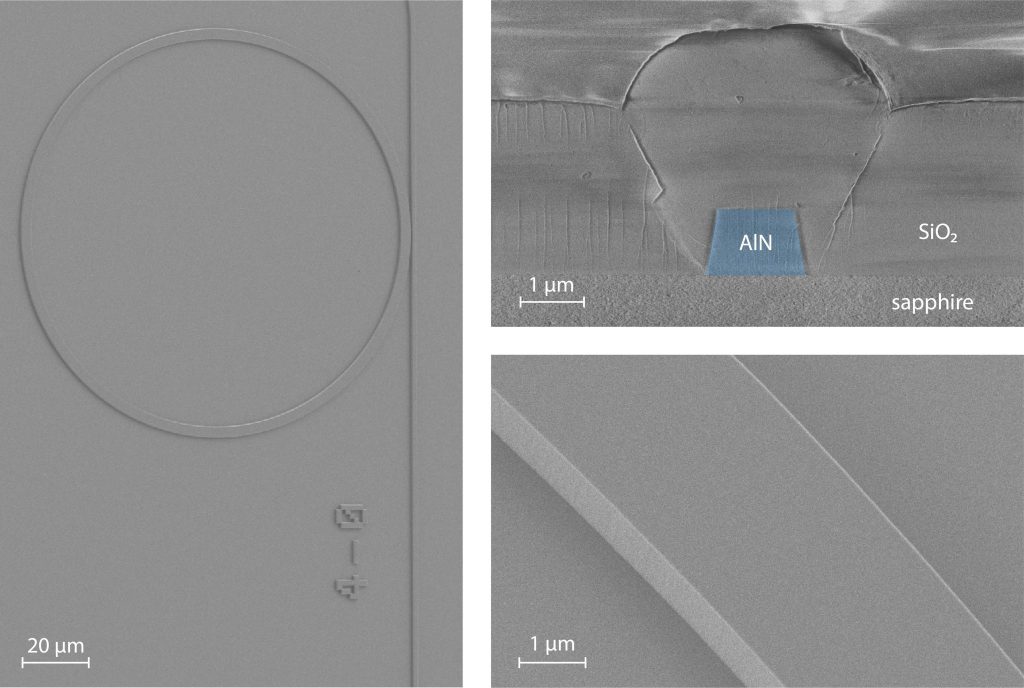
Fig. 1: Scanning-electron microscope images of a bus waveguide with a coupled AlN microring resonator. On the top right corner, we show a false-color image of a typical waveguide facet, whereas a tilted-view closeup of a microring can be found on the bottom right.
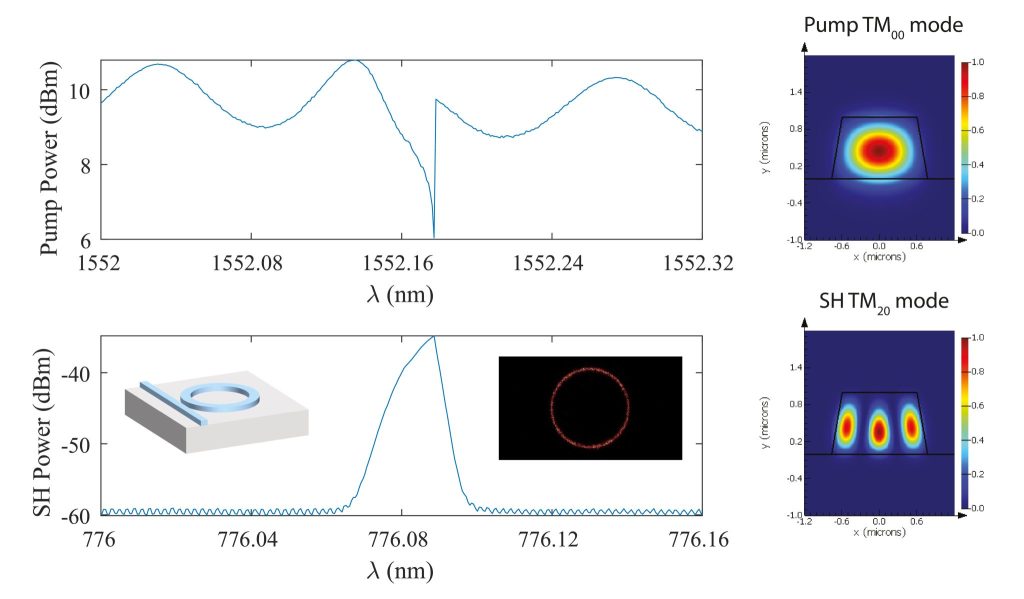
Fig. 2: Second-harmonic generation in an AlN microring resonator pumped at 1550 nm. When the second-harmonic signal is produced, a fraction is scattered away from the ring and some red light can be imaged using a conventional camera.
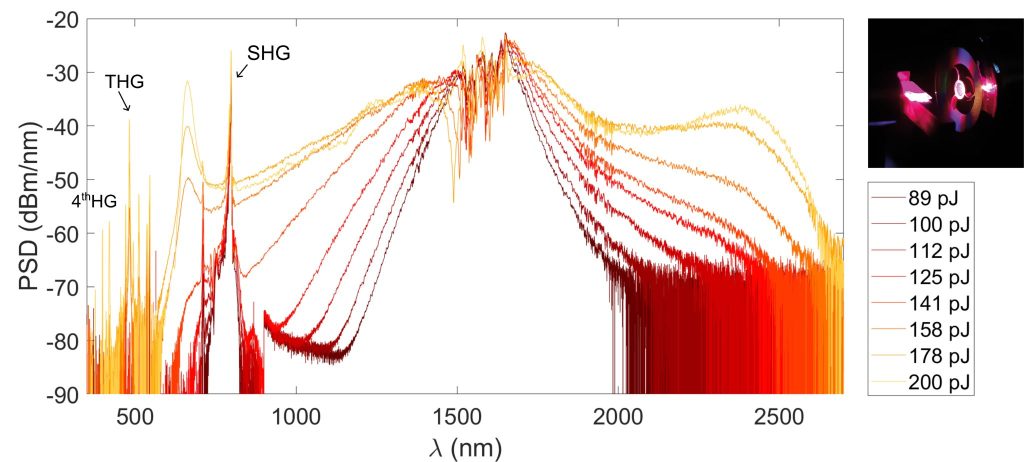
Fig. 3: Supercontinuum-generation spectra of an AlN waveguide pumped with a fs-pulsed laser at 1550 nm at different pulse energies. The inset shows visible light emitted from the chip when the pulsed laser beam is injected into the waveguide (measurements done through our collaboration with PHOSL).