AI in chemistry and beyond: Highlights in the field (ChE-605)

The Machine Learning Seminars are organized by Prof. Clémence Corminboeuf, Prof. Berend Smit and Prof. Philipp Schwaller, the seminars usually take place on Tuesdays at 15:15. Unless indicated otherwise, the lecture takes place on Zoom.

No scheduled events

See all events

PAST SEMINARS


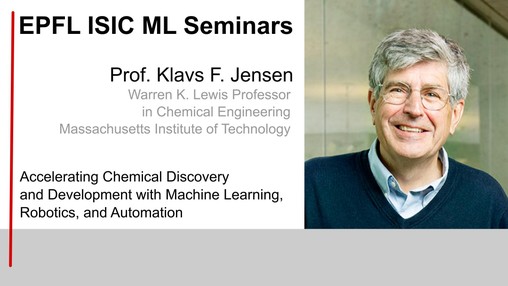
"Machine learning in chemistry and beyond" (ChE-605) seminar by Prof. Klavs F. Jensen: "Accelerating Chemical Discovery and Development with Machine Learning, Robotics, and Automation"

 18.11.2025   17:1518:15

Speaker: Prof. Klavs Flemming Jensen is a chemical engineer who is currently the Warren K. Lewis Professor at the Massachusetts Institute of Technology (MIT). Prof. Jensen was elected a member of the National Academy of Engineering in 2002 for fundamental contributions to multi-scale chemical reaction engineering with important applications in microelectronic materials processing and microreactor technology. From 2007 to July 2015 he was the Head of the Department of Chemical Engineering at MIT.
Location:  BCH 2218 &  Online
Category: Conferences – Seminars
Target audience: Informed public

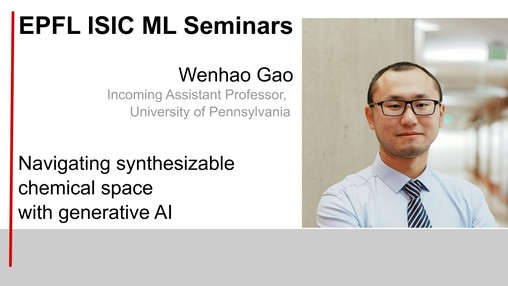
"Machine learning in chemistry and beyond" (ChE-605) seminar by Dr. Wenhao Gao: Navigating synthesizable chemical space with generative AI

 28.10.2025   17:0018:00

Speaker: Wenhao Gao is an incoming Assistant Professor in Chemical and Biomolecular Engineering at the University of Pennsylvania. He is currently a postdoctoral researcher at Stanford University with Prof. Grant Rotskoff and Stefano Ermon. Wenhao received his Ph.D. from MIT, where he was advised by Prof. Connor W. Coley. His research focuses on developing artificial intelligence methods that integrate chemical and physical principles to enable systematic and scalable molecular discovery for applications in drug design and sustainable materials. He has been recognized with numerous honors, including the Google PhD Fellowship, Takeda Fellowship, D. E. Shaw Research Fellowship, CAS Future Leaders recognition, and Forbes 30 Under 30 Asia in Healthcare and Science.
Category: Conferences – Seminars
Target audience: General public
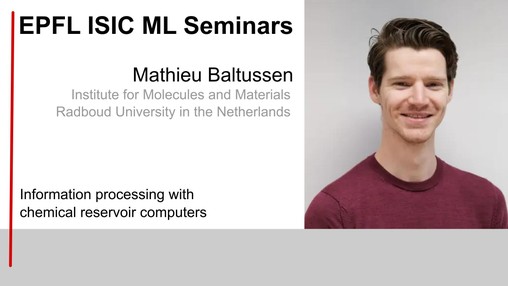
Machine learning in chemistry and beyond" (ChE-605) seminar by Mathieu Baltussen: Information processing with chemical reservoir computers

 14.10.2025   15:1516:00

Speaker: Mathieu Baltussen recently completed his PhD at the Institute for Molecules and Materials, Radboud University in the Netherlands. His research focused on information processing in chemical networks, resulting in the first reported chemical-based and protein-based reservoir computers. He also developed data-driven learning and optimization algorithms for synthetic enzyme pathways. Before his PhD he obtained cum laude double MSc degrees in physics and chemistry at Utrecht University and spent a year as an Erasmus research student investigating grain boundary dynamics in liquid crystals in the Colloid group at Oxford University.      
Category: Conferences – Seminars
Target audience: General public
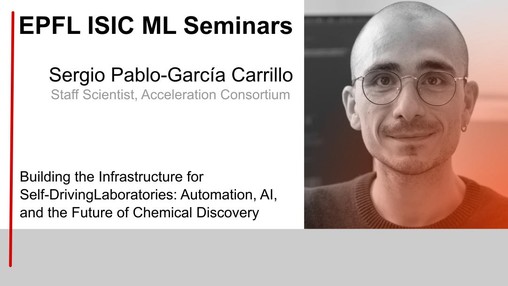
"Machine learning in chemistry and beyond" (ChE-605) seminar by Sergio Pablo-GarcĂ­a Carrillo: "Building the Infrastructure for Self-Driving Laboratories: Automation, AI, and the Future of Chemical Discovery"

 30.09.2025   15:1516:15

Speaker: Sergio Pablo-GarcĂ­a Carrillo earned his PhD at the Institut CatalĂ  d’InvestigaciĂł QuĂ­mica on chemoinformatics, automation, and machine learning for catalysis. He then joined the University of Toronto, focusing on lab automation and self-driving labs. His research now centers on automating chemistry, data management, and AI integration. Self-driving laboratories (SDLs) represent a transformative paradigm in chemical and materials discovery, integrating automated hardware with artificial intelligence to accelerate research. However, realizing the full potential of SDLs requires the development of key technological components, from intelligent software optimizers to advanced automation systems. In this talk, I will discuss the challenges and opportunities in building the infrastructure necessary for SDLs, highlighting the role of the Acceleration Consortium in driving this innovation. Additionally, I will explore how AI-powered tools, such as large language models for chemical data extraction, can seamlessly integrate into the SDL ecosystem, further enhancing research efficiency and discovery.
Category: Conferences – Seminars
Target audience: General public

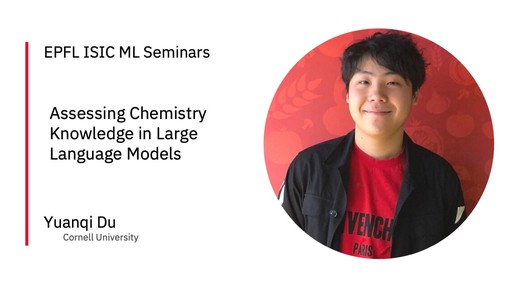
"Machine learning in chemistry and beyond" (ChE-651) seminar by Yuanqi Du: "Assessing Chemistry Knowledge in Large Language Models"

 27.05.2025   15:1516:15

Speaker: Yuanqi Du is a graduating PhD student at the Department of Computer Science, Cornell University, studying AI and its intersection with scientific discovery. His research interests include geometric models and probabilistic models (language models, generative models, sampling, stochastic control, optimal transport), and their applications in molecular simulation and discovery. Aside from his research, he is passionate about education and community building. He leads the organization of a series of events such as the Learning on Graphs conference and AI for Science, Probabilistic Machine Learning workshops at ML conferences and an educational initiative (AI for Science101) to bridge the AI and Science community.
Category: Conferences – Seminars
Target audience: General public
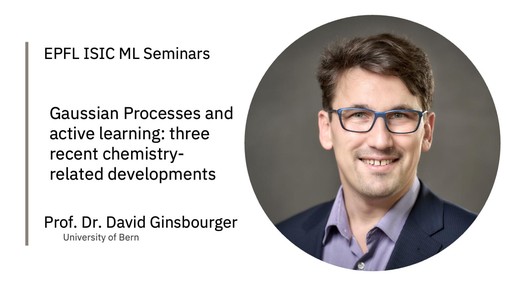
Gaussian processes and active learning: three recent chemistry-related developments

 18.03.2025  

Speaker: David Ginsbourger is heading the Uncertainty Quantification and Spatial Statistics Group and serving as Director of Studies in Statistics at the University of Bern, where I he is co-directing the Institute of Mathematical Statistics and Actuarial Science. At the University of Bern, he is also a member of the Oeschger Center for Climate Change Research, the Center for Artificial Intelligence in Medecine, and the Multidisciplinary Center for Infectious Diseases. On the editorial side, he is serving as Associate Editor of SIAM/ASA Journal on Uncertainty Quantification, Technometrics, and regularly as Area Chair / Meta-Reviewer for major Machine Learning conferences.
Category: Conferences – Seminars
Target audience: General public
Seminar by Derek van Tilborg: "Molecular deep learning at the edge of chemical space"

 04.03.2025   15:1516:15

Speaker: Derek van Tilborg
Category: Conferences – Seminars
Target audience: General public
"Machine learning in chemistry and beyond" (ChE-651) seminar by Dr. Tong Xie: "From Token to Discovery: A New Paradigm in Material Discovery"

 18.02.2025   15:1516:15

Speaker: Tong Xie gained his PhD from the School of Photovoltaic and Renewable Energy Engineering (SPREE), UNSW Sydney, acclaimed as one of Australia’s National Computational Infrastructure’s Top 10 HPC AI-Talents. As the CEO of GreenDynamics and the Group Lead of UNSW AI4Science, he is pioneering the use of Generative AI to accelerate the discovery and development of sustainable materials. His expertise extends to Natural Language Processing and Material Science. He also founded the DARWIN natural science language model, demonstrating his innovative approach to advancing AI in material sciences.
Category: Conferences – Seminars
Target audience: General public
Molecular deep learning at the edge of chemical space.

 04.02.2025   15:1516:15

Speaker: Derek van Tilborg
Category: Conferences – Seminars
Target audience: General public
Three Chemical Prediction Problems that AI will Solve (with Our Help)

 12.11.2024   15:1516:15

Speaker: Brett Savoie is the inaugural Coyle Mission Collegiate Professor of Engineering in the Department of Chemical and Biomolecular Engineering at the University of Notre Dame. Brett graduated with degrees in chemistry and physics from Texas A&M University in 2008, obtained his Ph.D. in theoretical chemistry from Northwestern University in 2014, and from 2014-2017 was a postdoc with Thomas Miller at Caltech. In 2017, Brett joined the faculty of the Davidson School of Chemical Engineering at Purdue University, where he established an independent research group to develop physics-based and machine learning methods to characterize and discover new organic materials. In 2022, Brett was promoted to the Charles Davidson Associate Professor of Chemical Engineering at Purdue University. In July 2024, Brett joined the faculty at Notre Dame to advance computational materials research and lead the university’s Scientific AI (SAI) initiative. Brett is the recipient of the ACS PRF, NSF CAREER, Dreyfus Machine Learning in the Chemical Sciences, and ONR YIP awards.
Category: Conferences – Seminars
Target audience: General public
Machine learning in chemistry and beyond" (ChE-651) seminar by Prof. Kim Jelfs: "Remembering the lab in computational molecular material discovery"

 01.10.2024   15:1516:15

Speaker: Kim Jelfs completed her PhD in Computational Chemistry at University College London, working on the development and application of modelling to understand zeolite crystal growth and was awarded the Ramsay Medal for the best completing PhD student. She then went on research visits at the Universitat de Barcelona, the University of Liverpool, and finally Imperial as a research fellow, where she is now a Professor since 2022. Kim was awarded a 2018 Royal Society of Chemistry Harrison-Meldola Memorial Prize, a 2019 Philip Leverhulme Prize in Chemistry and was named the 2022 UK Blavatnik Awards Laureate in Chemistry. Kim holds an ERC Starting Grant and is an Associate Editor for Chemical Communications.        
Category: Conferences – Seminars
Target audience: General public
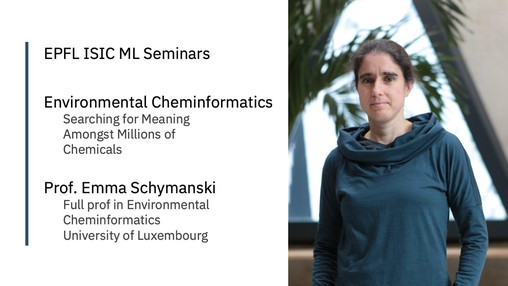
Machine learning in chemistry and beyond" (ChE-651) seminar by Prof. Emma Schymanski: "Environmental Cheminformatics – Searching for Meaning Amongst Millions of Chemicals"

 17.09.2024   15:1516:15

Speaker: Prof. Emma Schymanski is chemist known for her work identifying unknown organic compounds, particularly pollutants. She graduated with a B.Sc. in Chemistry and a B.E. in Environmental Engineering from the University of Western Australia in 2003. She completed her PhD at the Helmholtz Centre for Enironmental Research in Leipzig, Germany in 2011, and a postdoc position at the Swiss Federal Institute of Aquatic Science and Technology. She is now head of the Environmental Cheminformatics Group as a Full Professor at the University of Luxembourg.
Category: Conferences – Seminars
Target audience: General public
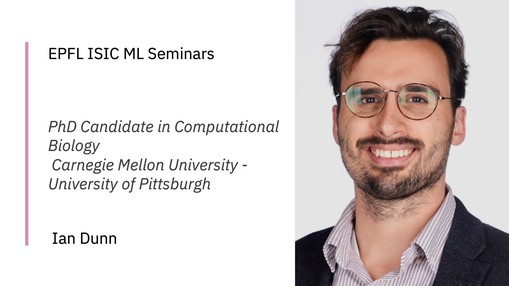
3D de novo generation of organic molecules

 25.06.2024   15:1516:15

Speaker: Ian is a PhD Candidate in the joint Carnegie Mellon University – University of Pittsburgh Computational Biology PhD Program where he is advised by David Koes. His research is focused on developing deep generative models for applications in structure-based design.
Category: Conferences – Seminars
Target audience: General public
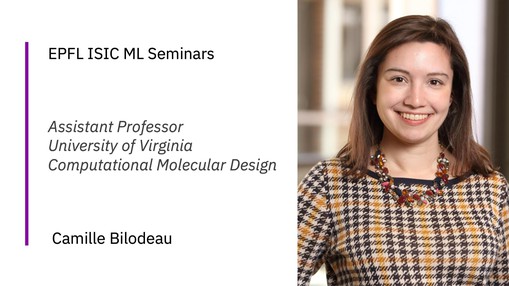
Generative Models for Molecular Discovery

 02.04.2024   15:1516:15

Speaker: Dr. Bilodeau is currently an assistant professor in Chemical Engineering at the University of Virginia. She received her B.S. and M.S. from Northwestern University and her Ph.D. from Rensselaer Polytechnic Institute, both in Chemical and Biological Engineering. During her Ph.D., she received the Lawrence Livermore Advanced Simulations and Computation Graduate Fellowship, through which she carried out research at Lawrence Livermore National Laboratory. She completed a postdoc at MIT working with Klavs Jensen and Regina Barzilay. Her research explores the intersection between artificial intelligence and molecular simulations with the goal of designing new molecules and materials.
Category: Conferences – Seminars
Target audience: General public
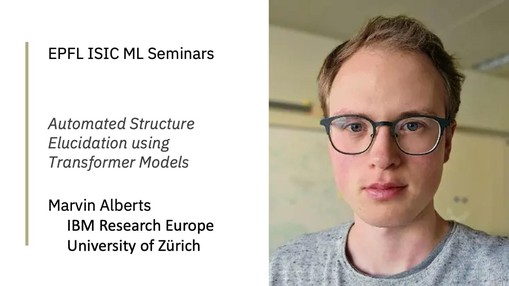
Automated Structure Elucidation using Transformer Models

 05.03.2024   15:3016:30

Speaker: Marvin is a PhD student jointly at IBM Research and the University of ZĂŒrich. His research focusses on multimodal language models applied to analytical chemistry. Before joining IBM he completed a Masters in Chemistry at Imperial College London.
Location:  CH G1 495 &  Online
Category: Conferences – Seminars
Target audience: General public

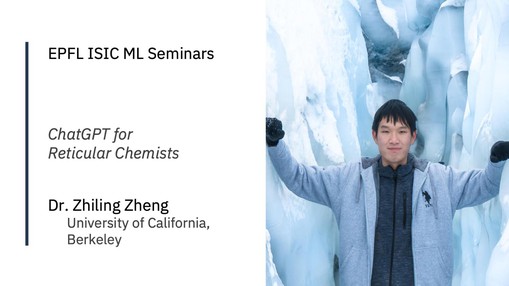
ChatGPT for Reticular Chemists

 12.12.2023   15:1516:15

Speaker:   Dr. Zhiling Zheng is a Postdoctoral Associate at the Massachusetts Institute of Technology and a member of the Bakar Institute of Digital Materials for the Planet (BIDMaP). He completed his Bachelor’s degree in Chemistry and Chemical Biology at Cornell University in 2019, where he worked under the guidance of Prof. Kyle M. Lancaster. He then earned his Ph.D. in Chemistry from the University of California, Berkeley in 2023, supervised by Prof. Omar M. Yaghi. In the early phase of his Ph.D., Dr. Zheng was trained as an experimental chemist, focusing on the design and synthesis of Metal-Organic Frameworks (MOFs) for atmospheric water harvesting and CO2 capture. Later, his research scope expanded to the use of large language models (LLMs) and machine learning (ML) in accelerating the discovery of reticular materials and drug molecules. Dr. Zheng is recognized as a Merrill Presidential Scholar and has received the Kavli ENSI Graduate Student Fellowship for his contributions to AI and Chemistry.
Category: Conferences – Seminars
Target audience: General public

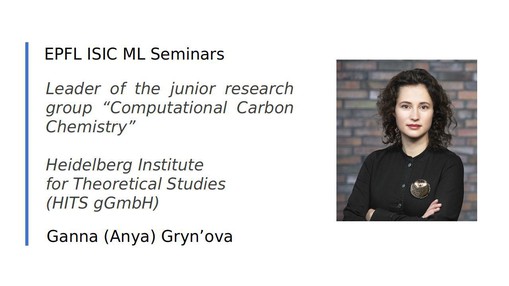
Exploring Chemical Space with Machine Learning

 04.12.2023   15:1516:15

Speaker: Originally from Ukraine, Ganna (Anya) Gryn’ova received her BS and MSc in chemistry summa cum laude from Oles Honchar Dnipro National University. In 2014 she received a PhD in computational chemistry from Australian National University. Her doctoral thesis gathered a number of awards, including the IUPAC-Solvay International Award for Young Chemists for one of the five most outstanding PhD theses in the general area of the chemical sciences worldwide. Dr. Gryn’ova continued her research career at École Polytechnique Fédérale de Lausanne as a postdoctoral researcher working on in silico modeling of organic semiconductors. In 2016 she won the Marie SkƂodowska-Curie Actions individual fellowship and focussed on the non-conventional architectures of single-molecule junctions. In 2019, Dr. Gryn’ova started her independent scientific career leading the junior research group “Computational Carbon Chemistry” (CCC) at the Heidelberg Institute for Theoretical Studies (HITS gGmbH) and Interdisciplinary Center for Scientific Computing (IWR) at Heidelberg University, Germany. The CCC group uses state-of-the-art computational chemistry and data science to explore and exploit diverse functional organic materials for applications in organocatalysis and environmental remediation. In 2021, Anya received the prestigious ERC Starting Grant for her project “PATTERNCHEM: Shape and Topology as Descriptors of Chemical and Physical Properties in Functional Organic Materials”; she is also a principal investigator in the Collaborative Research Centre SFB1249 “N-Heteropolycycles as Functional Materials” and the SIMPLAIX strategic research initiative on bridging scales from molecules to molecular materials by multiscale simulation and machine learning.
Location:  BCH 2218 &  Online
Category: Conferences – Seminars
Target audience: General public

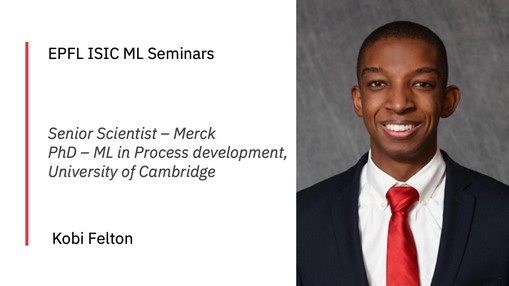
Accelerated Chemical Reaction Optimization using Multi-Task Learning

 14.11.2023   14:0015:00

Speaker: Kobi Felton is a chemical engineer interested in solving problems at the intersection of chemical engineering, chemistry and software. He holds a Bachelor of Science in Chemical Engineering from North Carolina State University and a MPhil Research and PhD in Chemical Engineering from the University of Cambridge, where he was a recipient of the Marshall Scholarship and the Cambridge-Marshall PhD Scholarship. His current projects include: Optimization of distillation control systems, Self-optimization of reactions using bayesian algorithms, Design of experiments for time-series datasets, and Designing descriptors for chemical reactions.
Category: Conferences – Seminars
Target audience: General public

What can AI do for molecular simulation?

 07.11.2023   15:1516:15

Speaker: Frank NoĂ© has a background in Electrical Engineering, Computer Science and Physics and did his PhD at University of Heidelberg in 2006. He became group leader at FU Berlin in 2007 and professor in 2013. Since 2022 he is Partner Research Manager in Microsoft Research AI4Science, also located in Berlin. Frank has received two European Research Commission (ERC) grants and the early career award in Theoretical Chemistry of the American Chemical Society (ACS). He is member of the Berlin-Brandenburg academy of sciences, a fellow in the European Laboratory for Learning and Intelligent Systems (ELLIS) and an ISI highly cited researcher. Frank’s research is highly interdisciplinary and focuses on developing Machine Learning methods to address fundamental questions in the natural Sciences.
Category: Conferences – Seminars
Target audience: General public

Molecular set representation learning

 24.10.2023   15:1516:15

Speaker: Daniel received his BSc in computer science at the Bern University of Applied Sciences in 2013 and his MSc in Bioinformatics and Computational Biology at the University of Bern in 2016. In 2020 he received his PhD in Chemistry and Molecular Sciences for his thesis “Scalable Methods for the Exploration and Visualization of Large Chemical Spaces” from the University of Bern under the supervision of  Prof. Jean-Louis Reymond. His main research interest is efficient machine learning and data visualisation applied to natural sciences, focusing on the intersection of chemistry and biology. After a two-year stay as a permanent research staff member at  IBM Research in the Team of Teodoro Laino working on machine learning for biocatalysis, he started as a postdoctoral researcher in the group of  Prof. Pierre Vandergheynst at EPFL.
Location:  MA A1 10
Category: Conferences – Seminars
Target audience: General public

See all events