
Institution Organisation Commission and delegates Associations Alumni
Institution
The Swiss Federal Institute of Technology Lausanne is structured into five major faculties: the School of Computer and Communication Sciences (IC), the School of Basic Sciences (SB), the School of Engineering (STI), the School of Life Sciences (SV), and the School of Architecture, Civil and Environmental Engineering (ENAC). Integrated into ENAC, the Institute of Architecture and the City (IA) is dedicated to research, while the Architecture Section (SAR) is responsible for teaching.
The School of Architecture, Civil and Environmental Engineering (ENAC) brings together three disciplines: environmental science and engineering, architecture and civil engineering. Created in 2002, this faculty’s mission is to address the complex challenges of sustainability and urbanisation in the 21st century. Adopting a transdisciplinary approach, ENAC combines these three fields to develop innovative solutions aiming to ensure a sustainable living environment for humanity.
The Institute of Architecture and the City (IA) is the ENAC structure responsible for research. Founded in 2002, it brings together researchers, students involved in research, and the institute’s management and administration. The institute comprises some twenty laboratories and several research groups. Research within the IA is developed primarily according to the specificities and skills of the laboratories and groups that comprise it.
The Architecture Section (SAR) is the ENAC structure responsible for teaching. In 2002, it replaced the former Architecture Department created in 1943 and joined the ENAC faculty alongside the former Civil Engineering and Rural Engineering Departments. The Architecture Section brings together teaching staff, students enrolled in the section, and the section’s management and administration. It offers two academic programmes leading to a bachelor’s and a master’s degree, respectively.
EPFL Architecture refers to the entity that brings together everything related to the field of architecture at EPFL. This term emerged in 2020 and reflects a desire to combine research and teaching, and to no longer differentiate between them in communications and strategies concerning architecture at EPFL.
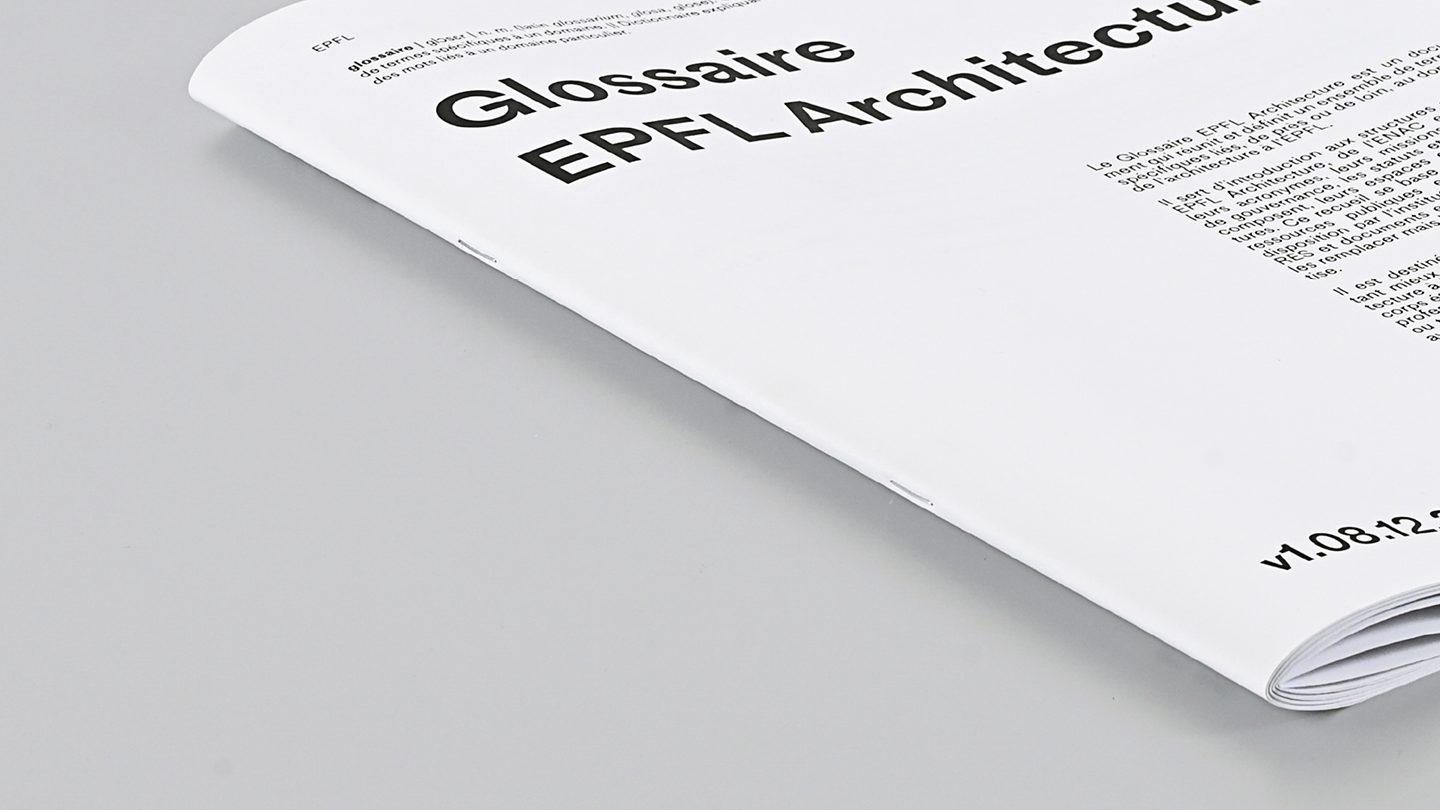
The EPFL Architecture Glossary defines terms related to the field of architecture at EPFL. It serves as an introduction to the fundamental structures of EPFL Architecture, ENAC, and EPFL, including their acronyms, missions, governance, statutes, and roles, as well as their spaces and infrastructure. The glossary is a contextualised, non-exhaustive document that is constantly evolving.

Organisation
The Institute of Architecture and the City (IA) and the Architecture Section (SAR) together form the EPFL Architecture. Their management team works collectively on academic aspects, curriculum quality, research strategy, and budget and resources, in collaboration with ENAC management.
Institute of Architecture
Director, Prof. Pier Vittorio Aureli
Architecture Section
Director, Prof. Sophie Delhay
Architecture Section
Deputy, Vanda Costa
Administrator, Gesualdo Casciana
Educational Coordinator, Maria Cunha
Master’s Project Coordinator, Corinne Waridel
Exchange Coordinator, Dr Sophie Lufkin
Visiting Programme Administrator, Corinne Chaumont Ganty
Institut d’architecture
Administrator, Isabelle Cogotti
Collaborator, Maria Cunha
EPFL Architecture
Head of communication, Marie Page
Commission and delegates
At EPFL, teaching commissions develop the study plans and the study control regulations in accordance with the guidelines set by the Vice-Presidency for Education. Students are represented by delegates and the general representative association in the school assembly, faculty councils and teaching committees, ensuring that their voices are heard in academic decisions.
Academic year 2025-26
President of the Commission
Section director, Prof. Sophie Delhay
Section deputy, Laure Kochnitzky Palluel
Professors, teaching lecturers and research lecturers (MER)
Prof. Nicola Braghieri, LAPIS
Prof. Claudia Devaux, ADHER
Prof. Charlotte Malterre-Barthes, RIOT
Dr. Andreas Schueler
Intermediate body
Maria João Cunha, SAR
EDAR doctoral student representatives (1 per CESAR session):
Reda Berrada, LAPIS
Tiffanie Paré, THEMA
Jérôme Zufferey, ENAC IT, lecturer SAR
Pierre Zurbrügg, SXL, lecturer SAR
ASAR (Architecture Department Student Association)
(1 per CESAR session):
Youssef Kali, 1st year master’s
Grégoire Rivier, 1st year master’s
Etudiant·es
Class representatives (see list below)
Academic year 2025-26
Students (1 delegate per year per CESAR meeting)
Tristan Béran, Preparatory year
Ana Jutzi, Preparatory year
Teodora Tilica, 2nd year of bachelor’s
Ariel Ghisays Berlincourt, 2nd year of bachelor’s
Mayli Bourgne, 3rd year of bachelor’s
Cyril Matala-Tala, 3rd year of bachelor’s
Esther Chatelain, 1st year of master’s
Nora Guigues, 1st year of master’s
Jean-Baptiste Bouleux, 2nd year of master’s
Composition and method of appointment (Art. 18 *)
Each Faculty section has its own teaching commission.
Teaching commissions are composed of members belonging to the corresponding section, namely:
- the section director, who chairs the commission,
- lecturers, assistants, research assistants and doctoral candidates,
- students.
Except for the section director, the members of the teaching commissions are appointed by the Faculty management after the Faculty Council approves the proposal. The term of office is two years; for students, it is one year. These terms of office are renewable.
Responsibilities, convocation and decision-making (Art. 19*)
The teaching commissions propose, in accordance with the guidelines of the Vice-Presidency for Education, the study plans and regulations for the assessment of studies in their respective sections.
- They evaluate the implementation of the study plans and the assessment of studies and propose improvements or adjustments.
- They coordinate their activities within the Faculty through their chairpersons. They may set up a coordination group.
- They settle day-to-day issues related to the running of studies.
- They advise the Faculty management on all matters relating to teaching.
- They advise the section directors.
- They meet at least once per semester, either at the request of their chair or upon the request of three of their members.
- They take their decisions by a simple majority of the members present.
Excerpt from the ENAC Organisational Regulations of 3 March 2003
Associations
EPFL recognises associations that comply with Swiss legal criteria, include members of EPFL or UNIL, and are dedicated to activities related to its missions. Among more than 100 recognised associations, ASAR is the only one linked explicitly to EPFL Architecture, managing its own governing bodies and commissions.
Associations
ASAR, Architecture Student Association
Commissions d’ASAR
DRAG lab, Promotion of parity and diversity
Event, Organisation of occasional socio-cultural and festive events
In Situ, Organisation of construction site visits
L’Atelier Magazine, Student platform for cross-disciplinary research, writing and publishing
La Baraque, Architecture Section Student Ball
MAP, Master Architectural Projects
OsCAR, Organisation of architectural competitions
TNT, Transition to a New Work Culture
Tournoi Bernard, Human Table Football Competition
UDA, A Dinner With
Alumni
EPFL Alumni connects EPFL graduates to an exclusive international network of over 40,000 contacts. Offering opportunities for networking, training, and advice across a variety of areas, such as careers and entrepreneurship, the organisation facilitates exchanges among alumni through its local and international chapters.