At LQNO we are interested to explore the influence of static electric fields on SERS and plasmon enhanced SFG on molecules, as well as the correlation between dynamic phenomena in the current and optical enhancement, to push the limits of our understanding in light-matter interactions at the nanoscale.
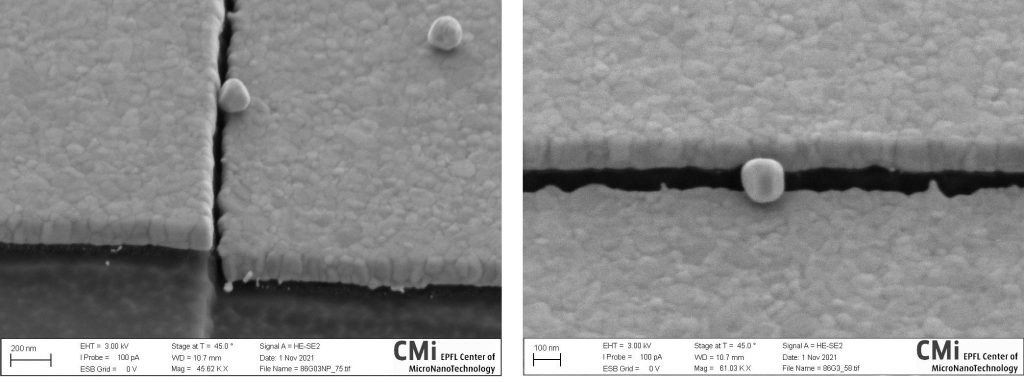
Our molecular junctions consist of a single layer of molecules placed between two contact metallic electrodes. To achieve this, we place the particle between a larger gap of electrodes functionalised with molecules.
Such small gaps between metallic structures (such as the widely used nanoparticle on mirror geometry) provide huge field enhancements not only at visible frequencies but also strong dc-electric fields (add image of simulation). This allows to enhance at the same time the light molecule coupling as well as to apply large fields and currents on the single molecular layer.
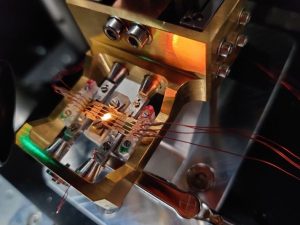
Different systems are used to explore the electron-phonon photon interplay, from mechanical break junctions in collaboration with IBM Zurich [1] to larger junctions formed by dielectrophoretic trapping [2], each system presents its own advantages.
[1] C.M. Gruber et al. Nano Letters 20, 6, 4346–4353 (2020) [https://pubs.acs.org/doi/abs/10.1021/acs.nanolett.0c01072]
[2] Amirtharaj, S.P, et al. “Light Emission and Conductance Fluctuations in Electrically Driven and Plasmonically Enhanced Molecular Junctions.” ACS Photonics 11, no. 6 (June 19, 2024): 2388–96. [https://doi.org/10.1021/acsphotonics.4c00291]