
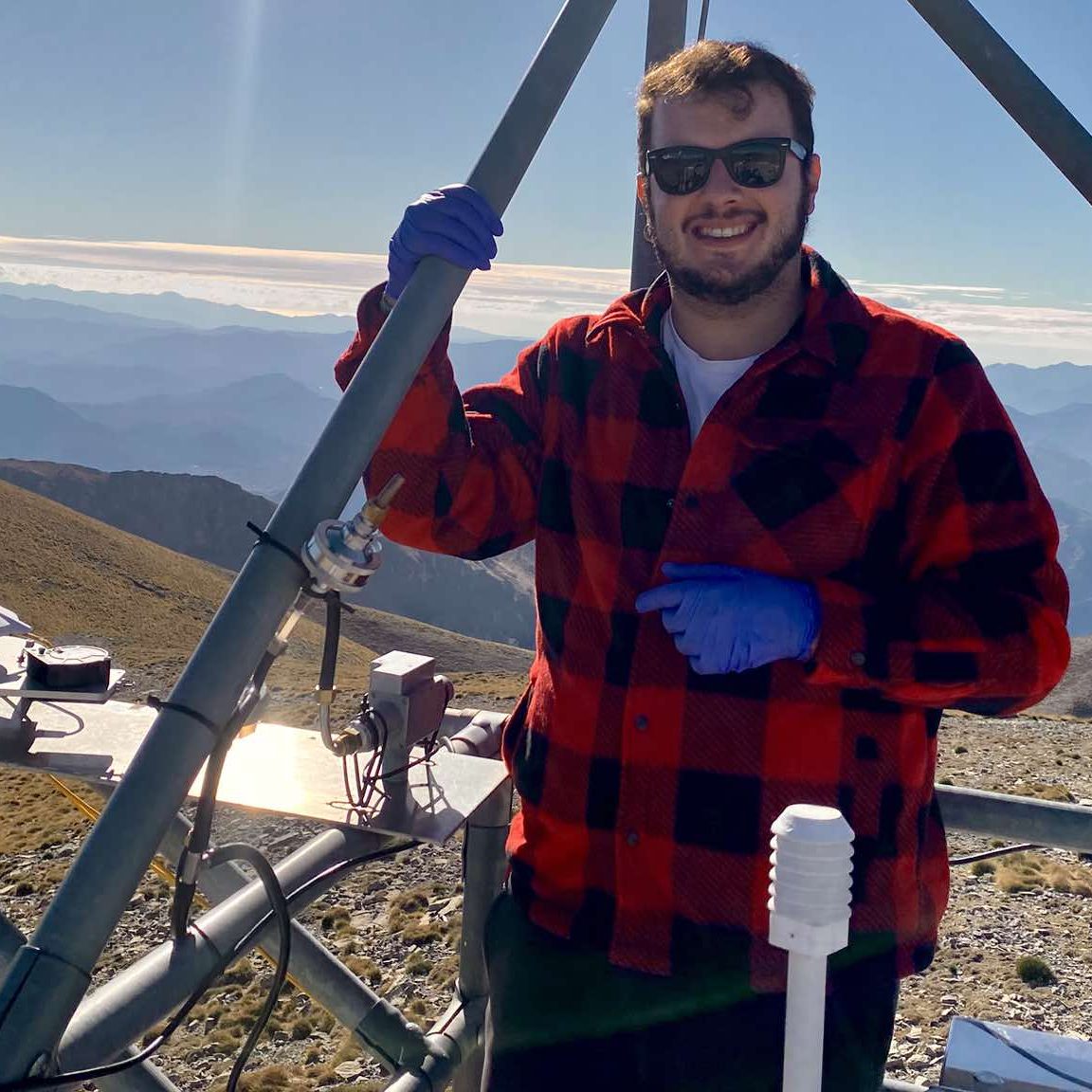
Can you say a few words about yourself?
I was born and raised in Patras, Greece, where I completed both my Bachelor’s degree in
Environmental Engineering and my Master’s degree in Chemical Engineering at the University
of Patras. Currently, I am a PhD candidate in Chemical Engineering at the University of Patras,
conducting my research at FORTH/ICE-HT. Through this research, I aim to deepen our
understanding of atmospheric acidification processes and their broader implications for air
quality and public health.
Did you choose your profession or did it choose you?
I would say it was a bit of both. Initially, I was drawn to environmental engineering because of
my passion for sustainability and solving real-world problems. I’ve always been interested in
how human activities impact the environment and wanted to be part of the solution. Over
time, I realized that the field perfectly aligned with my skills and values, making it feel like the
profession had chosen me as well. Environmental and Chemical Engineering are dynamic and
impactful fields, and I’m excited to contribute to building a more sustainable future.
What attracted you to join LAPI?
The opportunity to work with a team of experts who are commited to tackling pressing
environmental challenges really resonated with my own values. I’m eager to contribute to
LAPI’s mission and collaborate on impactful projects that can have a positive impact both
locally and globally.
Can you speak about the projects you are currently working on and other ones in the past?
During my undergraduate studies, I developed a flood prevention model for a real lake using
Computational Fluid Dynamics (CFD), which sparked my interest in applying theoretical
knowledge to real-world environmental challenges. For my Master’s diploma thesis, I focused
on engineering pH-sensitive polymeric sensors for detecting aerosol acidity—an effort that
became the most successful part of my graduate work. These sensors, were analyzed using
Raman and Surface-Enhanced Raman Spectroscopy (SERS), demonstrated strong potential for
environmental monitoring. Building on this success, I am continuing this research in my PhD,
aiming to optimize the sensors for real-time, wide-range pH detection. More broadly, my work
investigates the acidity of aerosols from various sources and examines the effects of
acidification and aging processes on oxidative potential (OP) and other key aerosol properties,
using both laboratory and field experiments.
What have been some of your biggest challenges?
One of the biggest challenges I’ve faced is balancing innovation with practical implementation
– comping up with new solutions while ensuring they are feasible and sustainable on a larger
scale. Also, staying adaptable in a constantly evolving field is both demanding and essential.
What have been some of your biggest successes?
One of my most significant research achievements to date has been the engineering of pH-
sensitive sensors—a key outcome of my Master’s thesis and the foundation of my current PhD
work. These sensors, successfully identified real pH values of aerosols in the critical range of
0.75 to 4—a range with profound implications for environmental and biological systems. This
capability was demonstrated during the CHOPIN Campaign in the winter of 2024, conducted
at a high-altitude setting on Helmos Mountain, Greece. Contributing to this field campaign
further validated the sensors’ performance in real-world conditions and highlighted their
potential for advancing atmospheric chemistry research.
You split your time between teaching and research. How do you view these two roles?
I view teaching and research as complementary roles that enhance each other. Both, keep you
grounded in the fundamentals of the field, while exploring new ideas and solving complex
problems. Each one enhances and strengthens the other.
What do you enjoy to do, outside of science and research?
Outside of science and research, I enjoy activities that allow me to connect with nature, such
as swimming, diving and hiking. It helps me recharge and stay inspired. I’m also very
passionate about volunteering for environmental causes, such as local clean-up initiatives. I
love reading – whether it’s about chemistry and environmental topics, personal development
– It’s a bit of a cliché, I know, or even fiction. And I’m a huge Star Wars fan – just imagine
working with lasers!
Where is the most interesting place you’ve been?
Every city I’ve visited has left a lasting impression on me, making it impossible to choose just
one as the most captivating!
A free thought for the end?
Just as the Force binds all things in the galaxy, my passion for lasers and atmospheric science
has united my childhood dreams with my current research. As Yoda says, ‘The journey is the
reward,’ and this adventure is far from over.