
Keywords: 3D printing, photopolymerization, wavefront shaping, multimode fiber
Background
Light-based 3D printing enables the fabrication of complex three-dimensional structures by locally polymerizing a photosensitive resin using a focused light source. The final feature size and shape therefore depend on several parameters, including the intensity and duration of illumination, the size of the focused spot, the overlap between neighboring exposures, and the diffusion of oxygen and reactive species within the resin. Understanding and controlling the delivered dose is consequently essential for achieving high-resolution printing while avoiding unwanted polymerization outside the desired structure.
An interesting approach to miniaturizing light-based fabrication is to use a multimode optical fiber (MMF) to deliver and focus the light. Morales-Delgado et al. demonstrated three-dimensional microfabrication through a multimode optical fiber by using wavefront shaping to generate and scan a focused spot at the distal end of the fiber [1]. More recently, transmission-matrix-based wavefront shaping has been used to improve the control and efficiency of microfabrication through optical fibers, including optimization of the focal spot and printing strategy [2]. These approaches open the possibility of performing microfabrication remotely through a very small optical probe, which could be particularly interesting for in-situ fabrication in confined or otherwise inaccessible environments.
Our group has developed FLIMME, a fluorescence lifetime endomicroscope based on wavefront shaping through a single multimode fiber [3]. The system uses the transmission matrix of the fiber to control the optical field at its distal end. Although an MMF produces a seemingly random speckle pattern at its output, controlling the input wavefront allows the light to be concentrated into a diffraction-limited focal spot. By changing the input wavefront, this spot can be scanned across the distal field without mechanically moving the fiber. The same principle can therefore be used to deliver a controlled optical dose to selected positions in a photosensitive resin (Figure 1).
The remaining speckle background must remain below the polymerization threshold. When the focal spot is scanned, the background illumination accumulates over time and can potentially result in unwanted polymerization outside the intended structure (Figure 2). The achievable printing resolution is therefore determined not only by the size of the optical focus, but also by the enhancement, power ratio, scanning strategy, and polymerization threshold of the resin. Understanding these effects and developing appropriate compensation strategies are key challenges for MMF-based 3D printing.
A further challenge is the interaction between the optical probe and the resin. If the resin is in direct contact with the distal end of the MMF, unwanted polymerization can occur on the fiber surface, potentially damaging or contaminating the probe and preventing repeated use. The proposed approach uses a trapped air layer between the MMF probe and the liquid resin. Similar to an inverted cup immersed in water, the geometry can maintain an air–liquid interface while keeping the resin separated from the optical surface. This principle could provide a simple way to protect the MMF while allowing light to be delivered through the air–resin interface and used for in-situ printing.
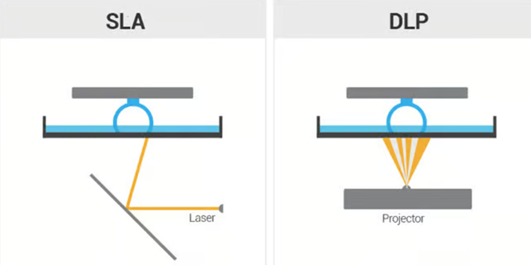
Figure 1 – Printing strategies using a scanning spot or a projected pattern
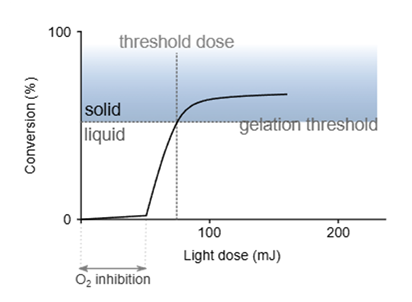
Figure 2 – Typical conversion curve of acrylates used for 3D printing resins
Project description
The objective of this project is to develop and characterize an ultra-thin multimode fiber probe for in-situ 3D printing based on wavefront shaping and controlled photopolymerization using the FLIMME setup (Figure 3).
First, the student will improve and characterize the current probe design based on the trapped-air/cup principle (Figure 4). The stability and geometry of the air–liquid interface will be investigated, with the aim of maintaining a reliable separation between the distal end of the MMF and the photosensitive resin during printing. Different geometrical configurations and experimental conditions will be evaluated to minimize resin leakage, interface instabilities, and unwanted polymerization on the fiber.
The student will then characterize the printing response of the system by performing controlled dose experiments. The influence of parameters such as exposure time, focal spot size, scanning speed, number and spacing of scanning spots, and overlap between neighboring spots will be investigated. The resulting printed features will be characterized to determine the relationship between optical dose and polymerized volume, and to identify the conditions required to obtain well-defined features while keeping the surrounding speckle background below the polymerization threshold.
Based on these measurements, the student will develop strategies for generating and optimizing printing patterns through the MMF. Python will be used to simulate the expected dose distribution, generate scanning trajectories, and compensate for the experimentally measured optical response of the system. In particular, the student will investigate how the measured point spread function, focal enhancement and power ratio, influence the final printed structure.
Finally, the student will demonstrate in-situ fabrication of increasingly complex structures using the optimized probe and printing conditions. The resulting structures will be characterized to evaluate the achievable spatial resolution, printing fidelity, and reproducibility of the approach.
Throughout the project, the student will gain experience in experimental optics, wavefront shaping through multimode fibers, photopolymerization and 3D printing, optical system design, Python-based simulations and pattern generation, and quantitative characterization of microfabricated structures.
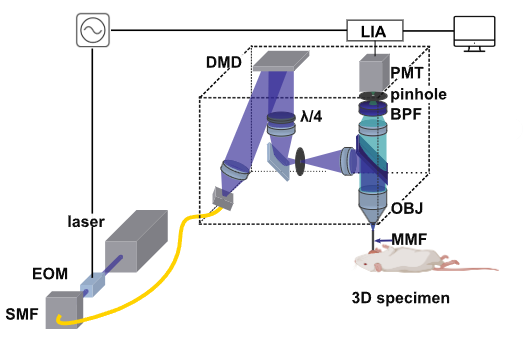
Figure 3 – Schematic of the FLIMME optical setup which will be used for 3D printing
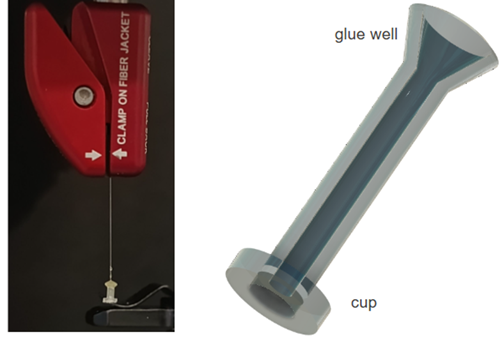
Figure 4 – Current adapter design for the 3D printing MMF probe
Student profile
The student should be interested in experimental optics, 3D printing and photopolymerization chemistry. Good communication skills in English are required, as the report shall be written in that language. The student should have some experience with Python or MATLAB, particularly for data analysis, simulations, or pattern generation. Previous experience with optics, microscopy, wavefront shaping, or 3D printing is appreciated.
Contact
If you are interested in this project, please contact me by email at: [email protected]
References
[1] Morales-Delgado et al. Three-dimensional microfabrication through a multimode optical fiber. Optics Express 25, 7031–7041 (2017).
[2] Konstantinou et al. Improved two-photon polymerization through an optical fiber using coherent beam shaping (2023).
[3] Fay et al. arXiv:2510.00267