
Introduction to TVAM
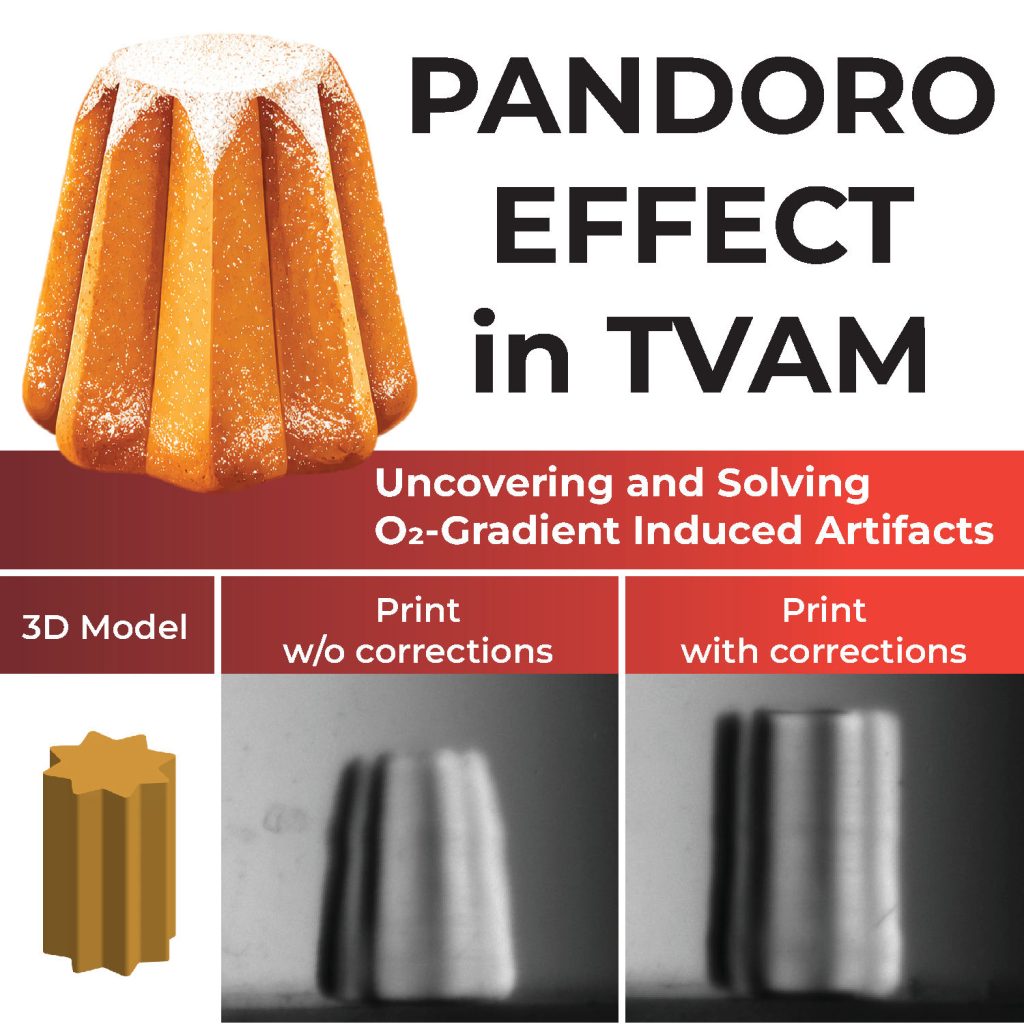
Tomographic Volumetric Additive Manufacturing (TVAM) is a light-based, layerless 3D printing technique capable of producing centimeter-scale objects within seconds. In TVAM, a rotating vial of photosensitive resin is illuminated with a sequence of 2D tomographic projection patterns and polymerization occurs only where the cumulative light dose exceeds the gelation threshold, forming the full 3D part in a single exposure cycle. A central challenge is computing projection patterns that account for optical effects (such as scattering, refraction, attenuation, …) which directly impact print fidelity and achievable resolution [1,2]. Recent advances frame this as an inverse light-transport problem solved through physically based differentiable rendering, enabling accurate modeling of optical effects [1]. However, print artifacts can still arise from chemical-physical effects such as oxygen gradients, as demonstrated by the recently characterized “Pandoro effect” a truncated-cone distortion caused by premature polymerization at the vial bottom [3].
Project Description
You will conduct systematic tests of the achievable resolution of TVAM prints. Using a diffusion-aware optimization model, you will evaluate and judge the resolution of prints produced under various conditions (e.g., different resins, vial geometries, and illumination configurations). The work will leverage the open-source Dr.TVAM framework for differentiable, physically based projection optimization [4], and will combine simulation-based analysis with experimental validation to map out the resolution limits of TVAM under realistic optical and chemical conditions.
Contact
Please apply by contacting Felix Wechsler ([email protected]) and Christophe Moser ([email protected]). Please attach a short motivation, your CV and a recent transcript of relevant grades.
Relevant Literature
- Nicolet, B., Wechsler, F., Madrid-Wolff, J., Moser, C. and Jakob, W., 2024. Inverse rendering for tomographic volumetric additive manufacturing. ACM Transactions on Graphics (TOG), 43(6), pp.1-17. DOI: 10.1145/3687924
- Wechsler, F., Sgarminato, V., Rizzo, R., Nicolet, B., Jakob, W. and Moser, C., 2026. Overprinting with tomographic volumetric additive manufacturing. Nature Communications. DOI: 10.1038/s41467-026-73477-3
- Rizzo, R., Wechsler, F., Zhang, Q. and Moser, C., 2026. Too Big, Too Small, Too O2: The Pandoro Effect from Oxygen Gradients in Tomographic Volumetric Additive Manufacturing. arXiv preprint arXiv:2604.06313. arXiv:2604.06313
- GitHub repository of Dr.TVAM: https://github.com/rgl-epfl/drtvam