
Introduction:
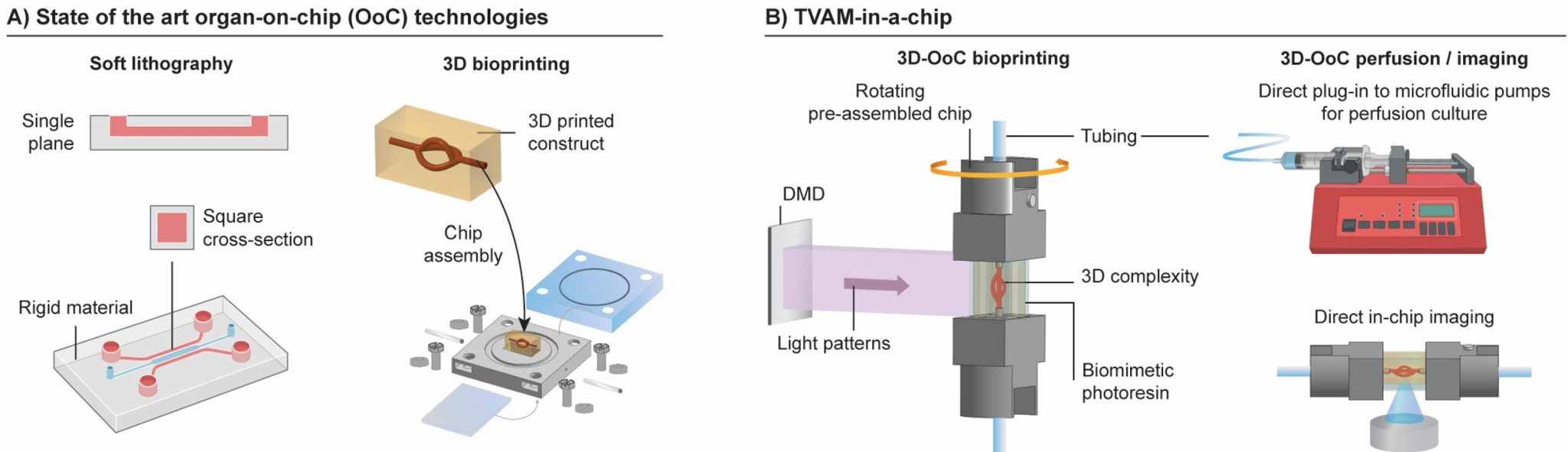
Human organ-on-chip (OoC) platforms are emerging tools for drug discovery and safety testing that replicate essential aspects of organ physiology and reduce reliance on animal models. Most OoCs rely on soft-lithography microfluidics or traditional 3D bioprinting. These are either limited in their complexity and biomimicry (soft lithography, see Figure A) or are slow and require multiple post-processing and assembly steps (bioprinting, see Figure A).
Tomographic volumetric additive manufacturing (TVAM) enables rapid fabrication of complex 3D structures but still depends on manual construct transfer and chip assembly. Thanks to recent developments in our lab,1 TVAM can now be used to directly 3D print high-complexity, high-cell-density perfusable models within preassembled, leak-proof TVAM compatible chips featuring integrated fluidics (TVAM-in-a-chip, see Figure B).2
Project Description:
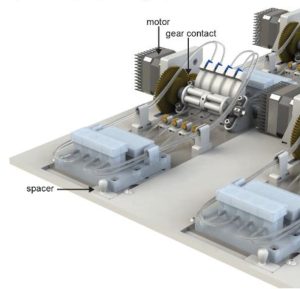
Your main goal will be to will design, manufacture, assemble and program modular perfusion systems to be used for TVAM organ-on-chips culture (see example in Figure 33). You will participate in TVAM printing sessions with photosensitive biomaterials and human cells to test the perfusion device. Your contribution will enable high-throughput TVAM-in-a-chip experiments for tissue modeling and drug screening.
Contact
Please apply by contacting Riccardo Rizzo ([email protected]) and Christophe Moser ([email protected]). Please attach a short motivation, your CV and a recent transcript of relevant grades.
References
- Wechsler, F., Sgarminato, V., Rizzo, R. et al. Overprinting with tomographic volumetric additive manufacturing. Nat Commun (2026). https://doi.org/10.1038/s41467-026-73477-3
- Rizzo, R.; Sgarminato, V.; Wechsler, F.; Moser, C. Tomographic Printing in a Chip: A Versatile Platform for Biomimetic 3D Organ-on-Chip. bioRxiv 2026. https://doi.org/10.64898/2026.02.26.708161
- Wolf K, van Gaal R, Uzel S et al. Perfusable 3D models of ureteric bud and collecting duct tubules. Cell Biomaterials, 2025; 2 DOI: 10.1016/j.celbio.2025.100297