Imaging and 3D Printing by Light control in Multimode fibers
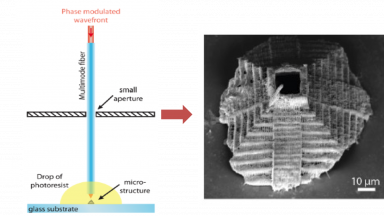
3D Printing and Endofabrication A complete method for additive manufacturing –also known as 3D printing- using a multimode optical fiber is demonstrated. Up to now, 3D printing systems have required large optical elements or nozzles in proximity to the built structure. In this system, we use time-gated digital phase conjugation, which consists of two steps: the calibration and the reconstruction step.
Light based droplet Printing
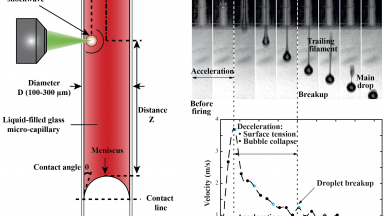
dvanced printing applications require functional inks with complex physical properties. Today there are two main approaches to generate liquid droplets on demand: piezoelectric and thermal actuation. Their jetting mechanism is based on the generation of a pressure pulse to eject a small amount of incompressible liquid through a nozzle, hence producing one or more microdroplets.

Deep Learning and Multimode Lasers
Multi-mode fibers (MMFs) are gaining widespread interest due to the constant growing need for high speed communication. The full data communication bandwidth potential of MMFs cannot be yet exploited due to the inter channel data scrambling inside the fiber. The individual channels, called modes, in the fiber mix as they propagate through the fiber, producing unrecognizable patterns on the distal end, known as speckles. With the advent of powerful processors and new neural network architectures, known as convolutional networks, there is now the excitement that machine learning could be a viable approach to decipher the scrambling occurring in MMFs and thus unlock their full bandwidth potential.

High resolution Retinal Imaging with TOPI
Retinal diseases are the major cause of blindness in industrialized countries. For example, an estimated total of 196 million people will be affected by age related macular degeneration in 2020. While tremendous effort is being made to develop novel therapeutic strategies to rescue retinal neurons and the retinal pigment epithelium, optimal means for evaluating the effects of such treatments are still missing.
S4S project – H2elios Neurocams
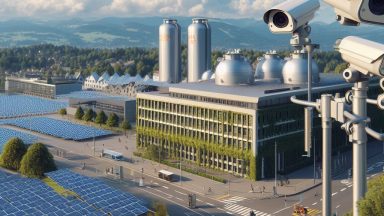
Accurate solar irradiance forecasting at various time horizons, from minutes to months, is crucial for managing energy storage, dispatch, and trading. This research uses publicly available webcam images and traditional weather forecasts to train neural networks for forecasting solar irradiance, focusing on the challenging 2 to 4-hour time horizon. The goal is to enhance EPFL’s ability to predict on-campus PV power production, thereby improving day-ahead energy resource dispatch plans. Deviations from these plans can result in substantial penalty charges. To achieve better adherence to dispatch plans, energy storage technologies like Li-based batteries and power-to-gas systems will be employed. This forecasting method can be scaled up from local to regional and national levels.

Boosting Two-photon polyermization with single-photon pre-sensitization
Photopolymerization-based additive manufacturing offers a powerful route for rapid production of complex three-dimensional structures. However, it faces a tradeoff: single-photon absorption (1PA) enables fast polymerization and high throughput but lacks resolution, whereas two-photon absorption (2PA) delivers sub-micron precision at the cost of speed. To address this limitation, we propose a method combining 2PP and one-photon absorption to leverage the complementary strengths of both mechanisms. A continuous-wave (CW) laser at 405 nm is used to pre-sensitize the resin via 1PA, rapidly reaching the polymerization threshold, followed by 2PA using a tightly focused femtosecond (fs) laser beam at 780 nm to provide remaining energy needed to surpass threshold and solidify the resin. The material is only polymerized at the intersection volume of two light sources. This sequential excitation approach significantly affects voxel growth kinetics, lowering the energy threshold and accelerating the polymerization.