
Computational thinking for all
Supporting the digital transformation
aThrough its Center for Learning Sciences LEARN, EPFL is supporting the digital transformation of education from kindergarten on. The projects of the Center LEARN seek to contribute to systemic change, as LEARN trains and supports teachers, collaborates with teacher trainers, creates and tests open access teaching material – and all of it with an approach of translational research building on and creating new evidence.
Computational thinking education at compulsory school level
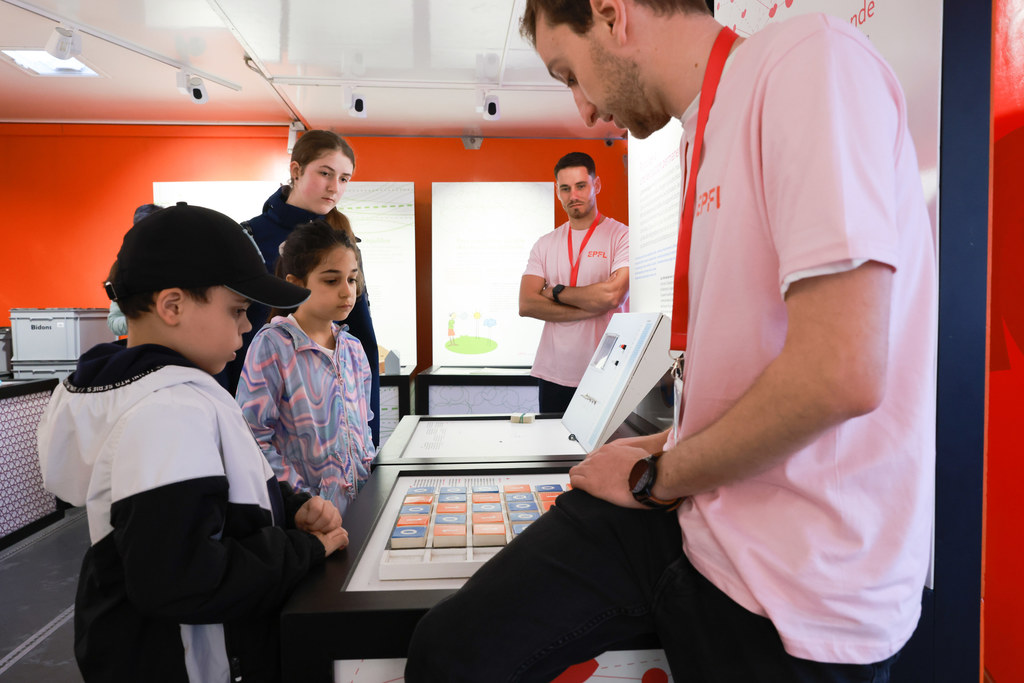
In the ambitious project éducation numérique “EduNum”, LEARN collaborated since 2018 with the Education department of Canton VD, the HEP Vaud and UNIL. Computational thinking is introduced in primary school by means of state-of-the-art unplugged computer science activities, i.e. learning activities that do not require any computer device, followed by plugged learning activities and educational robotics in higher grade levels. Teachers are trained to integrate the new skill of computational thinking in their classrooms based on the dedicated teaching material Decodage. The teaching material and training was first piloted with 12 schools, accompanied by research, and was then deployed in a peer-to-peer training approach to the whole Canton. An instrument was developed to measure computational thinking at primary school level, the competent Computational Thinking Test (El-Hamamsy et al., 2022).
Educational robotics is a strong field of computational thinking education at EPFL, based also on an education strand of the NCCR robotics and research in MOBOTS and CHILI lab. Research spans from the modelling of computational problem-solving (Chevalier et al., 2020) to the empirical testing of computational thinking interventions (e.g. in the project JUSThink) and the development of assessment instruments (Piatti et al., 2022). In terms of large-scale implementation, the robot Thymio, who won the Polytechnikpreis 2022, is among the most advanced projects. In order to support the adoption of Thymio, a MOOC addressed to teachers was created in three national languages. Teaching scenarios involving project-based challenges like the space missions in the R2T2 program are at disposal to teachers, alongside a large collection of educational robotics activities available to a dedicated community of teachers Roteco. Since 2021, educational robotics content for computational thinking is deployed in the Canton Bern initiative MINT mobil.
In order to sustain over time, it is important to enable the actors of the education system to continue evolving in the integration of computational thinking in any domain and at any level. Further initiatives are for instance the creation of open educational resources on data literacy from teachers for teachers as part of the Swissuniversities funded project Swiss Digital Skills Academy.