
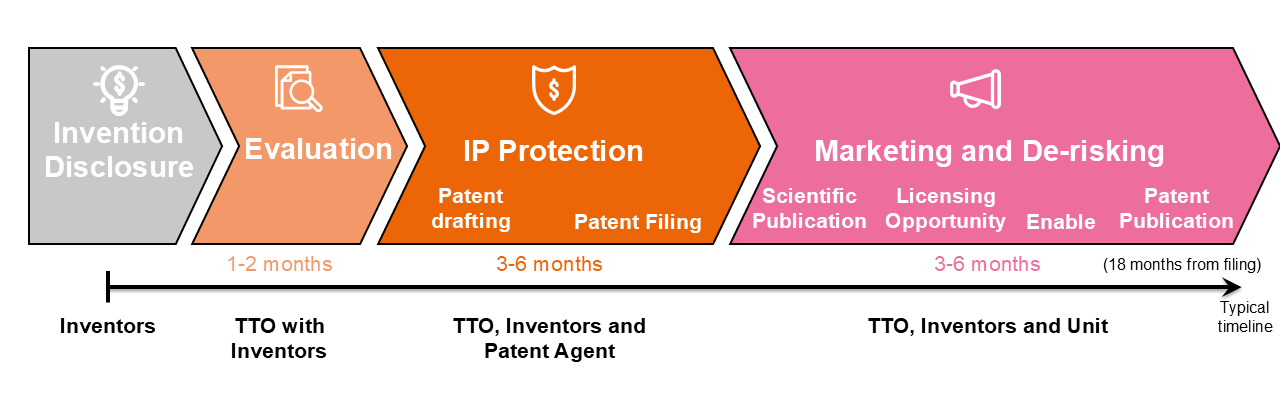
EPFL researchers disclose their inventions to the Technology Transfer Office (TTO) through an invention disclosure form or a software disclosure form. The invention disclosure (ID) is an internal declaration, needed at EPFL, to start the effective work for technology transfer. It includes a detailed description of a new and inventive technology, with respect to known approaches and solutions, and its potential uses. It also contains the complete list of inventors or software authors as well as possible projects and contracts related to the new technology, such as collaboration agreements with third parties or external funding agencies.
Inventions, software and other research results generated by EPFL employees and members of the teaching staff belong to EPFL. The individuals involved in research activities therefore need to notify the TTO of their inventions, software and other results with potential for commercial development.
For more information, please contact the TTO.
The TTO, together with the inventors, evaluates the invention with regard to its possible areas of application, economic potential and patentability. In collaboration with inventors and the head of the unit concerned, the TTO proceeds with this evaluation and then defines a technology transfer strategy.
For software, the TTO and the head of the unit concerned evaluate the software and define a strategy for its development and transfer.
Protecting an invention through a patent is often essential if it is intended to be transferred to the economy. Patent applications are made on behalf of EPFL, subject to third party rights, and will name the inventors.
The TTO is responsible for managing patents and patent applications for EPFL.
As a general rule, the fees of the filing of the priority patent application are covered by the TTO. The unit is asked to cover 50% of the further costs (e.g. prosecution, maintenance and additional filings), provided that the TTO and the unit concerned are in agreement as to the procedure pursued.
EPFL technologies stem from breakthrough research in engineering, life and basic sciences. Every year between 30 and 50 technologies are transferred from EPFL to industry under exclusive or non-exclusive basis. The TTO, together with the inventors, creates, publishes and shares licensing opportunities to promote new technologies to established companies.
To advance the commercial development of technologies, the TTO provides support to research teams through its enable programme.
enable invests in tomorrow’s technology. It supports creative innovators as they move their ideas from the lab to the market. The programme is suited for researchers who have developed a technology that is the subject of a patent application filed (or in the process of being filed) with the TTO, or a software disclosed to the TTO, and who do not intend to create a startup that exploits this technology.
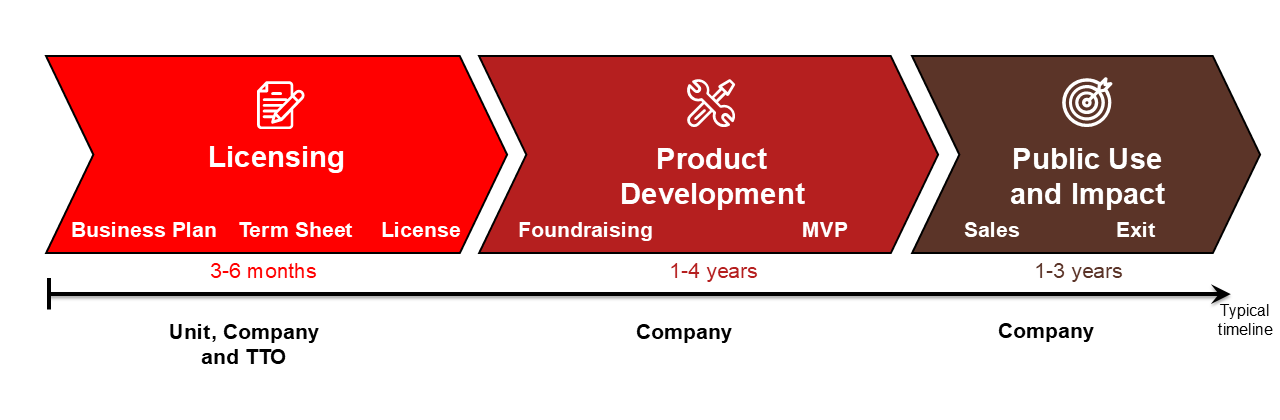
The TTO negotiates with established companies or startups the transfer of EPFL intellectual property. A license allows the transfer of technology that is protected by intellectual property rights. The TTO negotiates technology transfer contracts in collaboration with the head of the unit concerned.
A first discussion on the Business Plan for the commercialization of the technology is held between the company or startup and the TTO. A first term-sheet is established to summarize the main commercial terms (field of use, exclusivity, milestones, royalties).
Once the term sheet is agreed between the parties between the parties a fully license is negotiated. The license is signed by TTO and co-signed by the professor heading the originating laboratory. License agreements are long-term relationships.
In general, when inventors present a credible startup project, the technology can be licensed to the startup. Entrepreneurs can also contact the EPFL Startup Launchpad for support throughout their startup journey. Consult the EPFL startup guidelines for more information on terms and conditions of such license agreements. An annotated license agreement is also available for information purposes.
Sometimes businesses are interested in an invention but want to evaluate it or carry out complementary studies themselves over a period of time, reserving therein some rights on the technology, before committing to a license. In these cases, option agreements are the appropriate instrument. You can contact the TTO for further details.
When EPFL professors or employees participate in the creation and development of a startup, it is necessary to clarify the question of potential conflicts of interest. Please consult this dedicated page to further clarify any potential conflicts of interest.
Once the license agreement is executed, the product development phase commences by company or a newly incorporated startup who transforms EPFL’s protected technology into a marketable product or service. Guided by the business plan and the contractual milestones negotiated with EPFL, the company focuses on achieving key development objectives. These milestones typically encompass the delivery of a minimum viable product or service that demonstrates the technology’s commercial viability, as well as the successful raising of capital through investment rounds to finance growth and market entry.
Throughout this phase, the Technology Transfer Office (TTO) provides ongoing support to help the company meet its obligations and advance from prototype to commercial launch. Inventors remain essential partners, contributing technical expertise and assistance as required by the license, while the TTO ensures that milestone compliance and intellectual property is diligently maintained.
To explore the growing roster of companies bringing EPFL innovations to market, please visit the Startup Launchpad website to view our startup portfolio and success stories.
The main objective of technology transfer is to allow promising results to be developed so that society may benefit through the marketing of new products.
The TTO works with EPFL researchers to turn their technologies into business opportunities that can benefit society in particular by capturing and licensing EPFL’s intellectual property assets, managing collaborations with industry, and by accelerating the commercialization of early-stage technologies.
EPFL also supports societal impact by helping researchers share their software; those wishing to understand how to share software can read this page.
EPFL follows the common licensing principles for spin-offs defined within the ETH-Domain, ensuring that its licensing practices align with the ETH Domain’s commitment to broad knowledge dissemination and a fair return on investment.
EPFL operates a balanced revenue-sharing model designed to incentivize and reward innovation while sustaining future research. Under EPFL policies, net revenue from marketed IP is divided into equal thirds: one portion rewards the inventors for their creativity and encourages further innovations; another supports the originating laboratory by funding new research, equipment, and personnel; and the final portion is reinvested into EPFL’s broader teaching, research and innovation activities. This three-way distribution creates a virtuous cycle where commercialization success directly feeds back into science.
According to labs’ research objectives, EPFL is ready to support the licensee (established company or startup) in demonstrating the technology’s viability in industrial applications. This support is framed by research collaborations.
EPFL’s research collaborations with industry are governed by tailored agreements that protect intellectual property while fostering innovation.
The TTO jointly negotiates, approves, and signs all contracts granting rights to EPFL-generated IP, ensuring the institution retains teaching and research rights, limited liability, and fair compensation. Depending on the partnership goals, researchers and companies can choose from several collaborations frameworks and agreements such as Research Agreements, Innosuisse, Industrial Grant, or Service Agreements each with distinct rules on IP ownership, publication freedom, and overhead.
From the earliest discussions, the TTO works alongside laboratories to define the appropriate agreement type, secure publication rights, and establish clear IP terms that benefit both partners.
While the head of the unit leads the scientific execution, the TTO manages contractual compliance, enabling seamless knowledge transfer from lab to industry.
EPFL’s research collaborations with industry rest on a foundation of confidentiality and clear IP governance, starting with NDAs and MTAs that secure early exchanges of information and materials.
Contact
EPFL Innovation Park J
CH-1015 Lausanne
Switzerland
Mail: [email protected]
Phone: +41 21 693 70 23