Plasma Shapes
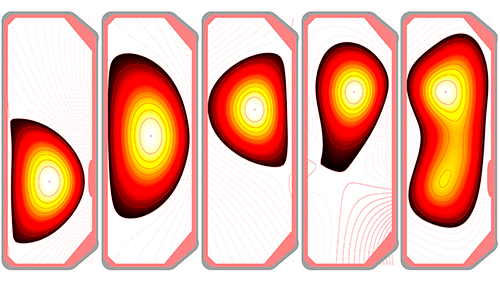
Cross section of TCV showing contours of the magnetic field and the plasma density in colour
The Tokamak à Configuration Variable (TCV) stands out among fusion devices for its unparalleled flexibility in plasma shaping. By leveraging fast magnetic controllers, TCV can generate a wide range of magnetic configurations allowing in-depth studies on plasma confinement, stability, and exhaust physics critical for the development of future fusion reactors.
|
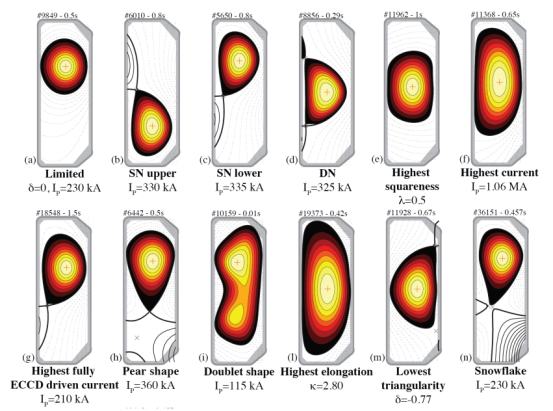
In limited configurations (a), the plasma is in direct contact with a material surface. The contact defines the plasma boundary (or last closed flux surface). While simpler to generate and control, limited plasmas suffer from a high impurity influx and lower confinement. On TCV, limited discharges are often used for studying fundamental plasma physics or reactor startup phases. |
 |
In diverted configurations (b), the last closed flux surface is defined by one or multiple X-points, where the poloidal field vanishes. The X-point separates a region of closed flux-surfaces, where plasma is well confined, from a region of open flux-surfaces that intersect the TCV vessel known as the scrape-off layer (SOL). This separation allows plasma-wall interactions to take place at a distance to the hot plasma, reducing its contamination with impurities.

|
TCV can create single-null (SN) configurations, where the X-point is positioned either at the top (upper single-null) or bottom (lower single-null) of the machine. |

|
|
Double null (DN) configurations feature two X-points, one above and one below the plasma. |

|
|
Plasmas with extreme elongation (κ), shown to be beneficial by TCV experiments at increasing plasma pressure while maintaining stability, a feature critical for reactor-scale tokamaks. |

|
|
Triangularity (δ), defined by the plasmas tilt towards or away from the major radius, known as Positive Triangularity (PT) and Negative Triangularity (NT) |

|
The triangularity (δ) in particular, plays another important role in confinement. Positive triangularity (+δ), used in most tokamaks, improves edge stability and performance. However, negative triangularity (-δ)—where the plasma tilts in the opposite direction—has been found on TCV as well as other tokamaks to suppress turbulence and enhance confinement performance, presenting an alternative to conventional reactor designs.
The flexible shaping of TCV also enables magnetic topologies with multiple X-points in different positions:
|
The snowflake divertor, first produced on TCV, utilises a second-order null point, to define the last closed flux surface. This creates a flux contour with 2 legs enclosing closed flux surfaces and 4 divertor legs. The snowflake geometry will depend on the exact position of the two nearby X-points. Depending on their relative location, the scrape-off layer shape will change, with significant effects on the exhaust performance. |

|
|
A recently developed configuration, the Jellyfish divertor, extends this approach with a third X-point, which distributes exhaust power more effectively. |

|
|
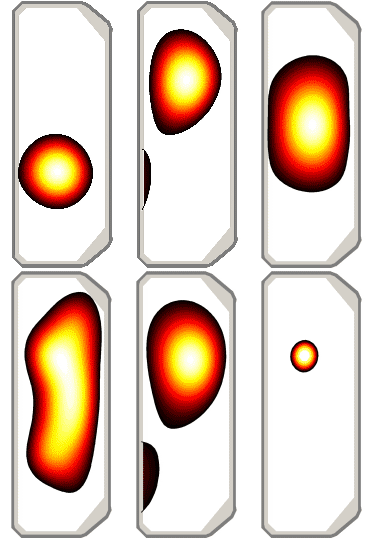
TCV has demonstrated the ability to sustain two independent plasmas simultaneously within a single vessel, known as plasma droplets. |

|
By studying these plasma configurations, TCV contributes to optimizing plasma shaping for future fusion reactors like DEMO, where controlling plasma-wall interactions are essential for sustained high-performance operation. The versatility of TCVs magnetic control places it at the forefront of tokamak physics, driving innovation in the design of next generation fusion devices.