
Regimes + Scenarios
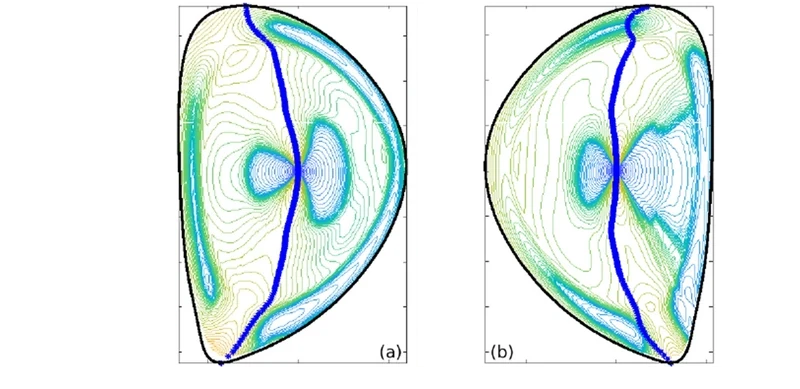
Separation between good vs bad curvature regions and contours of local magnetic shear in (a) Positive Triangularity (b) Negative Triangularity
The Tokamak à Configuration Variable (TCV) explores a diverse range of plasma regimes and operational scenarios, each offering unique insights and contributing to the development of optimized operational modes for future fusion reactors like ITER.
|
One of the most fundamental distinctions in plasma confinement is between Low (L-mode) and High (H-mode) confinement mode. L-mode is the default operating regime in tokamaks, characterized by relatively high turbulence and moderate energy confinement. |
 |
In contrast, H-mode, first discovered in ASDEX and extensively studied in TCV, exhibits a sudden transition to reduced turbulence and improved confinement above a certain level of injected power, driven by the formation of an edge transport barrier (ETB). This barrier results in a sharp increase in plasma pressure and temperature, significantly enhancing performance.
However, H-mode operation introduces edge-localized modes (ELMs) that results in bursts of energy that can damage plasma-facing components. Since operation in H-mode necessitates exceeding a power threshold, understanding how this transition scales with engineering parameters is of primary importance for extrapolation to a reactor. Additionally, TCV’s flexible shaping and heating capabilities enable studies of ELM suppression and mitigation strategies, such as magnetic shaping.
Beyond standard H-mode operation, TCV investigates non-inductive operation and internal transport barriers (ITBs), crucial for steady-state fusion reactor scenarios. Non-inductive current drive, achieved in TCV by injecting microwaves (see Electron Cyclotron Current Drive) and Neutral beams (see Neutral Beam Injection), allows for potentially indefinite tokamak operation. The versatile control and microwave heating system of TCV can be used to drive current in a specific region of the plasma in order to form an internal transport barrier (ITB). The ITB forms a layer which tends to block the passage of particles and heat, much like the insulating wall of a thermos. This can strongly reduce turbulence and enhance confinement and can lead to significantly improved core performance.

Another critical area of research in TCV is “plasma detachment”, which is a necessary condition for protecting the components (the divertor) responsible for handling the intense heat and particle flux escaping from the core plasma. In high-performance fusion devices, the heat loads striking the divertor can reach levels comparable to those on the surface of the sun, posing a significant challenge to reactor longevity. Detached plasmas achieve heat flux reduction by cooling the boundary plasma before it impacts the divertor via impurity radiation and plasma-neutral interactions, causing the plasma to “detach” from direct contact with the reactor wall. As a result, the extreme exhaust heat is redistributed over a larger surface area, preventing damage to plasma-facing components. In fusion reactors, detachment is achieved by adding impurities — such as neon or argon — into the edge of the plasma. These impurities enhance radiation in the divertor; however, it is crucial to prevent core contamination by keeping the impurities confined to the divertor, ensuring they do not diffuse into the main plasma and degrade its performance. Achieving and controlling plasma detachment is a delicate balance. It requires precise control over the plasma density, temperature, and magnetic geometry to ensure the plasma remains stable and well confined while allowing efficient heat exhaust. TCV explores various techniques to achieve and optimise detachment, including active impurity seeding, alternative divertor geometries (e.g., snowflake divertor), and real-time detachment feedback control. Understanding detachment physics is essential for future reactors such as ITER, as it ensures efficient heat management while maintaining core plasma performance.
Through these studies, TCV continues to refine our understanding of plasma confinement, transport, and exhaust solutions, contributing directly to the optimisation of fusion