
Heating the plasma
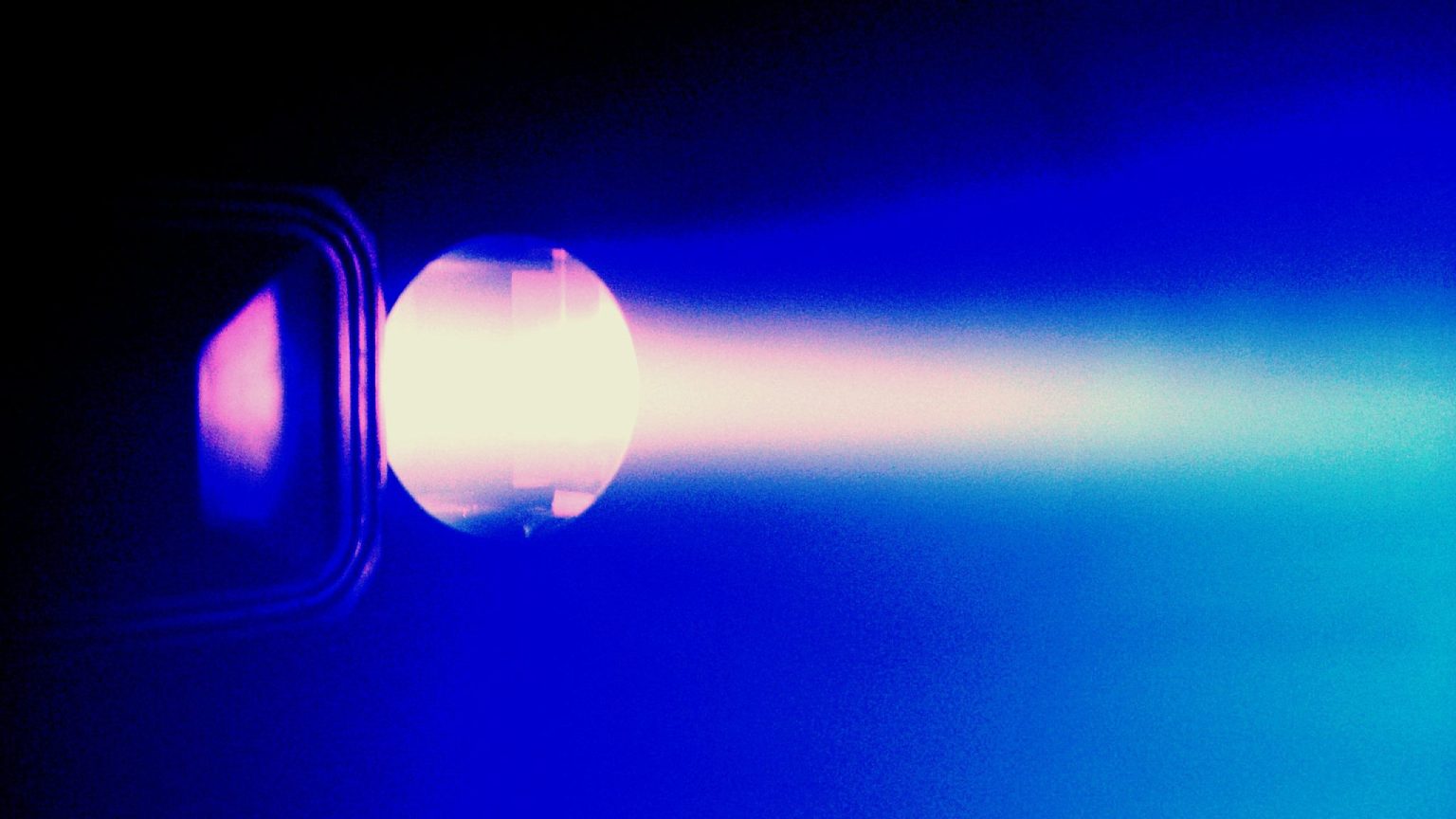
Plasma generated by Diagnostic Neutral Beam Injector into TCV vacuum vessel
To achieve the high temperatures required for fusion, external heating systems are essential. The plasma can heat itself through its own electrical resistance, but this effect tops out at high temperatures as resistivity decreases. On TCV, we use two heating methods to push temperatures into the range needed for sustained fusion:
- Microwave Heating – Electron Cyclotron Resonance Heating (ECRH) uses high-frequency microwaves to directly transfer energy to electrons in the plasma, rapidly increasing temperatures.
- Neutral Beam Injection (NBI) – High-energy neutral atoms are injected into the tokamak, which heat up the plasma through particle collisions.
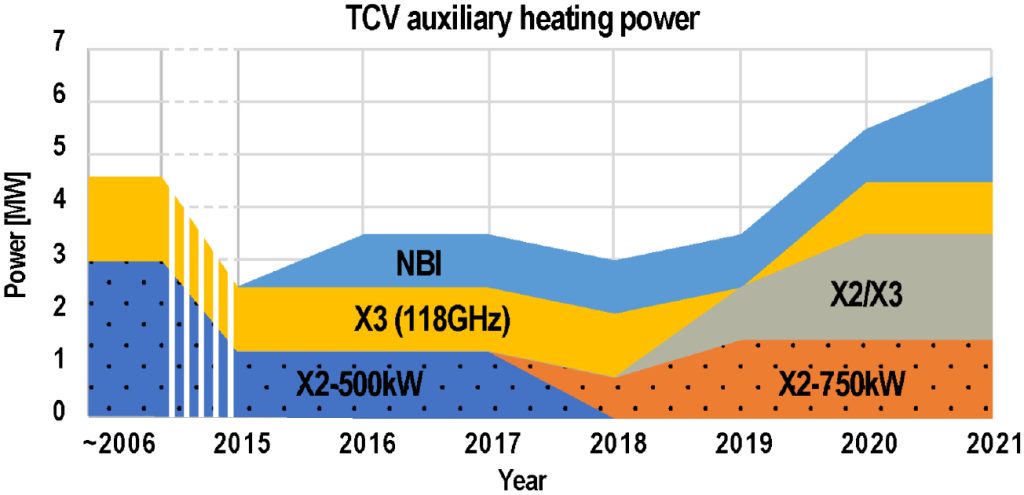
As of 2025, TCV is equipped with two NBI systems, which together can deliver up to 2.3 MW of power. Five gyrotrons currently provide a further 3.5MW through microwave heating, and additional gyrotrons to be installed in 2026 will bring this up to 5.3MW.
All in all, resistive heating plus these auxiliary heating methods provides almost 7MW of power; more than enough to sustain the high-temperature plasmas needed for fusion experimentation.
|
Electron Cyclotron Resonance Heating (ECRH) uses microwaves to directly transfer energy to electrons in the plasma. Wave guides are used to enable targeted delivery of powerful microwaves, whilst beam launchers positioned at ports in the tokamak focus and direct these microwaves into the plasma. This system is highly adjustable, allowing us to precisely deposit power at different points in the plasma. This power injection is used to modulate both temperature and current: |
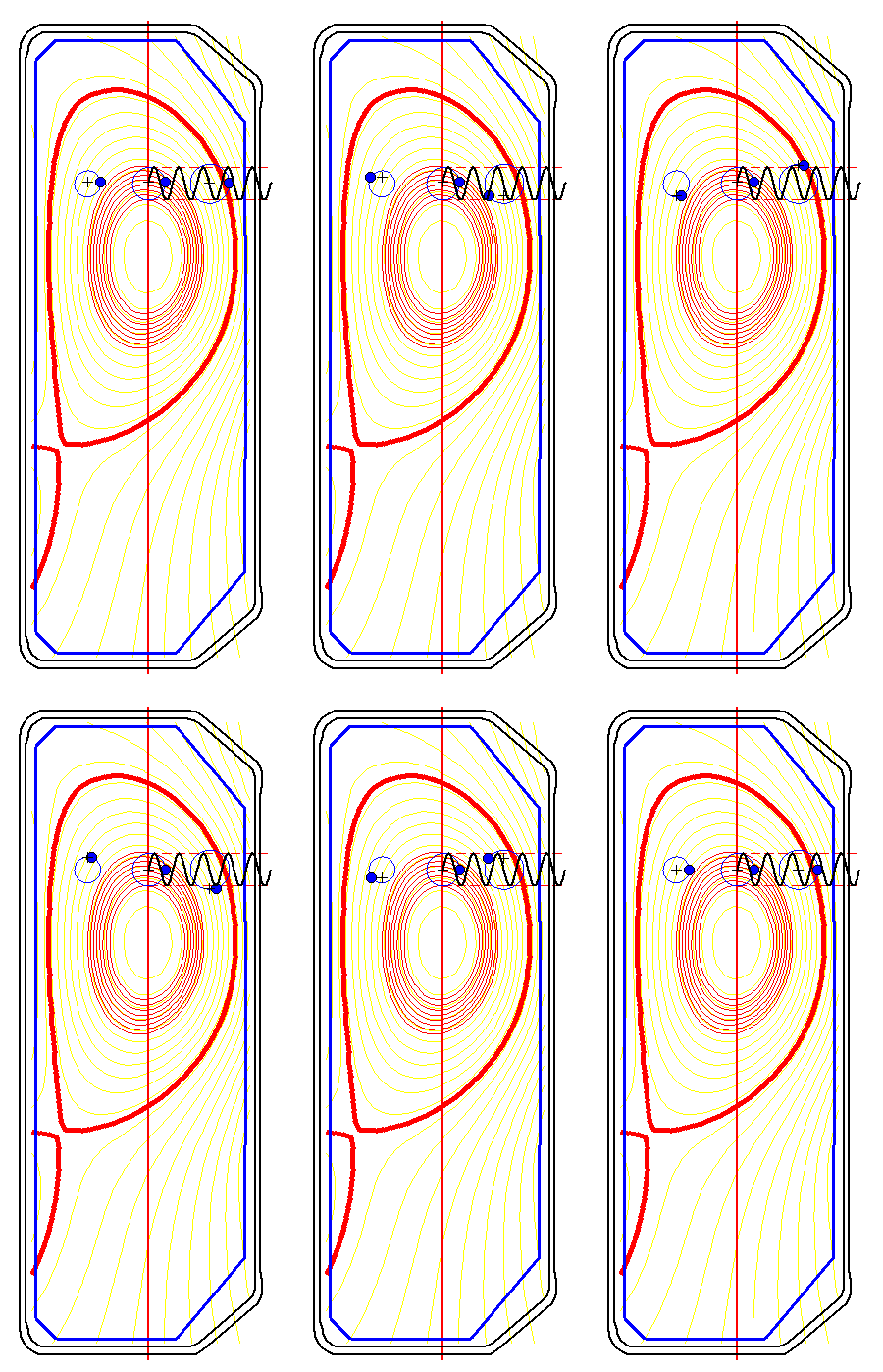 |
- Temperature increases when the microwave frequency matches a harmonic of the frequency at which plasma electrons rotate around the magnetic field lines (the electron cyclotron frequency).
- Toroidal Current increases by accelerating the population of plasma electrons which are travelling along the magnetic field lines in the same direction as the injected microwaves. This effect is called Electron Cyclotron Current Drive (ECCD).

By modulating these two effects, the adjustable wave guides and launchers enable fine plasma control, wherein the response of instabilities to the effects of the waves are observed in precise, cause-effect studies. This makes TCV an ideal testbed for exploring the applications of ECRH and ECCD in tokamak reactors.
|
The neutral beam systems on TCV provide a source of fast ions and provide access to fusion relevant conditions. TCV is equipped with three neutral beam systems: NBI-1, NBI-2 and the Diagnostic Neutral beam (DNBI), all injected horizontally at the TCV midplane. |
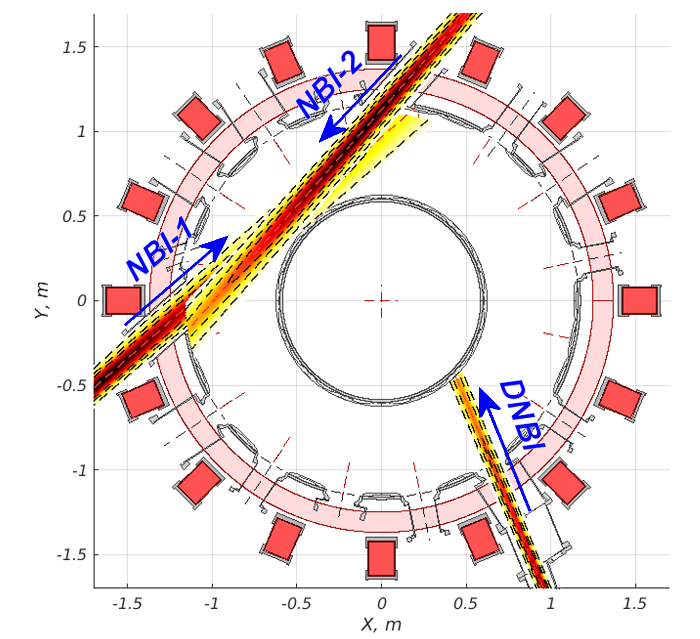 |
Since 2015, A 1.3 MW heating beam (NBI-1) with 28 keV particles has been operated on TCV. Plasma regimes with high plasma pressure, a wider range of ion to electron temperature ratios and significant fast-ion densities have been studied on TCV with NBH
A second 1MW high-energy neutral beam (NBI-2) with 50-60 keV particles was procured, partly manufactured and installed on TCV in July 2021. This high-energy beam aims to provide more localised on-axis heating at higher plasma densities and access conditions with stronger interactions between fast ions with static and dynamic fields as well as enable control of the plasma rotation. With both NBI systems used in combination, the rotation of the plasma can be tailored or cancelled out entirely. The higher particle energy of NBI-2 greatly enhances the operating spaces for fast ion studies at different ion energies.
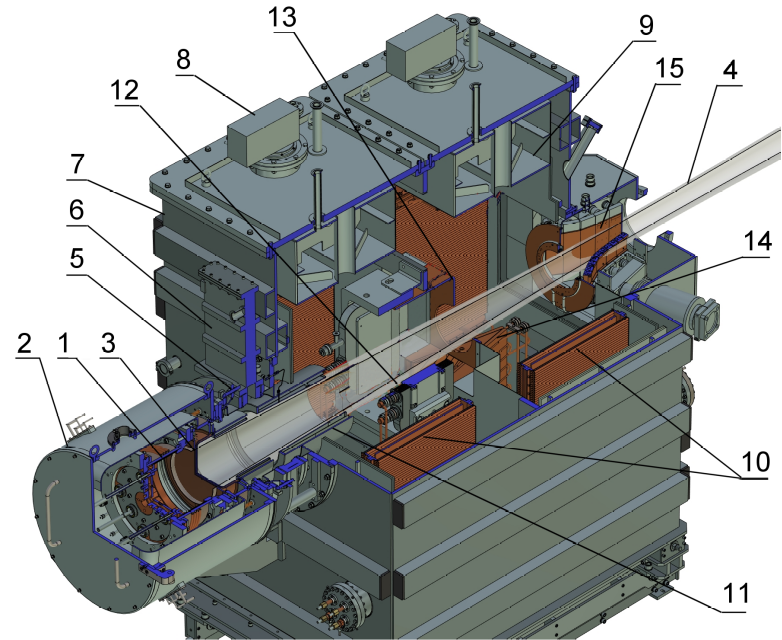
Together, these NBIs enable:
- High plasma pressures, pushing TCV closer to reactor-relevant conditions and allowing for the study of pressure-driven instabilities and confinement
- A wide range of electron-to-ion temperature ratios, allowing for experimentation with the energy distribution and its effects on plasma particle transport and turbulence
- High densities of fast ions; essential for studying the effect of energetic particles on plasma instabilities
- Control of plasma rotation: by imparting angular momentum to the plasma
Real-time control of all these factors in coordination with TCV’s control systems enables researchers to test scenarios that future fusion reactors will rely on.