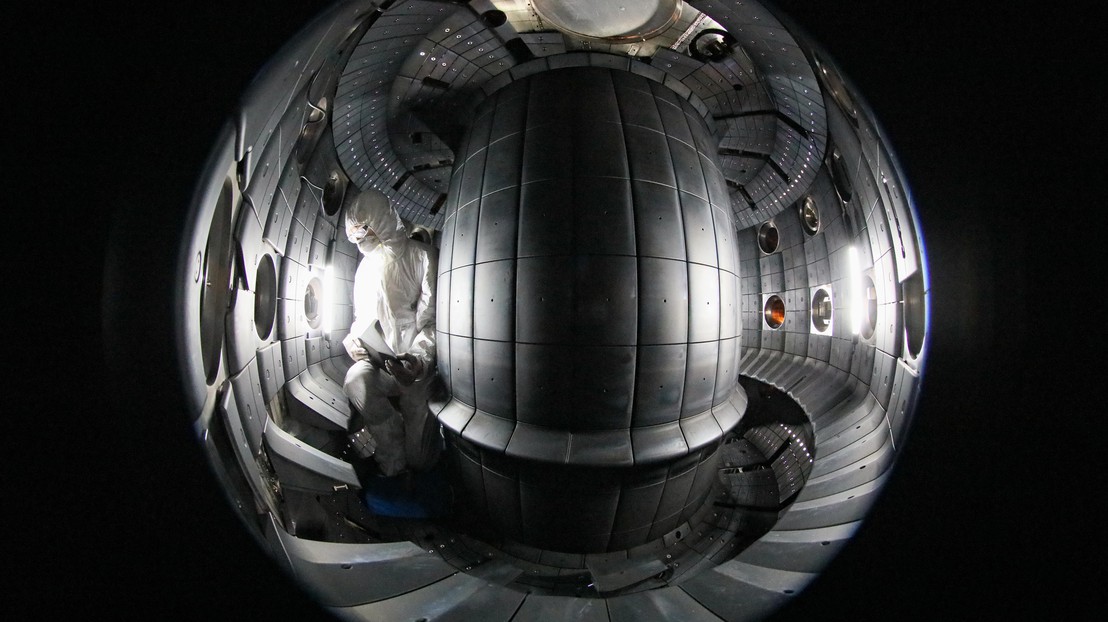
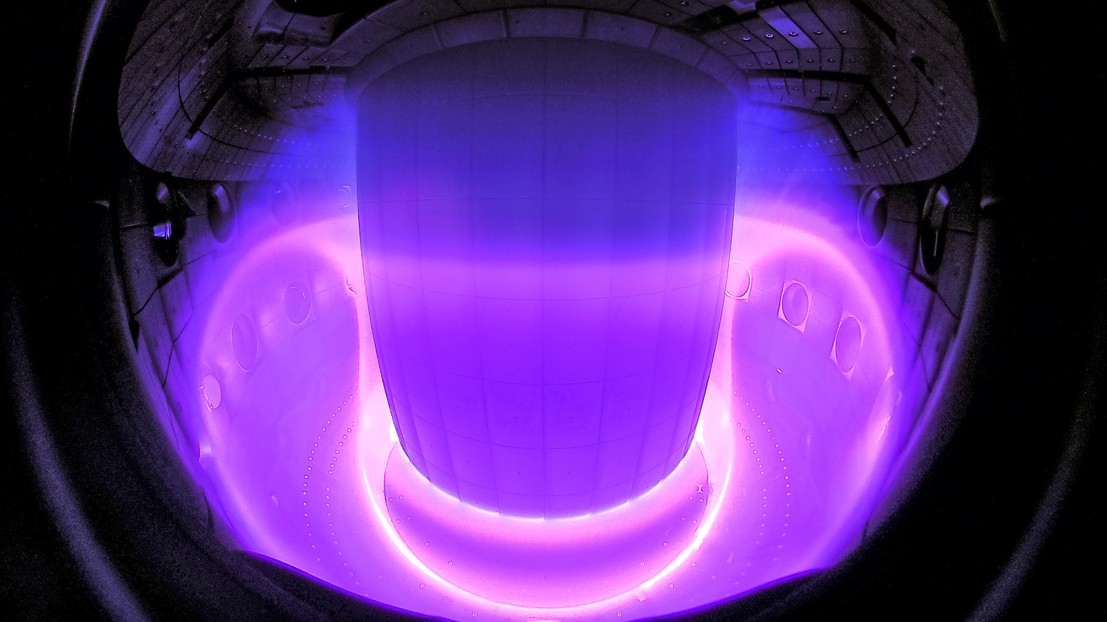
At SPC, we are exploring new ways to manage the intense heat released by fusion devices. A recent study explored a novel plasma shape using a secondary magnetic “X-point”. This setup, called an XPTR (X-point target radiator), helps cool the reactor exhaust more effectively without disturbing the core burning plasma. It turns out that this cooling happens because of the shape of the magnetic field, irrespective of whether the particles in the plasma are indefinitely trapped or not. This discovery could lead to better designs for future fusion reactors, making it easier to handle heat without damaging equipment or affecting performance. DOI: https://doi.org/10.1103/PhysRevLett.134.185102
Fusion reactors rely on powerful microwaves created by machines called gyrotrons to heat the plasma, but these devices can become unstable due to the build-up of trapped electrons. This instability can lead to failures, making precise design and manufacturing important. To better understand and solve this problem, the SPC built the T-REX device to explore this phenomenon. It replicates the conditions inside gyrotrons using controlled electric and magnetic fields, enabling researchers to study the trapped electron behaviour more closely. This work will help improve the reliability and efficiency of gyrotrons, which are key to making fusion energy a practical, clean power source. DOI: https://doi.org/10.1063/5.0212127
As antibiotic resistance rises and traditional cleaning methods harm the environment, safer alternatives are becoming more and more essential. Plasma-activated water (PAW) is a promising, eco-friendly solution that kills bacteria using water that has been exposed to a plasma. This study developed a portable device and tested its ability to kill E. coli. Results show that recirculating the water boosts its germ-killing power—mainly due to acidified nitrites. The research highlights the importance of water re-circulation in making PAW more effective. This innovation brings us closer to sustainable, low-cost disinfection methods that could be used in industries like food safety and healthcare. DOI: 10.1016/j.cej.2024.149915
Scientists at SPC have studied how much plasma can safely be packed into fusion machines. By analysing data from three major experiments and using physics-based models, turbulence—chaotic flows inside the plasma—were found to limit how dense the plasma can get. This work redefined these boundaries, showing that more heating power helps control this turbulence, allowing for higher plasma densities to be achieved. This is important for future reactors like ITER, which could operate more safely and efficiently than previous estimates predicted. This new understanding gives confidence even if the reactor suddenly shifts to a less stable state during operation. DOI: https://doi.org/10.1103/PhysRevLett.128.185003
Controlling a fusion plasma is extremely complex. In a collaboration with Deep Mind, SPC scientists applied a new AI system that learns how to control magnetic fields on its own, adapting to many different plasma shapes and conditions. This system worked successfully on the TCV tokamak, even achieving rare and challenging shape configurations like twin plasma “droplets.” The results show that AI can make fusion research faster and more flexible – bringing us closer to practical fusion energy. DOI: https://www.nature.com/articles/s41586-021-04301-9