
A History of TCV

Photo of the installation of the steel support structure around two engineers working on the central solenoid
The Tokamak à Configuration Variable (TCV) has played a pivotal role in fusion research for over 30 years, yielding numerous breakthroughs and world records in plasma physics. Throughout decades of operation, TCV has been at the forefront of research in scenario discoveries and developments, exhaust physics, flexible shaping, microwave heating, and pioneering diagnostic developments.
TCA: The ancestor of TCV
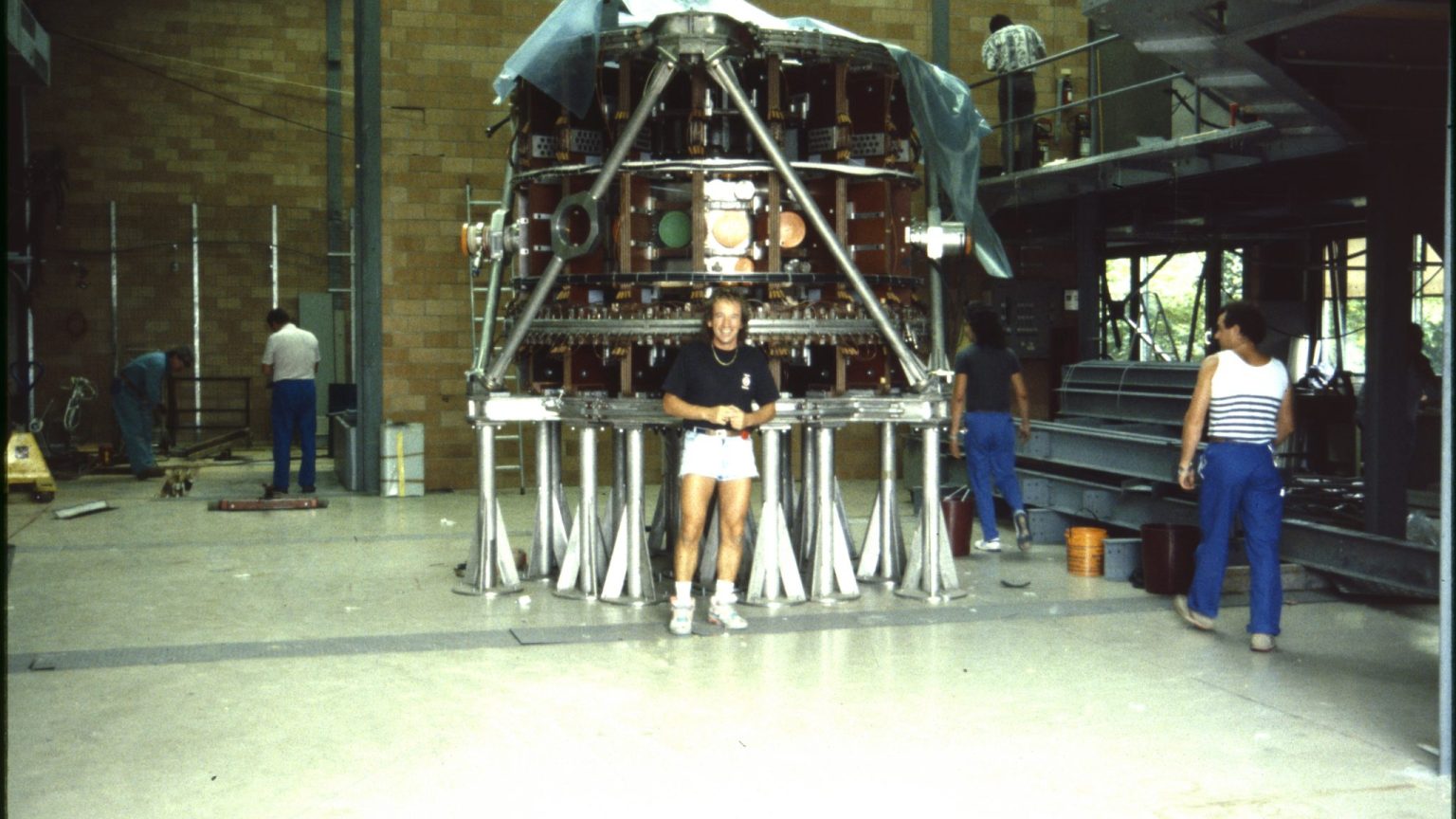
Dismantling of TCA in 1991
TCV’s origins trace back to the Tokamak Chauffage Alfvén (TCA), which operated from 1980 to 1992. TCA’s primary objective was to explore a potentially more efficient and cost-effective method of plasma heating known as Alfvén wave heating. While the results did not meet expectations, TCA was at the forefront of establishing a significant breakthrough—the boronization technique, developed by ACI (University of Zurich) and PSI (Villigen), reduced oxygen impurities in the plasma substantially. After TCA was decommissioned, its core components were transferred to the Plasma Physics Laboratory at the University of São Paulo, where they were reassembled into the TCABR (Tokamak Chauffage Alfvén Brésilien).
In parallel, numerical calculations of the ideal stability of tokamak plasmas showed the strong advantage of having elongated plasmas, leading to a beta limit named after SPC’s director at that time Prof. Troyon. Additional simulations showed that there was limited stable plasmas above an elongation of 3, which defined the TCV vacuum chamber. This limit was later confirmed experimentally with dedicated TCV discharges.
Birth of a star

The unpacking of the main component of the TCV steel vacuum
Construction of TCV began in 1989, and by November 1992, the first plasma was produced, marking the beginning of its scientific campaigns in June 1993. Within the first year, TCV successfully demonstrated a wide range of plasma shapes and magnetic configurations, reaching plasma currents of up to 1 MA, while also achieving high-confinement modes with relative ease.
Following the installation of the first ECRH system (1.5 MW at 82.7GHz) in 1998, new TCV record electron temperatures of 6 keV (70,000,000 degrees) were achieved. The application of this system in 1999 produced the world’s first plasma current driven only by ECH for 1.9 seconds, paving the way for new lines of research for tokamaks.

Fish eye camera view of TCV with full carbon first wall in December 2007 after sand-blasting
By 2000, TCV’s power capabilities doubled to 3 MW, supplemented by an additional 0.5 MW at 118 GHz, allowing for further advances in current profile modification using ECRH and ECCD. The system was expanded again in 2001 with two additional 0.5 MW 118 GHz ECRH sources. By 2002, TCV reached record electron temperatures of 18 keV, demonstrated quasi-stationary enhanced confinement regimes and the direct role of the q profile on transport barrier with ohmic current perturbations as well as in fully non-inductive scenarios and for the first time successfully achieved plasma heating using third-harmonic ECRH. Over the next few years, TCV underwent gradual upgrades to its diagnostic, control, and heating systems. A major maintenance effort in 2007–2008 included the dismantling and cleaning of its 1,600 graphite tiles.
In 2008, two major advancements were made:
- The first experimental realisation of a “snowflake” divertor.
- The first real-time control of plasma current and elongation using ECRH actuators.
Between 2009 and 2012, research focused on characterizing the snowflake divertor, investigating transport barriers, and controlling edge-localized modes (ELMs) using ECRH, demonstrating the first stationary no ELM regime with 3rd harmonic heating only. In 2013, TCV launched a Neutral Beam Injection (NBI) development program, and new experimental configurations were pioneered, including IN-mode, the first triple-X configuration, and X-Point Target scenarios.
Unleashing TCV’s potential

Installation of the first Neutral Beam Injection system
In 2014-2015, TCV underwent a shutdown for NBI installation and major diagnostic/infrastructure upgrades. Following this, TCV joined the EUROfusion consortium, intensifying the research on disruptions and runaway electrons as well as power exhaust and alternative divertors, such as Snowflake, Super-X, and X-Divertors. In 2016, with the commissioning of 1 MW of NBI and two additional 0.75 MW ECRH sources, TCV achieved a new record ion temperature of 2.5 keV.
TCV continued its expansion in 2016 with new diagnostic capabilities (Thomson scattering, RADCAM, RDPA, and GPI) and a focus on pedestal and H-mode physics. As part of the organisational transition from CRPP to SPC, additional, optional components called baffles were commissioned for TCV, which enable different exhaust geometries to be realised. Interest in negative triangularity plasmas, first explored on TCV in the 1990s, was revived in a series of dedicated studies, leading to other experiments worldwide testing and confirming its potential application in a demonstration (DEMO) reactor. Additionally, the first successful formation of two simultaneous plasmas (“droplets”) within TCV was achieved. The TCV real-time control system was reorganised and a generic Supervisory and Actuator Manager with Off-Normal Event handling (SAMONE) was developed, which is the state-of-the art for integrated control developments and a key ingredient for reactor grade machines.
In 2021, in anticipation of the installation of a second NBI system, TCV deployed several fast particle diagnostics, including FILD and FIDA. In 2022, a collaboration with DeepMind led to the first demonstration of plasma magnetic control using deep reinforcement learning. The arrival of the second NBI in 2023 necessitated significant upgrades to neutron shielding which occured in tandem with the introduction of new diagnostic and experimental systems, such as LaBrDoRE and Pilatus.
Realising future solutions

A computer aided drawing of the Tightly Baffled Long Legged Divertor (TBLLD)
A major infrastructure upgrade is currently in progress, aiming to introduce:
- A Runaway Electron Mitigation Coil (REMC).
- A Tightly Baffled Long-Legged Divertor (TBLLD).
In support of these new experimental scenarios, advanced diagnostic systems are being built, including Fast antennas for GHz wave recognition, Tangential contrast phase imaging and a reciprocating probe.
With over 30 years of innovation, TCV has evolved into one of the world’s most versatile tokamaks, boasting state-of-the-art diagnostics, flexible heating systems, and advanced real-time control capabilities. Its continued development ensures that TCV remains at the forefront of fusion research, driving the next generation of discoveries in plasma physics.
For more information, see the SPC annual reports.