
As cities continue to expand, it has become crucial to describe their evolution in time and space (e.g. Verbavatz & Barthelemy, 2020). Urban growth often occurs at a faster-than-exponential rate, which may result in innovation cycles, finite-time singularities, or even collapses (as observed in finance and biological systems).
This project aims at (i) reviewing the literature on the space-time evolution of urban areas, (ii) explore the feedbacks between population growth and the development of urban transport networks in selected cities/regions, (iii) test and adapt an existing urban growth model and (iv) verify whether simple spatial rules can explain complex urban dynamics (e.g. Li et al. 2017). A good knowledge of mathematical modelling (i.e. partial differential equations) and coding (e.g., Matlab/Python) is required for this project.
If you are interested, please contact Prof. Gabriele Manoli ([email protected]).
This project aims to simulate flow and transport processes in the subsurface to assess groundwater contamination at a selected site and explore remediation options.
If you are interested, please contact Prof. Gabriele Manoli ([email protected])
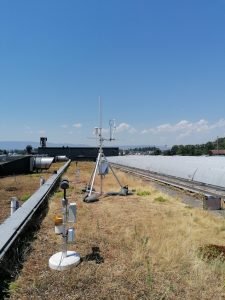
Urban areas emit large amounts of CO2 into the atmosphere, they modify the surface energy balance, generally increasing surface and air temperatures, and they also affect atmospheric humidity, wind, and air quality. This project aims at testing urban climate sensors (e.g., a flux tower installed at the UNIL campus, thermal cameras, drones), analyse the collected data, and/or develop an anthropogenic CO2 emissions model (Stagakis et al., 2023) to compare observations with theoretical results.
 .
.
Cities modify the surface energy balance, generally increasing surface and air temperatures. While the physical drivers of urban warming and its diurnal evolution are well understood, the high spatial heterogeneity of urban surfaces make it difficult to properly characterise the space-time variability of the temperature fields. To overcome this problem, this project aims at developing a stochastic description of urban climate. A strong background in mathematics (e.g., stochastic differential equations) and physics (e.g., climate) is required for this project.
If you are interested, please contact Prof. Gabriele Manoli ([email protected]).
On June 2023 Switzerland passed a new climate and innovation law that aims at accelerating the country transition from fossil fuel to renewable energy and attaining the zero-emission goal by 2050. As urban environments continue to grow, so does their energy demand and because of this, it is crucial that Swiss cities be at the frontline of the shift in energy production towards renewable sources.
At the URBES lab we use a combination of mesoscale and microscale numerical models to explore the urban wind energy potential across major Swiss conurbations. In this context, we are looking for a motivated student to help with the ingestion of the swissBUILDING3D 3.0 Beta high resolution building morphology dataset into the PALM-4U (Maronga et al. 2020) computational fluid dynamics (CFD) model.
A good knowledge of the AutoCAD or (Arc/Q)GIS softwares is required for this project.
If you are interested, please contact Prof. Gabriele Manoli ([email protected]). or Dr. Aldo Brandi ([email protected]).
Taking advantage of existing high-resolution datasets (e.g., Li et al., 2025), this projects aims to describe traffic flows in cities using theories and approaches from fluid dynamics and porous media.
If you are interested, please contact Prof. Gabriele Manoli ([email protected]).
The project consists in the use of Machine Learning (ML) approaches for applications to urban climate (e.g., to predict space-time variations of temperature, humidity, and wind speed), land use change (e.g., to predict changes in Land Climate Zones over time), mobility and urban growth (e.g., daily commuting, urban sprawl). Knowledge of ML is a prerequisite for this project (e.g., CS-433 Machine Learning course).
If you are interested, please contact Prof. Gabriele Manoli ([email protected]).
Temporal changes in population density patterns are vital for the study of cities, disaster risk management, and planning of infrastructure. However, exisiting studies typically focus on place-of-residence statistics ignoring the space-time variations resulting from human mobility, from hourly to seasonal timescales.
This research consists in the development of a gravitational model for the description of the aforementioned population dynamics.
If you are interested, please contact Prof. Gabriele Manoli ([email protected]).
Human mobility behavior follows, to a certain degree, universal regularity and distributions as described, for example, by radiation (Simini et al., 2012) and gravity models (Zipf., 1946). However, the robustness of these models has not been tested in the unique context of Switzerland. This project aims to (1) analyze the commuting flows in Switzerland and identify the key flows and patterns using the Communal Matrix dataset) (2) investigate the potential of existent models e.g., from Scikit-Mobility packages in Python to predict the flows (3) analyze the characteristics of aggregated commuting flows, e.g., distance distributions and scaling laws, and (4) compare the results with other datasets (e.g., Spanish mobility data).
Extreme temperatures have negative impacts on human health but also on transport infrastructures (e.g., roads, railways, airports). For example, heatwaves can cause the buckling of rail tracks (e.g., Sanchis et al. 2020) or the melting of road asphalt (ABC News, 2015), causing traffici disruptions and potentially cascading failure events. These project aims to assess changes in the frequency of future buckling events (and/or other transport-related risks) by considering the spatial and temporal distribution of world infrastructures and temperature projections.
If you are interested, please contact Prof. Gabriele Manoli ([email protected])
Coming soon – experience with ENVI-met (or similar CFD codes) recommended.
If you are interested, please contact Prof. Gabriele Manoli ([email protected])
Coming soon ….
The project aims at combining algorithmic techniques with state-of-the-art datasets to create critically-articulate and aesthetically-appealing visualizations. An interest/background in design and programming is recommended.
If you are interested, please contact Prof. Gabriele Manoli ([email protected])
This project will focus on assessing the impact of weather (e.g., rainfall, heat) on mobility patters and transport mode choices (e.g., using this dataset).
If you are interested, please contact Prof. Gabriele Manoli ([email protected])