Urban Structure & Dynamics
Urban planning applications and policies aimed at shaping healthier and more sustainable urban environments should account for such complex interactions as they regulate the growth and functioning of cities, often resulting in emergent large-scale phenomena. Yet our ability to quantitatively describe city behaviour is still limited due to the variety of processes, scales, and feedbacks involved.
At URBES we seek to analyze and conceptualize complex urban dynamics in the most general terms to predict and optimize future urbanization trajectories.

https://epfl-enac.github.io/urbes-viz/
Stochastic description of urban metabolism
A current tenet in the science of cities is the emergence of power-law relations between population size and a variety of urban indicators. Yet, existing scaling theories depend on ad-hoc definitions of city boundaries and neglect of intraurban variability of city properties. To deal rigorously with these biases, we explore the hypothesis that the empirical statistics of intracity variations in urban characterisitcs (e.g., population, road networks, carbon emissions) can be described as fluctuations of spatially dependent random variables (Hendrick et al., 2025).

Covariations in urban metabolism. (A) Joint probability density function (PDF) for population and street intersections for six cities. (B) Data collapse of the joint distribution in A. (D) Joint PDF for population and residential CO2 emissions for the same six cities. (E) Data collapse of the joint distribution in D. See Hendrick et al. (2025) for details.
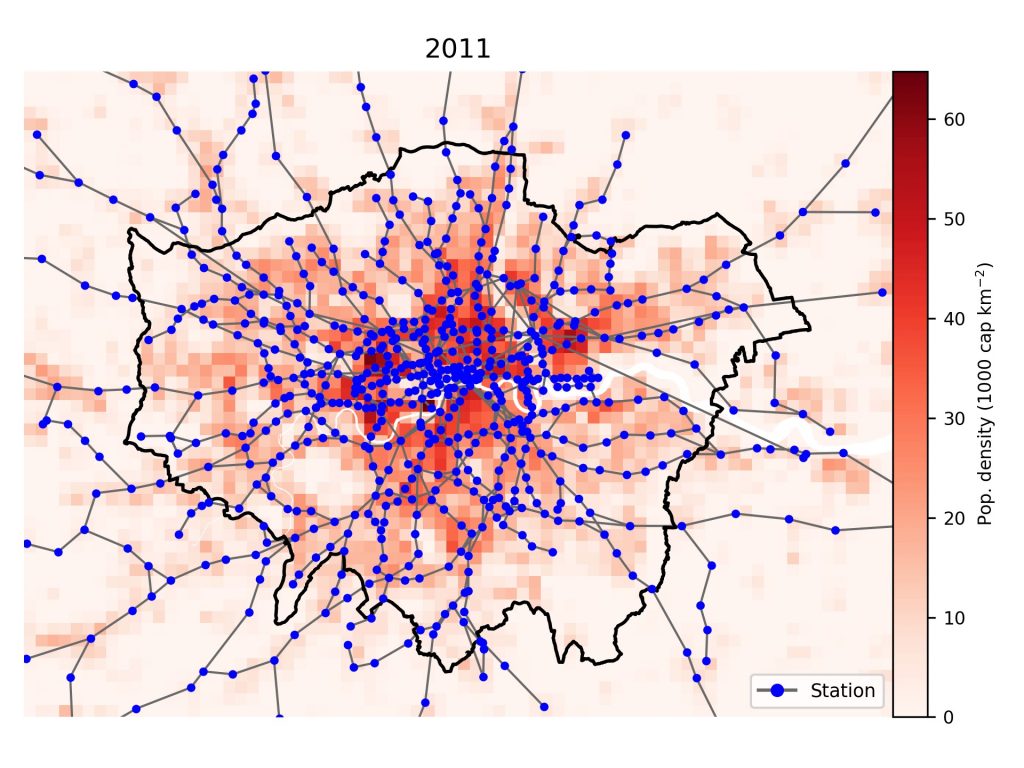
Coevolution of population and transport networks
The space-time evolution of population and urban transport networks display striking similarities with the behaviour of biological organisms – watch our animation for the city of London and read our article or watch the seminar “Behind the paper with Royal Society Journals” by Gabriele Manoli.