
On 21 June 2026, Theodora Giovanazzi presented the paper “Privacy Codified: Domestic Space, Typology, and Class from Serlio’s Book VI to the Fuggerei in Augsburg” at the 9th Biennial Conference of the European Architectural History Network, held at Aarhus University (17-21 June 2026).
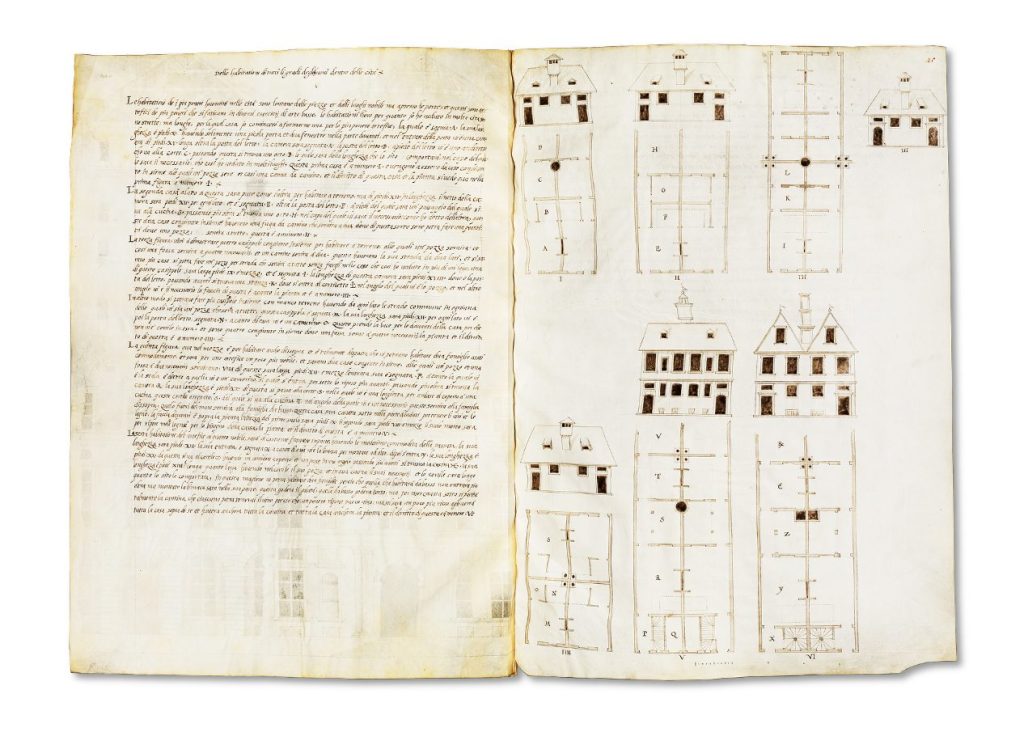
Sebastiano Serlio’s Book VI: On Domestic Architecture (c. 1540s) was the first architectural treatise in Europe to assign domestic types to specific social groups, ranging from hovels for poor citizens to houses for kings. Through his manuscript, the question of housing for the ‘deserving poor’ was established as an architectural subject, situating them within the same typological lineage as those of the nascent middle class. In the treatise, as the wealth of the inhabitants grew, houses acquired rooms with more clearly defined uses, suggesting that access to privacy depended on material resources.
In parallel to the drafting of Serlio’s manuscript, the Fuggerei in Augsburg—one of the earliest large-scale housing projects for the ‘shamefaced’ poor—was built in the 1520s. The Fuggerei, with its uniform row housing, individual entrances on the street fronts, and small private gardens at the rear, materialized some of the principles implicit in Serlio’s typologies. Whereas earlier large-scale housing often relied on communal spaces, the Fuggerei strengthened the concern for privacy on both the domestic and urban scales and, for this reason, can be read as an early example in which the emerging yet still inchoate separation of living and working became a powerful tool for educating its inhabitants to the work ethic of wage labor and homeownership.
The paper argues that within the habitations of the lower classes, privacy was not meant to preserve the solitude of one or more members of the household but to reinforce the isolation of the family and to sharpen the separation between public and private, which governments deemed one of the most effective ways to govern people. What emerges from these two case studies points less towards a privacy of the poor than towards a privacy for the poor: an aspiration inherited from the upper classes’ desire for withdrawal and separation, which trickled down to the lower classes no longer as the possibility of personal solitude but as a pedagogical and paternalistic instrument whose ideological goal was that of educating laborers to a precise way of living in line with the emerging capitalist organization of society.