
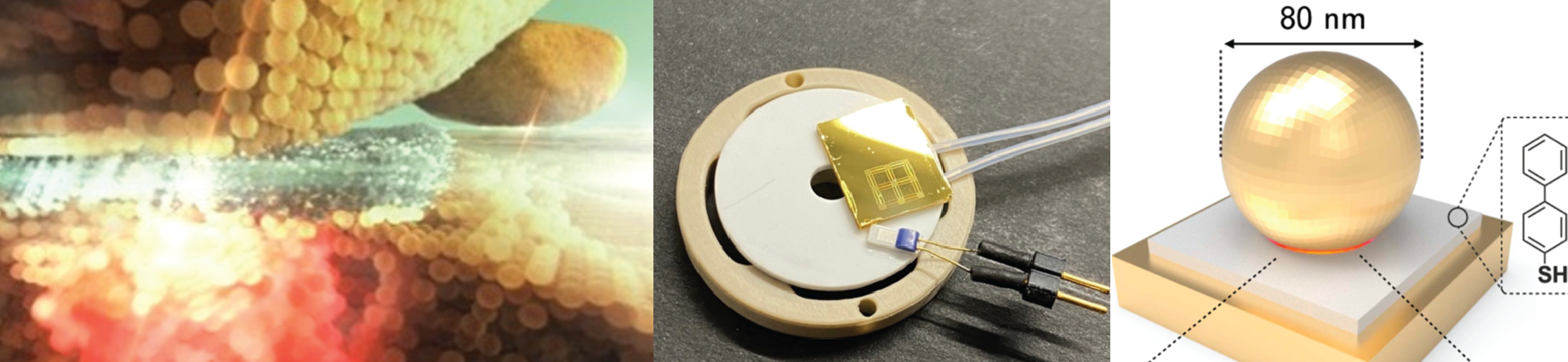
We work on Molecular Cavity Optomechanics, Nanoscale thermometry in plasmonic cavities, Light-driven phenomena in plasmonic nanocavities, Molecular transport and spectroscopy in plasmonic nanojunctions and Optomechanical frequency upconversion in nanocavities:
We work on Molecular Cavity Optomechanics, Nanoscale thermometry in plasmonic cavities, Light-driven phenomena in plasmonic nanocavities, Molecular transport and spectroscopy in plasmonic nanojunctions and Optomechanical frequency upconversion in nanocavities:
Ongoing projects
Bio-medical applications
Foodborne pathogens represent a significant threat to public health and result in millions of tons of food waste every year. Current bacterial detection methods are slow and only provide results after 1-5 days. Our work at the LQNO is dedicated to advancing food safety through innovative bacterial detection methods: by using a combination of Surface-Enhanced (…)
Molecular transport and spectroscopy in plasmonic nanojunctions
At LQNO we are interested to explore the influence of static electric fields on SERS and plasmon enhanced SFG on molecules, as well as the correlation between dynamic phenomena in the current and optical enhancement, to push the limits of our understanding in light-matter interactions at the nanoscale.Our molecular junctions consist of a single layer (…)
Past projects
Molecular Cavity Optomechanics
Ever since its discovery in 1974 [1], SERS has revolutionized the field of Raman spectroscopy by demonstrating sensitivities down to single molecule [2,3]. However, precise mechanisms which govern SERS are still poorly understood, in particular under strong laser driving. To address this issue, we fabricate well-defined nanocavities with sub-2-nm gaps and sharp plasmonic resonances, which (…)
Optomechanical frequency upconversion in nanocavities
Benefiting from the plasmonic resonance capable of nanoscale light confinement, metallic gap nanoantennas (and their coupling with low-dimensional materials) have been demonstrated a powerful platform to research a variety of novel phenomena with unprecedented sensitivity, including, plasmon-exciton strong coupling, enhanced optical nonlinearities and molecular cavity optomechanics.In this project, we are developing a molecular platform coupled (…)