
Development of drugs based on cyclic peptides
Most drugs are based on small molecules that can conveniently be administered as a pill. For many disease-relevant targets, however, it has been challenging to develop drugs using such “classical” small molecules because the target proteins lack suitable pockets or clefts for high-affinity binding. Macrocyclic molecules, such as cyclic peptides, offer an attractive alternative because they can engage relatively flat and featureless protein surfaces and thereby address targets that are difficult to reach with conventional small molecules. Their favorable binding properties arise in part from their larger size, which enables more extensive interactions with the target, and from their cyclic structure, which restricts conformational flexibility and reduces the entropic penalty upon binding.
In our laboratory, we develop and apply methods for generating and screening large and structurally diverse libraries of cyclic peptides. We have a particular interest in relatively small cyclic peptides that are membrane-permeable (the bottom format in the “middle space” of the figure), as these molecules combine the strong target-binding properties of larger molecules with important drug-like properties of small molecules. Our long-term goal is to develop ligands identified from these libraries into therapeutics.
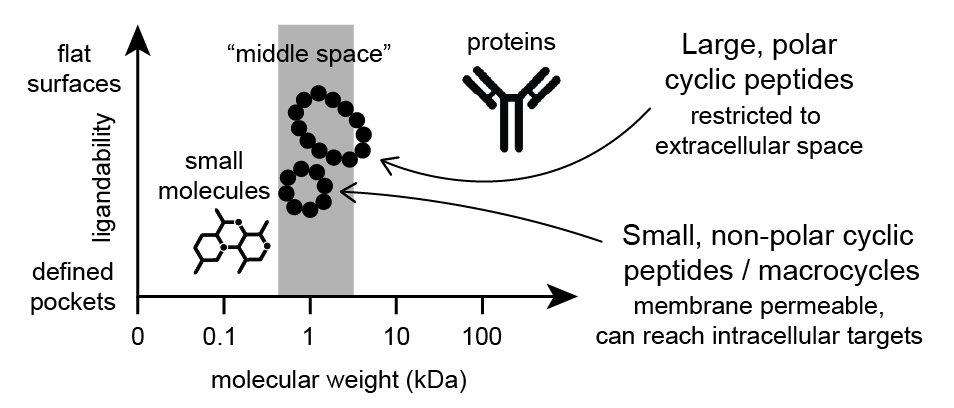
Figure: Comparison of different drug modalities. Among cyclic peptides, which occupy the “middle space” between small molecules and proteins, it is important to distinguish between smaller, relatively non-polar cyclic peptides that can be membrane-permeable (lower group) and larger cyclic peptides that are typically not membrane-permeable (upper group). Our laboratory is particularly interested in developing the former class, with the goal of combining the strong target-binding properties of cyclic peptides with the ability to access intracellular targets and/or enable oral application.
Publications:
Heinis, C., et al., Nature Chemical Biology, 5 (2009)
Zorzi, et al., Nature Communications, 8 (2017)
Wilbs, J., et al., Nature Communications, 11 (2020)
Merz, M.L., et al, Nature Chemical Biology, 20 (2024)
Ji, X., et al., Nature Chemical Biology, 22 (2026)
High-throughput synthesis of peptide libraries
To identify membrane-permeable cyclic peptides that bind to disease-relevant targets of interest, we are developing new methods for generating and screening large combinatorial libraries of small cyclic peptides (<1 kDa). Several of our strategies are based on high-throughput chemical synthesis in microwell plates, allowing the use of thousands of structurally diverse building blocks (including hundreds of non-canonical amino acids), enabling the libraries to be screened directly in functional assays and allowing the robust identification of molecules that bind to and modulate disease-relevant targets.
To synthesize large numbers of peptides in parallel, we have developed both solid- and solution-phase methods that yield crude peptides of sufficiently high purity to be screened without purification. We have further miniaturized and automated these methods for peptide synthesis in 384-well plates (solid phase) and 1,536-well plates (solution phase). Screening tens of thousands of fully randomized cyclic peptides has led to the identification of potent binders to several targets, including inhibitors of challenging protein–protein interactions.
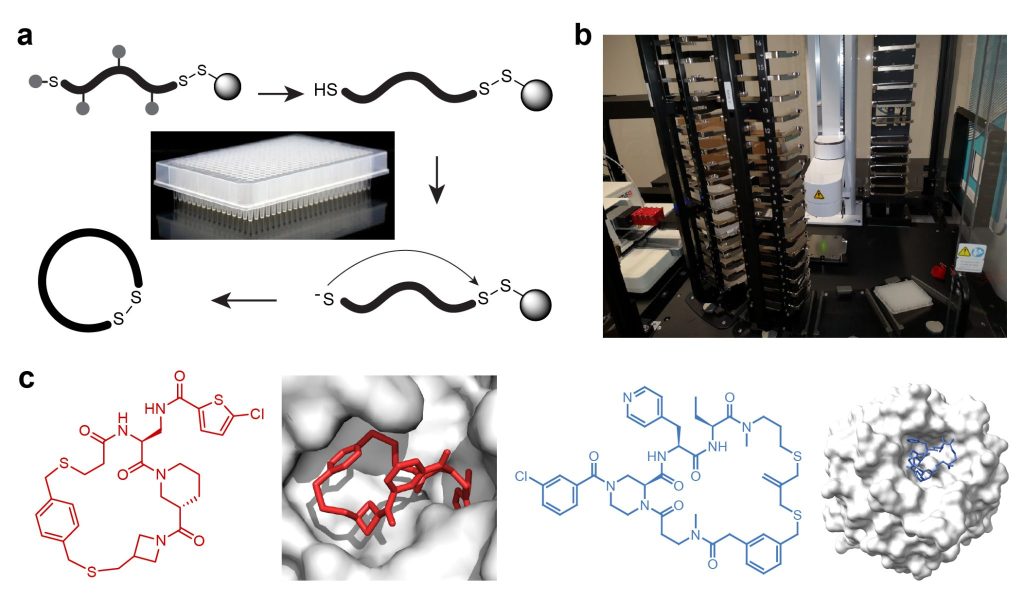
Figure: Strategy used for SPPS of small cyclic peptides with high crude purity (a), robotic platform used for the synthesis and screening (b), and examples of cyclic peptides identified (c).

Video: Solid-phase peptide synthesis in 384-well plates. Colored solutions were used for better illustration of the reagent transfer.
Publications:
Kale, S., et al., Science Advances, 5 (2019)
Habeshian, S., et al., ACS Chemical Biology (2022)
Habeshian, S., et al., Nature Communications (2022)
Bognar, Z., et al., Organic & Biomolecular Chemistry (2022)
Merz, M.L., et al, Nature Chemical Biology, 20 (2024)
Schüttel, M., et al, Journal of Peptide Science (2024)
Nielsen, A.L., et al., Angew Chem Int Ed Engl., 64 (2025)
Ji, X., et al., Nature Chemical Biology, 22 (2026)
Encoded peptide libraries
We have developed bicyclic peptide ligands to a wide range of disease targets using a phage display-based strategy shown in the figure below. In brief, cysteine-rich peptides displayed on phage are reacted with a small organic linker to form bicyclic peptide structures. Large combinatorial libraries (> a billion variants) of bicyclic peptides (bound to phage) are isolated in affinity selections. Binders are identified by sequencing the encoding DNA that is enclosed in the phage particle.
Towards to generation of smaller cyclic peptides that are membrane permeable, we are generating DNA-encoded libraries (DEL) of peptides. A challenge with generating peptide DEL libraries is the coupkling of amio acid in presence of DNA in aqueous solvent and the large number of consecutive couplings, leading to poor library quality and difficulties in identifying binders. We are trying to overcome this limit by developing methods for synthesizing peptide DELs of high quality.
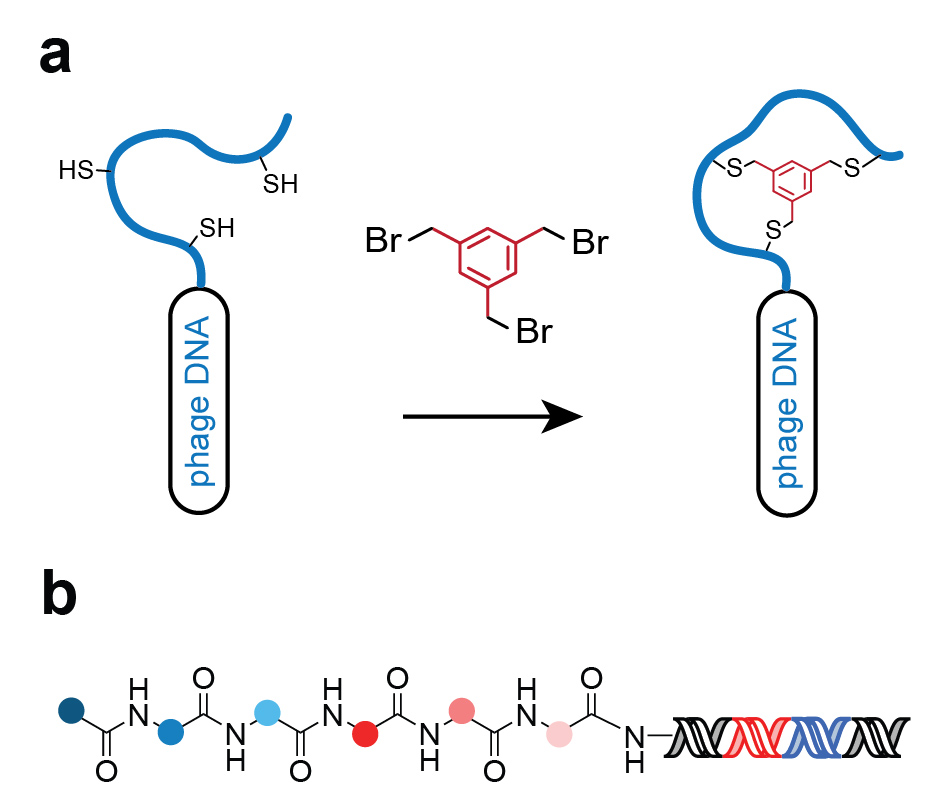
Figure: Strategies for generating encoded libraries of (cyclic) peptides by phage display (a) and DEL technology (b).
Publications:
Heinis, C., et al., Nature Chemical Biology, 5 (2009)
Kale, S., et al., Nature Chemistry, 10 (2018)
Kong, X.-D., et al., Nature Biomedical Engineering, 4 (2020)
Diaz-Perlas, C., et al., Nature Communications, 14 (2023)