
- Student projects in LMIS1
- We offer a variety of projects for students for both semester and master projects in the field of Micro- & Nanoengineering. Mostly, the proposed projects are linked to our ongoing research topics for PhD projects, postdocs or senior scientist, that are funded by EPFL or third party funds (SNF, CTI/KTI, EU, etc). In that way, the student is involved in real-life topics with clearly assigned tasks that are complementary but in collaboration with the laboratory’s research staff. Alternatively, we also invite Master students to propose their own idea on the realization of a new technology or device in the field of Micro- & Nanoengineering. If you have a concrete idea, please don’t hesitate to talk to Prof. J. Brugger and Prof. G. Boero directly or to one of the staff members to see if a Semester or Master project can be defined around the idea generated by you.
Nanostencil for Single Ion Doping
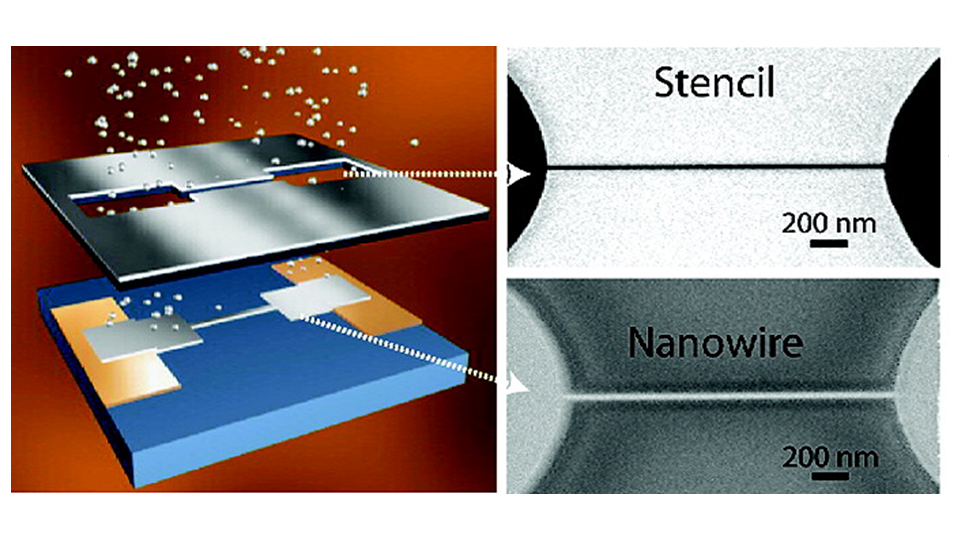
At LMIS1 we are also taking part on the research for new quantum technologies by using nanostencils (consisting into a very thin Si3N4 membrane with nanoapertures patterned into it) as masks for the precise placement of single ions into silicon in order to use their nuclear or electronic spins as quantum entities to be utilized as qubits for quantum computing. We are currently exploring different strategies such as ion implantation or ion diffusion to achieve single ion doping and improve the state-of-the-art.
Even though no specific student project is currently available on this topic, proactive students, interested in our research, are encouraged to get in touch with us for eventually discussing about “out-of-the-box” intuitions and ideas. In the case you are motivated to carry out a student project, please, directly contact Pol Torres Vila ([email protected]), Dr. Arnaud Bertsch ([email protected]) or Prof. Jürgen Brugger ([email protected]).
Grayscale nanolithography for 2D nanoelectronics
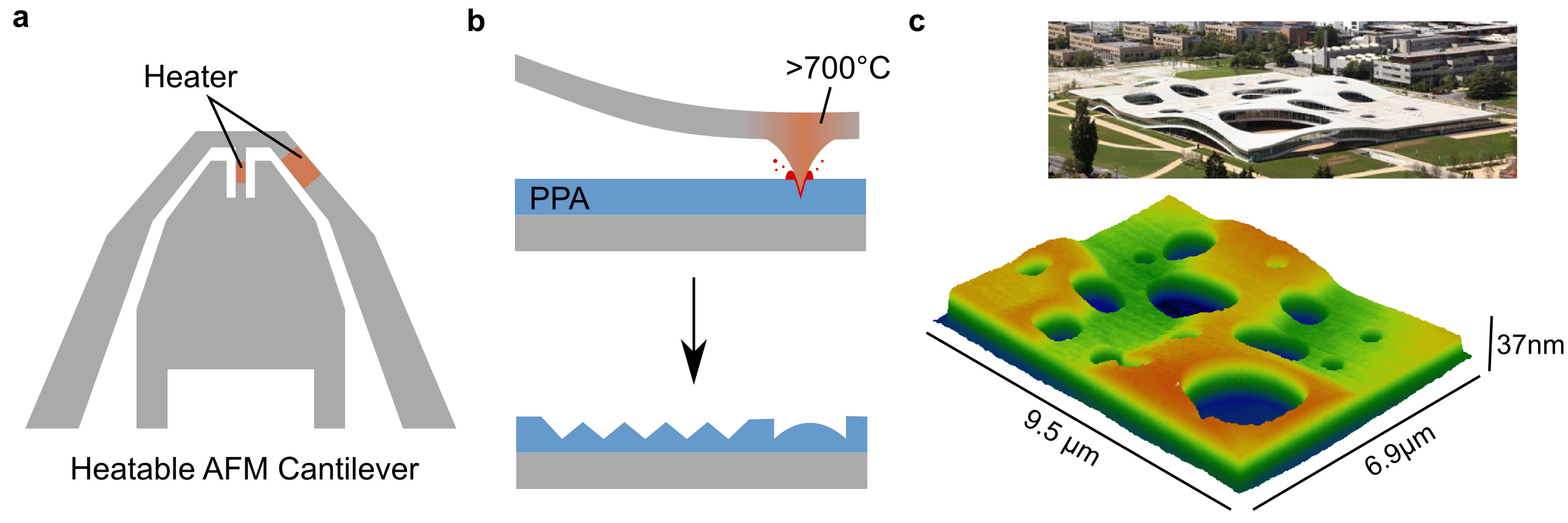
While nanolithography has historically focused on downscaling, there is now a growing interest in grayscale nanolithography for introducing or enhancing functionality in micro-nanodevices applied to optics and fluidics. Grayscale thermal scanning probe lithography (t-SPL) achieves single-digit nanometer spatial resolution and sub-nanometer depth control. In t-SPL, a heated nanotip is used to pattern a temperature-sensitive resist. The fine control over the indentation depth of the tip via an electrostatic potential between the tip and the substrate allows the fabrication of grayscale patterns with high precision.
Amplification of greyscale nanopatterning via thermal scanning probe lithography and dry etching techniques
Type: Master/Semester project
Fields: Microengineering- Material Science-Additive Manufacturing
Project Overview
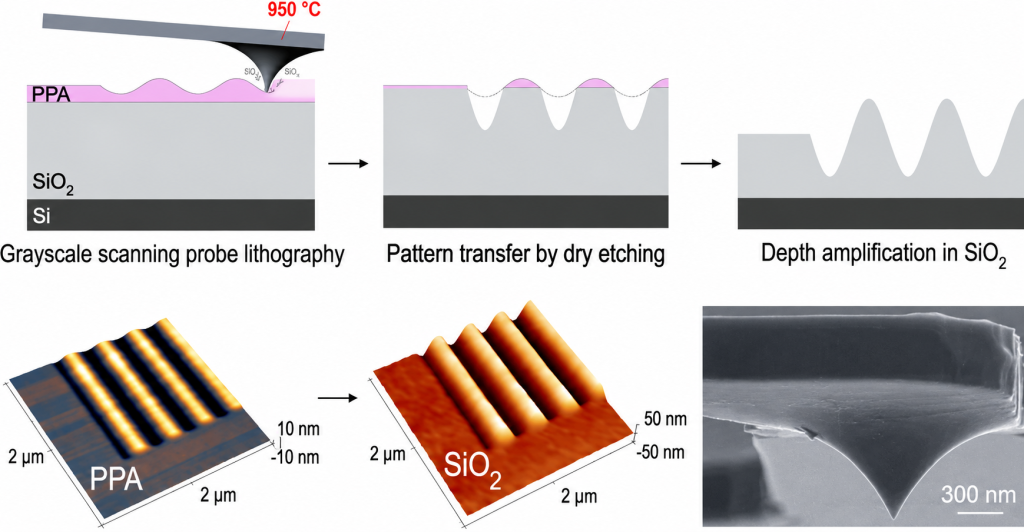
Greyscale-structured surfaces with nanometer-scale features are increasingly being explored for applications in optics and fluidics. Thermal scanning probe lithography (t-SPL) enables high-resolution patterning with excellent vertical resolution. However, its maximum achievable patterning depth in resist is limited. This project aims to combine t-SPL with plasma dry etching to amplify nanoscale resist topographies into dielectric substrates while maintaining high pattern fidelity and reproducibility. Characterization techniques, including atomic force microscopy (AFM) and scanning electron microscopy (SEM), will be employed to accurately quantify the resulting surface topography and evaluate the fidelity of pattern transfer and amplification. Such a method for aspect ratio amplification and smooth greyscale nanopatterns has the potential to find application in the fabrication of photonic and nanoelectronics.
What You Will Work on
Tasks will be tailored to your background and interests and may include:
- Design greyscale geometry input for the t-SPL nanopatterning
- Test different dry etching recipes and tune the relevant etching parameters
- Measure the topography of greyscale before and after dry etching to study how different etching parameters affect the amplification.
Why join
- Hands-on experience in advanced nanofabrication
- Work on an interdisciplinary research study
Reference:
[1] Berke, et al. Microsystems & nanoengineering 10.1 (2024)
Contact:
Chenhao Wang ([email protected]), Shulang Shen ([email protected]), Prof. Jürgen Brugger ([email protected])
Transient electronics made by stencil lithography
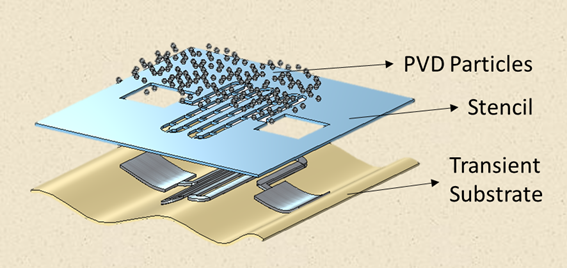
At LMIS1, our research efforts in stencil lithography have yielded significant advancements. The recent invention of the bridge stencil has allowed us to pattern a wider range of shapes with greater precision. Expanding on this success, we are now shifting our focus to materials. Leveraging the resistless nature of stencil lithography and its ability to avoid liquid processes, we aim to utilize transient materials like magnesium and zinc for patterning. Our ultimate objective is to establish an electronic library in transient form, showcasing the potential of stencil lithography in the patterning of more kinds of materials.
Optimization of Ion Beam Etching for IGZO Thin-Film Transistors on Biodegradable Substrates
Type: Master/Semester Project
Section: Microengineering – Physics – Electric Engineering – Materials Science
Electronic waste has become an increasingly severe environmental issue, with traditional non-degradable substrates contributing significantly to this problem. One potential solution is to replace these conventional substrates with biodegradable materials, such as Polyvinyl Alcohol (PVA), cellulose, or silk. However, these materials often face challenges, including low fabrication thermal budgets and poor water or chemical resistance. As a result, it is essential to adapt the material choices and fabrication processes to overcome these limitations while still maintaining performance in electronic applications.
At LMIS1, the research focuses on using Indium-Gallium-Zinc Oxide (IGZO) as the semiconductor channel for thin-film transistors (TFTs) on biodegradable substrates. IGZO is a widely used n-type semiconductor in display technology, known for its room-temperature deposition via RF sputtering and its moderate electrical properties, including a carrier mobility of approximately 20 cm²/(V·s) in its amorphous state. The team employs stencil lithography for patterning the IGZO film, enabling a liquid-free, room-temperature fabrication process. So far, the team has successfully achieved clear patterning with 5 µm structures, and electrical properties have been validated through resistivity and Hall effect measurements. Additionally, a trial using ion beam etching (IBE) was conducted, which resulted in a 5 µm blurring with 25 nm etching depth.
The goal of this student project is to optimize the ion beam etching parameters for IGZO films patterned with stencil lithography. The focus will be on achieving the steepest possible edge with a controllable etching speed. The project will begin with IGZO films on solid substrates, such as silicon chips with a thermal oxide layer, and may extend to soft and biodegradable substrates if time allows. The use of stencils with bridges to pattern closed-loop structures, such as isolating IGZO islands, will also be explored. The final objectives will be tailored to the student’s interests, capabilities, and available time, providing a hands-on opportunity to contribute to the development of electronic devices on biodegradable substrates.

Figure 1 : (a) A stencil chip. (b) Process flow of IBE with stencil. (c) Optical image and (d) SEM of IGZO structures patterned by IBE through stencil, with (e) and (f) AFM scans of it, showing a blurring of 5 µm by etching 25 nm in depth.
Possible tasks:
- Optimize ion beam etching (IBE) parameters to achieve steep edge and controllable etching rate.
- Evaluate etching quality with AFM and SEM.
- Transfer process to biodegradable substrates.
- Fabricate closed-loop IGZO structures with bridge stencils.
Contact: Chenxiang Zhang ([email protected])
Droplet Microfluidics for Advanced Additive Manufacturing

Under the umbrella of multi-material 4D printing, at LMIS1, we are developing an innovative microfluidic-based additive manufacturing technique that can deposit polymerizable microdroplets encapsulating multiple materials with variable space resolutions. This technological advancement offers flexibility and accuracy in constructing complex structures and objects with enhanced functionalities while maintaining a similar production rate to existing AM techniques.
Characterization of Ultrasound-Activated Piezoelectric Microbeads for Bioelectronic Applications
Fields: Bioengineering | Neuro-X | Electrical engineering | Microengineering
Project Overview
This project focuses on the experimental characterization of ultrasound-activated piezoelectric composite microbeads developed via microfluidics for bioelectronic applications [1]. While these microbeads, embedding piezoelectric (BaTiO₃) and magnetic (Fe₃O₄) nanoparticles, have already demonstrated controlled fabrication and magnetic actuation, their piezoelectric response remains unquantified. The goal is to investigate how effectively they convert ultrasound into electrical signals, a key step toward enabling wireless neural stimulation and other minimally invasive biomedical technologies. By bridging this gap between material fabrication and functional performance, the project contributes to wireless, minimally invasive neural interfaces.

Fig. 1. Microfluidic synthesis of composite microbeads encapsulating 20 wt% piezoelectric (BaTiO₃) and 5 wt% magnetic (Fe₃O₄) particles. (A) Optical image of the microfluidic junction illustrating droplet generation in the dripping regime. (B) Droplets collected prior to UV curing. (C) SEM image of the solidified beads. Scale bars: 100 µm.
What You’ll Work On
Tasks will be tailored to your background and interests and may include:
- Set up and optimize an ultrasonic actuation for stimulating microbeads
- Measure the piezoelectric electrical response (current/voltage) under ultrasound
- Perform parameter sweeps of ultrasound frequency and intensity
- Study how microbead quantity/concentration affects electrical output
- Analyze experimental data to identify trends and scaling behavior
Why Join?
- Cutting-edge research teams in microfluidics and bio-applications
- Opportunity to contribute to ongoing research and potentially to a publication
References:
[1] Han, Mertcan, et al. Nature Communications 15.1 (2024): 2013.
Contact Tao Zhang ([email protected]), Prof. Yujia Zhang ([email protected]), Prof. Juergen Brugger ([email protected])
Mixed reality learning for microfabrication practical
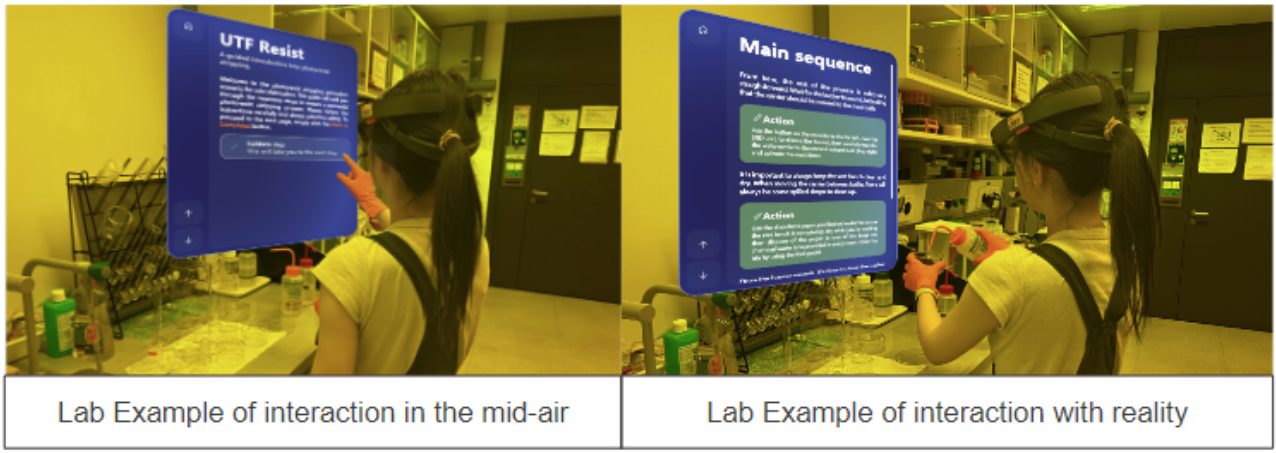
At LMIS1, we are currently embarking on a novel journey to integrate mixed reality into learning methods for microfabrication processes. This approach presents a promising avenue as it allows hands-free interaction and diminishes cognitive load during learning. Our research is dedicated to creating interactive mixed-reality content to revolutionize microfabrication and cleanroom training practices. As we scrutinize the effectiveness and feasibility of multimodal learning within a mixed reality framework, we are embracing various learning strategies including gamification, scaffolding, and multimodal interaction.
Designing MR Guidance for Microfabrication via Real-World Interaction
Type: Master/Semester Project
Section: Additive Manufacturing, Microengineering, Material Science
Project Overview
In LMIS1, we have been developing different affordances of a mixed reality system for microfabrication learning. This is a continuous work based on the previous project. In this project, we would like to handle the learning task by using Unity 3D and extensions. We have already developed and implemented a mixed reality platform, and are looking forward to a low-threshold implementation in the lab with real-world object interaction. Additionally, this project requires organizing a small-scale study and testing the usability and microfabrication experimental practices’ adaptability. Based on the feedback and data, an iterative design and development for improvement is needed.
What You’ll Work On
Tasks will be tailored to your background and interests and may include:
- Exploring real-world sensor events through Azure IoT Hub/Socket for secure messaging
- Developing and prototyping new communication solutions for HoloLens
- Designing 3D models that fit the microfabrication process, for example, plasma generation.
- Exploring the network communication for collaboration synchronization.
- Exploring the low-cost implementation of a virtual reality system based on the current project
- Evaluate and assess the usability test for the mixed-reality platform
Why Join?
- Hands-on design and development experience for mixed reality
- The cutting-edge extended reality (XR) development experience
What do we expect?
- A proactive student who would like to contribute to the challenging problem
- Able to program at least one language fluently, preferably C# or Python
- Previous project experience or related background knowledge in communication
- Curious about the mixed reality technology, if you also have a microengineering background, it will also be preferred
Contact: Qinglan Shan ([email protected])
ESR and NMR Spectroscopy
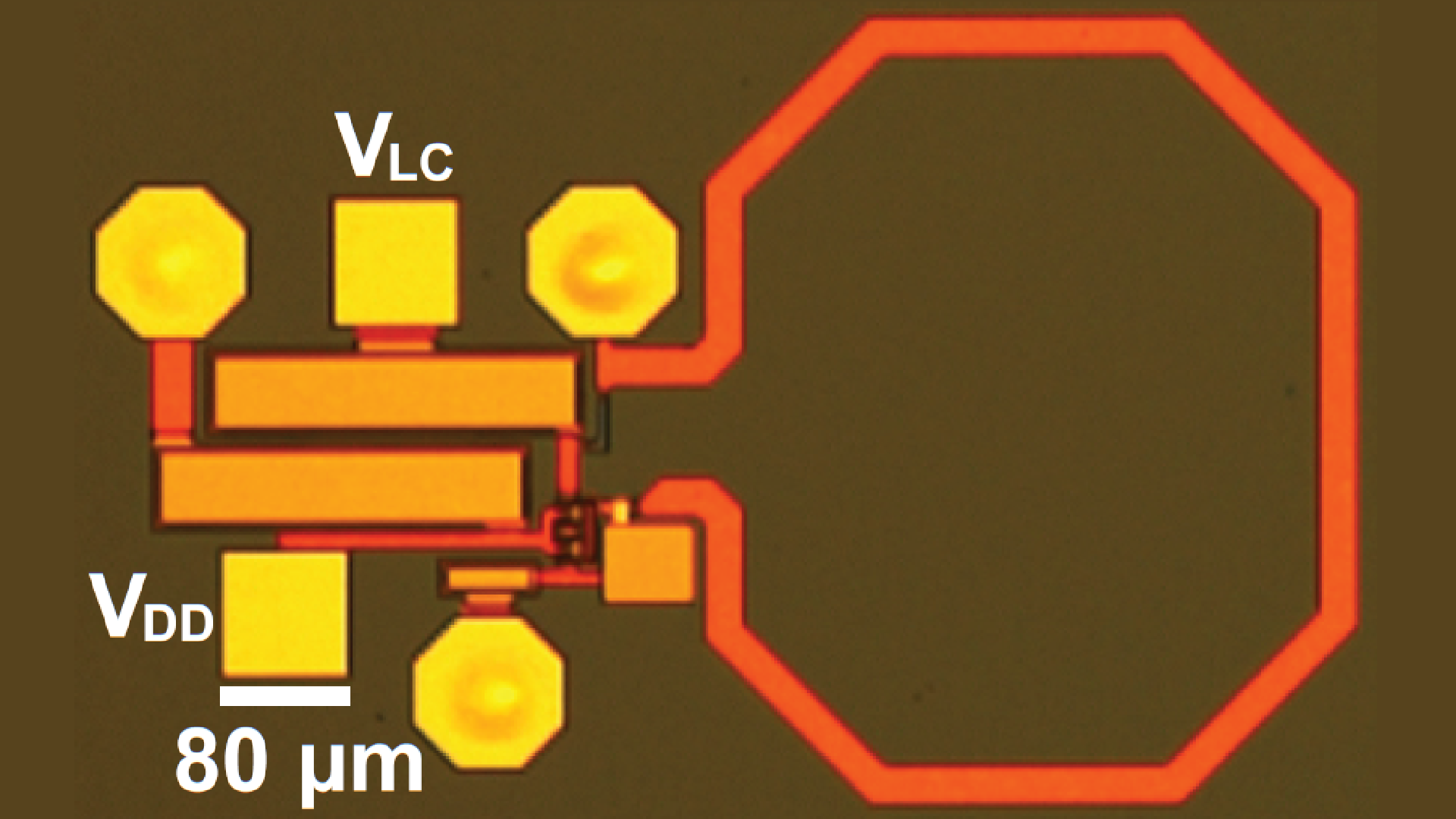
Electron Spin Resonance (ESR) spectroscopy is a widely used technique for the recognition of chemical radicals and species. At LMIS1 we are currently working on the optimization of ESR sensors’ sensitivity, especially for samples in the nanoliter and sub-nanoliter range, through the use of superconducting resonating structures.
Microchannel characterization of liquid sample for Dynamic Nuclear Polarization (DNP) measurements
Type: Semester project Fall 2026
Fields: Microengineering
Project Overview
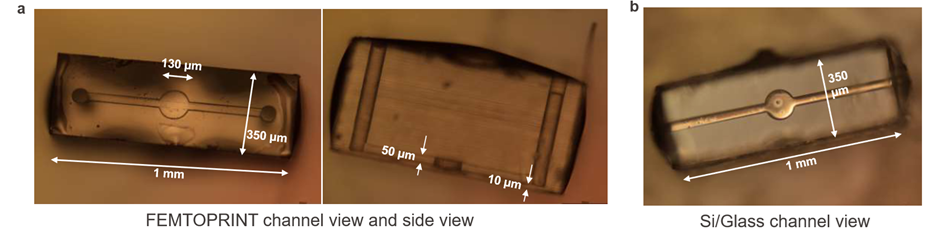
Dynamic nuclear polarization (DNP) is a powerful technique that enhances NMR sensitivity by transferring polarization from electron spins to nuclear spins. At LMIS-1, an in-house miniaturized DNP chip has been developed to investigate novel approaches for performing DNP measurements at the microscale. While the chip has already demonstrated effective operation with solid samples, measurements with liquid samples remain challenging. This is because dedicated microchannel devices are needed to confine the liquid sample within a small volume, typically in nL scale.
This project aims to overcome this limitation by developing reliable techniques for filling, sealing, and characterizing microchannels fabricated in previous work. In parallel, a new device concept will be investigated if needed, potentially involving clean-room fabrication.
What You Will Work on
Tasks will be tailored to your background and interests and may include:
- Develop and optimize methods for filling and sealing the fabricated microchannels with liquid samples
- Evaluate the suitability of device for on-chip DNP measurements
- Investigate new microchannel/device concept and perform clean-room fabrication
Why join
- Hands-on experience in microfabrication and device characterization
- Work on an interdisciplinary research study
Contact
Xinwei Li ([email protected]), Mohammadparsa Mirzaeisarmad ([email protected]), Prof. Giovanni Boero ([email protected])
Download PDF